




How to Care for Your Bedding: The Complete Guide to Washing, Drying, and Extending the Life of Your Sheets
You spend a third of your life in your bedding. If those sheets cost $80 or $300, the per-night value is determined almost entirely by how long they last — and that is almost entirely determined by how you care for them. Most bedding damage is not caused by use: it is caused by washing too hot, over-drying, using the wrong detergent, or storing improperly. A set of high-quality bamboo or long-staple cotton sheets that should last seven to ten years frequently deteriorates in two, not because the fiber failed, but because the care routine did. The American Cleaning Institute estimates that improper laundering is the leading cause of premature textile wear, responsible for fiber degradation, color loss, and structural breakdown that washing at correct settings would have prevented entirely.1 This guide gives you the complete evidence-based framework for washing, drying, storing, and maintaining every type of bedding in your home.
Washing: Temperature, Cycle, and Frequency
Water temperature is the most consequential washing variable. The instinct to wash bedding in hot water feels hygienic — and for pathogen control, it is partially correct — but it comes with significant fiber costs. Repeated high-temperature washing (above 60°C / 140°F) causes three compounding forms of damage: fiber swelling and contraction that weakens the weave structure over time; color fade as dye molecules are displaced from the fiber matrix; and shrinkage, particularly in natural fibers like cotton and bamboo viscose that have not been pre-shrunk during manufacturing.2
Evidence-based temperature guidelines by fabric type:
- Cotton (standard and percale): 40°C (104°F) for regular maintenance washes; 60°C (140°F) no more than once a month for deep sanitization (e.g., after illness). The NHS recommends 60°C specifically for killing house dust mites in allergy sufferers’ bedding.3
- Bamboo-derived fabric (viscose/rayon): 30–40°C (86–104°F) maximum. Bamboo viscose has a lower thermal tolerance than cotton; temperatures above 40°C accelerate fiber breakdown and cause irreversible pilling. Always select the gentle or delicate cycle.
- Linen: 40°C (104°F); linen softens and improves with washing over time but is vulnerable to high-heat shrinkage in early washes.
- Microfiber: Cold to 30°C (86°F) maximum. High temperatures melt the ultra-fine synthetic filaments, permanently reducing softness and moisture-wicking performance.
- Down and down alternative duvets/pillows: 40°C (104°F) on a gentle cycle with an extra rinse to remove all detergent residue, which mats down clusters if left in the fill.4
How often should you wash? The American Academy of Dermatology recommends washing pillowcases and fitted sheets once per week, as they accumulate sweat, body oils, dead skin cells, and dust mite allergens at a rate that becomes hygienically significant within seven days.5 Duvet covers and flat sheets can extend to every two weeks if a top sheet is used consistently. Duvet inserts and pillow inserts should be washed every two to three months.
Detergents: What Helps and What Harms
Not all detergents treat fabric equally, and several widely used formulations cause cumulative damage that is invisible until the sheet is already significantly degraded.
- Enzyme-based detergents: Highly effective at breaking down biological soils (sweat, oils, dust mite allergens) at low temperatures. The preferred choice for regular weekly washing at 30–40°C — they clean more effectively at lower temperatures than conventional detergents, meaning you can reduce wash temperature without sacrificing hygiene.1
- Bleach and optical brighteners: Chlorine bleach is highly corrosive to natural fibers — it breaks the cellulose chains in cotton and bamboo, causing progressive thinning and eventual hole formation with repeated use. Optical brighteners (fluorescent whitening agents) accumulate in the fiber over multiple washes and cause yellowing when exposed to heat, the opposite of their intended effect. For white sheets, use an oxygen-based whitener (sodium percarbonate) instead, which whitens without fiber damage.2
- Fabric softeners: A widely misunderstood category. Liquid fabric softeners work by coating fibers with a waxy cationic surfactant layer that reduces inter-fiber friction, producing a temporarily soft feel. The problem: this coating reduces the fabric’s moisture-wicking and breathability performance — the opposite of what you want in bedding. With repeated use, the buildup attracts more soil and reduces the effectiveness of your detergent. For premium bedding, skip liquid softener and use a tennis ball or dryer ball in the dryer instead to maintain loft mechanically.4
- Dosage: More detergent is not more effective. Excess detergent creates residue that stiffens fabric and is difficult to fully rinse at standard cycle lengths. Use the manufacturer’s minimum recommended dose, or less for lightly soiled loads.
Drying: The Second Most Damaging Step
High-heat machine drying is the fastest way to shorten bedding lifespan. Tumble drying at high heat causes three types of damage: thermal fiber stress (natural fibers contract sharply, weakening the weave); pilling (fiber ends break and tangle into surface pills); and elastic degradation in fitted sheet corner bands, which lose their stretch after repeated high-heat cycles.3
Best-practice drying protocol:
- Tumble dry on low heat or air/fluff setting only. Remove while still very slightly damp to reduce heat exposure and avoid over-drying, which is as damaging as over-heating.
- Line drying is the gentlest option and adds a pleasant natural freshness, particularly for linen and cotton. Avoid direct midday sunlight for colored or dark sheets, as UV exposure bleaches fabric over time; dry in shade or indirect light.
- Never dry bamboo viscose on high heat — it will shrink and lose its characteristic softness irreversibly.
- For down duvets and pillows: dry thoroughly on low heat with two or three tennis balls or dryer balls to break up clumped fill clusters. Incomplete drying of down fill creates conditions for mold growth inside the insert, which is both a health hazard and a permanent quality loss.4
Storage: Protecting Bedding Between Seasons
Improper storage is responsible for a category of bedding damage that most people never connect to their habits: yellowing, musty odor, and moth damage. The following principles apply to all natural-fiber bedding stored for more than two weeks:
- Always store clean: Body oils and invisible soil residues oxidize over months, producing the characteristic yellowing and musty smell that appears when stored sheets are retrieved. Never store bedding that has been used without washing first.5
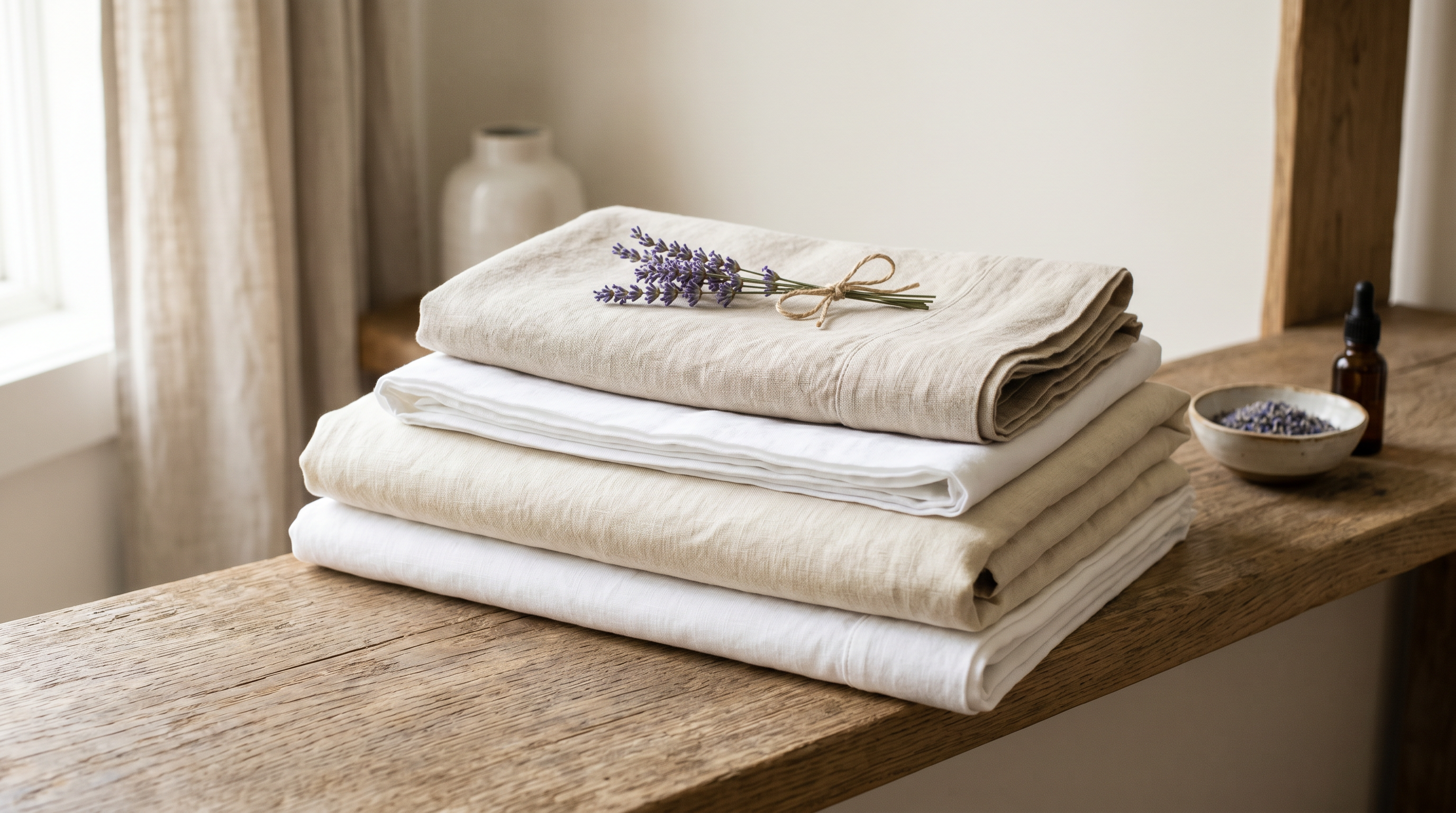
- Breathable storage only: Sealed plastic bags trap humidity, creating a micro-environment favorable to mold and mildew. Store in cotton or linen storage bags, or pillowcases — never in plastic. A cedar block or sachet of dried lavender in the storage bag provides natural moth deterrence without chemical residues.
- Cool, dry, dark location: Heat accelerates fiber oxidation; moisture promotes mold; UV light fades color. A linen closet away from exterior walls (which can be cold and damp in winter) is ideal.
- Fold loosely: Tight, sharp folds create permanent crease lines in the fabric over time. Fold loosely and re-fold along different lines every few months if storing for a full season.
Lifespan Expectations by Bedding Type
With correct care, here is what you should reasonably expect from quality bedding:2,6
- Cotton percale / sateen sheets (300–600 thread count): 5–10 years with weekly washing at correct temperature
- Bamboo viscose sheets: 5–7 years with gentle care; 2–3 years with high-heat washing/drying
- Linen sheets: 10–20+ years — linen is the most durable natural bedding fiber and actually becomes softer with each wash
- Down duvets: 10–15 years with correct washing and annual professional cleaning
- Down alternative duvets: 5–8 years
- Pillows (polyester/fiber fill): 1–2 years
- Pillows (memory foam / latex): 3–5 years
Bedding Care Checklist
- ✔ Wash sheets and pillowcases weekly at 40°C (104°F); use 60°C only once a month for deep sanitization.
- ✔ Use an enzyme-based detergent at the minimum recommended dose — never more.
- ✔ Skip liquid fabric softener; use dryer balls instead to maintain loft mechanically.
- ✔ Never use chlorine bleach on natural fibers; use oxygen-based whitener for white sheets.
- ✔ Tumble dry on low heat only, or line dry in shade; remove sheets while still slightly damp.
- ✔ Dry bamboo viscose on the lowest heat setting available — never high heat.
- ✔ Wash down inserts quarterly; dry thoroughly with dryer balls on low heat.
- ✔ Store seasonal bedding clean, in breathable cotton bags, in a cool dark space.
- ✔ Shake and air out duvets monthly; this redistributes fill and reduces dust mite density.
- ✔ Replace pillows every 1–2 years (fiber fill) or 3–5 years (foam/latex) regardless of appearance.
Conclusion
Caring for your bedding is not complicated — but it does require breaking a few very common habits (hot water, too much detergent, fabric softener, high-heat drying) that are so normalized they feel correct. The tradeoff is straightforward: apply the right routine once, and your investment in quality bedding pays back multiples in extended lifespan, sustained softness, and consistent performance night after night. The sheets that feel extraordinary on day one should still feel extraordinary on year five.
LuxClub bedding is designed and manufactured to last — every sheet set includes detailed care instructions matched to the specific fiber used, so you never have to guess. When you care for it right, it takes care of you.
References
- American Cleaning Institute. (2024). "Laundry best practices and fabric care." CleaningInstitute.org. Retrieved 2026.
- Slater K. (1991). Textile Degradation. Textile Progress, 21(1). The Textile Institute, Manchester.
- National Health Service UK. (2023). "Washing bedding to reduce dust mite allergens." NHS.uk. Retrieved 2026.
- International Fabricare Institute. (2022). "Care and cleaning of down and down alternative products." IFI.org. Retrieved 2026.
- American Academy of Dermatology Association. (2024). "How often should you wash your sheets?" AAD.org. Retrieved 2026.
- Textile Exchange. (2023). "Fiber longevity and end-of-life considerations in natural textiles." TextileExchange.org. Retrieved 2026.
- Hohenstein Institute. (2022). "Impact of domestic laundering on textile performance properties." Hohenstein.com. Retrieved 2026.
- Which? Consumer Research. (2023). "How to make your bedding last longer." Which.co.uk. Retrieved 2026.