



The Complete Pillow Buying Guide: How to Choose the Right Fill, Loft, and Cover for Your Sleep Style
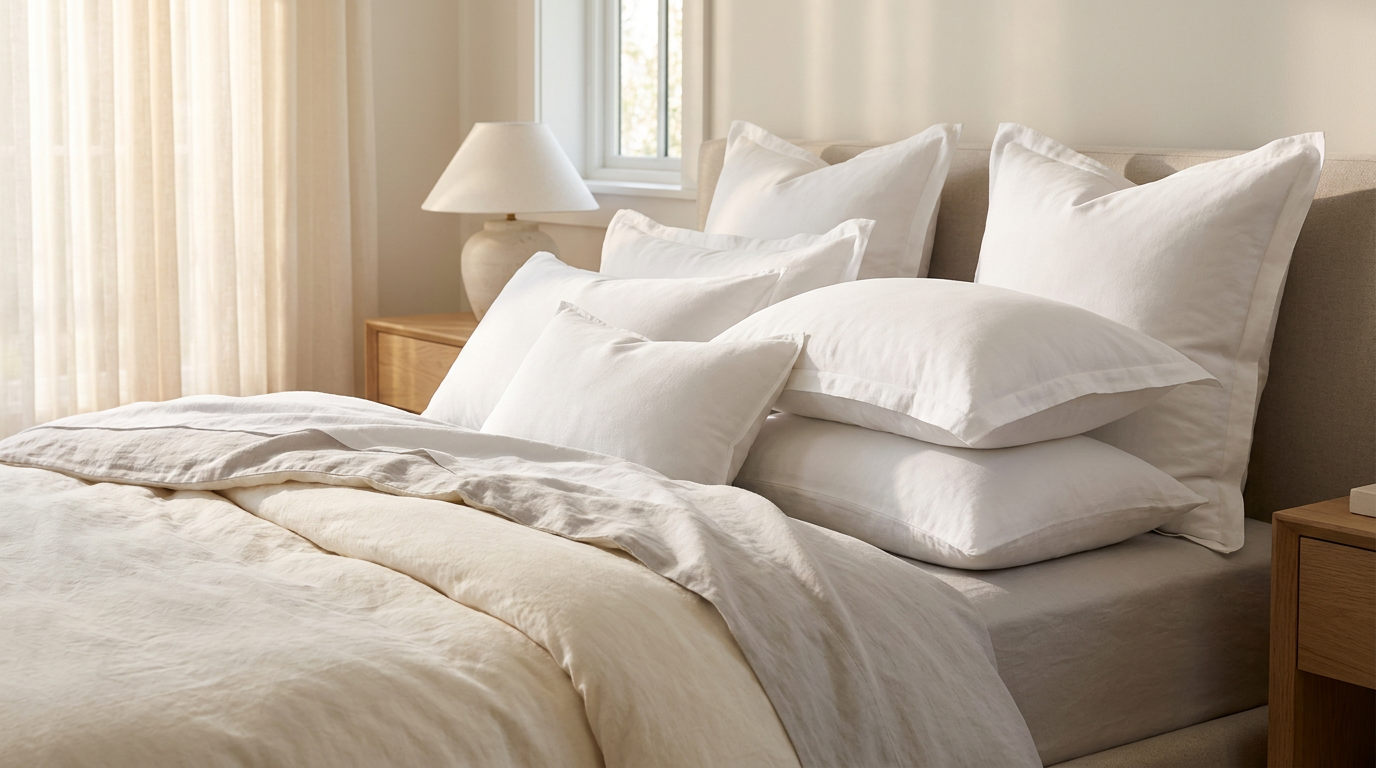
You spend roughly one-third of your life in bed, yet most people give more thought to buying a new laptop than they do to choosing the pillow that cradles their head every night. The right pillow aligns your spine, regulates your temperature, and keeps you breathing freely — all while you're unconscious. Get it wrong, and you may wake up stiff, groggy, and reaching for the ibuprofen. This guide cuts through the marketing noise and tells you exactly what to look for before you buy.
Why Your Pillow Matters More Than You Think
Research published in the Journal of Pain Research found that subjects who switched to an orthopedically appropriate pillow reported a statistically significant reduction in neck pain within just four weeks.[1] Cervical spine alignment during sleep is critical: a misaligned neck can compress the intervertebral discs and strain the paravertebral muscles, contributing to the kind of chronic morning stiffness that millions of adults dismiss as "just getting older."[2]
Beyond pain, pillow choice also influences sleep quality scores. A 2019 study in the Journal of Chiropractic Medicine noted that pillow height (often called "loft") significantly affected subjects' reported sleep quality, with the wrong loft increasing arousals and reducing slow-wave sleep duration.[3] In short, your pillow is not a passive accessory — it is an active participant in your recovery every night.
Understanding Fill Materials: The Core Trade-Offs
The fill material determines how a pillow feels, how it responds to pressure, how it breathes, and how long it lasts. The four most common options each suit a different kind of sleeper.
Memory foam contours to the shape of your head and neck, offering excellent pressure relief for side sleepers with broad shoulders. However, traditional memory foam retains heat. The Sleep Foundation notes that memory foam pillows tend to sleep warmer than down alternatives, which can be a problem for hot sleepers.[4] Shredded memory foam variants partially address this by allowing greater airflow.
Down and down alternative fillings are prized for their soft, cloud-like feel and superior breathability. Genuine goose or duck down scores well on the Audubon-certified fill power scale — a fill power of 600 or above indicates high-quality loft per ounce.[5] The caveat: down is compressible and may collapse under the weight of a side sleeper's head, reducing cervical support over the course of the night. Down alternative (typically polyester microfiber clusters) mimics the softness of down at a lower price point and is hypoallergenic by design.
Latex is naturally resilient, meaning it springs back to its original shape rather than conforming slowly like memory foam. Natural Dunlop or Talalay latex is also naturally resistant to dust mites and mold — a meaningful advantage for allergy sufferers.[6] It sleeps cooler than memory foam but is heavier, and some people find its bouncy response less comfortable than the cradling sensation of foam.
Buckwheat hulls represent an ancient East Asian sleep technology that has quietly gained a following in Western wellness circles. Buckwheat pillows allow air to circulate freely through the loose hulls, making them exceptionally cool. Their firmness provides strong cervical support, though the rustling sound and rigid feel take adjustment time for new users.
Matching Loft and Firmness to Your Sleep Position
Pillow loft — the height of the pillow when it lies flat — is arguably the single most important specification to get right, and it is almost always determined by your dominant sleep position.
- Side sleepers need a high loft (4–6 inches) to fill the gap between the mattress and the side of the head. A too-thin pillow forces the head to drop, compressing the lower cervical vertebrae.
- Back sleepers do best with a medium loft (3–4 inches). The goal is to keep the head aligned with the thoracic spine, preventing the chin from tucking toward the chest or lifting unnaturally upward.
- Stomach sleepers should use a very thin pillow — or ideally no pillow at all under the head — to avoid hyperextending the neck. Placing a thin pillow under the abdomen can also reduce lumbar strain in this position.[7]
Firmness compounds with loft: a higher-loft soft pillow may compress to the same effective height as a lower-loft firm pillow once your head sinks in. Always consider how much your chosen fill compresses under realistic head weight (typically 10–12 pounds for an average adult).[8]
Fill Power, Thread Count, and the Pillow Cover
Consumers are familiar with thread count as a sheet metric, but it also matters in pillow shells. A tightly woven shell with a higher thread count (300 or above in a long-staple cotton) does two things: it keeps fine fill particles from working their way through the fabric, and it creates a softer surface against the face. Sateen-weave covers feel noticeably silkier than percale, though percale breathes slightly better.
For those interested in temperature regulation, bamboo-derived viscose shells are worth noting for their wicking properties. Brands working with moisture-management fabrics — LuxClub, for instance, incorporates bamboo-blend construction in several of its pillow and sheet offerings — have leaned into this characteristic to address the hot-sleeper problem without relying solely on foam engineering.
For down pillows specifically, fill power (measured in cubic inches per ounce) is the meaningful quality marker. Fill power of 500–550 is considered entry-level quality; 600–700 is mid-range; 750 and above is premium. Higher fill power means the down clusters are larger and more intact, providing better loft per ounce and generally longer lifespan.
Allergen Considerations: When Your Pillow Becomes a Problem
The American College of Allergy, Asthma & Immunology estimates that house dust mites — which colonize bedding readily — affect up to 20 million Americans.[6] Mites do not actually live inside the pillow fill so much as in the dead skin cells (dander) that accumulate in the pillow cover and outer layers. A tightly woven allergen-barrier cover combined with regular washing is more effective than fill type alone in reducing mite populations.
That said, fill material does play a secondary role. Natural latex, as noted, inhibits mite growth through its cellular structure. Synthetic fills like shredded foam or microfiber polyester are also easier to wash at high temperatures, which kills mites — natural down, by contrast, must be washed carefully to avoid damaging the clusters and typically requires a longer dry cycle.
Practical Buying Checklist
- Determine your primary sleep position before anything else — loft is position-dependent.
- Check fill material against your temperature sensitivity: latex and down breathe; traditional memory foam retains heat.
- If you have allergies, choose a pillow with an allergen-barrier cover and verify the fill can be machine-washed at 60°C (140°F).
- For down pillows, look for fill power 600+ and a thread count of 300+ on the shell.
- Replace pillows every 1–2 years for synthetics, every 2–3 years for quality down, and every 3–4 years for latex — performance degradation, not just hygiene, is the primary driver.
- Perform the "fold test" on synthetic pillows: fold the pillow in half and release. If it stays folded instead of springing open, it has lost its loft and needs replacing.
- Always check the return policy. Reputable brands typically offer a trial window of at least 30 days because pillow comfort is highly subjective and difficult to assess in a store.
Conclusion
Choosing the right pillow is less about brand prestige and more about a clear-eyed assessment of your sleep position, temperature preferences, and any sensitivities you carry into bed each night. A well-chosen pillow, maintained properly, genuinely changes the quality of your mornings — and, by extension, the productivity of your days. The research is consistent on this point: cervical alignment, sleep-stage integrity, and allergen load are all measurable and all influenced by something as tactile and immediate as what you rest your head on.
If you've been sleeping on the same pillow for years without a second thought, this might be the nudge to reconsider. It's one of the highest-return upgrades you can make to your sleep setup — and once you've felt the difference a properly supportive, breathable pillow makes, you'll wonder why you waited so long. We've found that pairing the right pillow with quality, breathable bedding compounds the benefit significantly; if you're looking to round out your sleep setup, it might be worth exploring what's out there — the sheet and pillow collections at LuxClub are a solid place to start.
References
- Persson L, Moritz U. "Neck support pillows: a comparative study." Journal of Manipulative and Physiological Therapeutics. 1998;21(7):439–446.
- Cagnie B, Danneels L, Van Tiggelen D, De Loose V, Cambier D. "Individual and work related risk factors for neck pain among office workers: a cross sectional study." European Spine Journal. 2007;16(5):679–686.
- Gordon SJ, Grimmer-Somers K, Trott P. "Pillow use: the behaviour of cervical stiffness, headache and scapular/arm pain." Journal of Pain Research. 2010;3:137–145.
- Sleep Foundation. "Best Pillow for Hot Sleepers." Updated 2023. sleepfoundation.org.
- International Down and Feather Bureau (IDFL). "Fill Power Testing and Standards." 2022. idfl.com.
- American College of Allergy, Asthma & Immunology. "Dust Allergy." 2023. acaai.org.
- Huang H-Y, Liu J-J. "Sleep posture and low back pain: a narrative review." Asian Spine Journal. 2016;10(4):758–766.
- De Loose V, Burnotte F, Cagnie B, Stevens V, Van Tiggelen D. "Prevalence and risk factors of neck pain in military office workers." Military Medicine. 2008;173(5):474–479.