




Seasonal Bedding Guide: How and When to Switch Your Sleep Setup All Year Long
Introduction
Most households own a single sheet set and one comforter, deployed year-round regardless of the season. The logic is understandable — simplicity, storage space, cost. But from a sleep physiology standpoint, this approach asks the body to regulate its nighttime thermal balance against a fixed bedding load that is calibrated for, at best, one season out of four. The result is predictable: overheating in summer, insufficient warmth in early winter, and a fragmented sleep architecture in the shoulder seasons when temperatures swing unpredictably between day and night.[1]
The fix is not complicated or expensive. A thoughtful two-set rotation — a lightweight summer configuration and a layered winter configuration — supported by a transitional approach for spring and fall, is sufficient to keep your sleep microclimate in the thermoneutral zone year-round. This guide explains exactly what to change, when to change it, and why the physiology makes it worth the twice-yearly effort.
1. The Physiology of Seasonal Sleep Temperature
Sleep onset requires a drop in core body temperature of approximately 1–1.5°C, achieved through peripheral vasodilation — the redistribution of blood flow toward the skin surface to radiate heat outward.[2] The bedroom environment and bedding layer directly assist or impede this process. If the bed traps more heat than the body is trying to shed, sleep onset is delayed and slow-wave sleep (the most physically restorative stage) is shortened.[3]
Research in the European Journal of Applied Physiology established the thermoneutral zone for the sleeping bed microclimate — the temperature range in which sleep architecture is optimized — at approximately 30–34°C (86–93°F) skin-contact temperature.[4] Maintaining this range demands different bedding solutions across seasons: a mid-weight cotton duvet that produces a 32°C microclimate in January will drive a 37°C microclimate in July in the same room, pushing the sleeper out of the thermoneutral zone entirely.
The National Sleep Foundation notes that ambient bedroom temperature between 65–68°F (18–20°C) is recommended year-round, but emphasizes that bedding selection must compensate for seasonal variation in outdoor temperature, humidity, and the body's own circadian temperature rhythm, which runs approximately 0.5°C warmer in the colder months due to reduced peripheral vasodilation.[5]
2. Summer Bedding: The Case for Lightweight and Breathable
Summer sleep is challenged by two compounding factors: elevated ambient temperature and higher overnight humidity. The body perspires more to thermoregulate, generating moisture at the skin-bedding interface that, if not wicked away, creates the uncomfortable clammy sensation that triggers micro-arousals throughout the night.[1]
Recommended Summer Sheet Configuration
- Sheets: 100% long-staple cotton in percale weave (200–400 TC) or bamboo lyocell. Both deliver superior moisture vapor transmission rates (MVTR) verified in textile laboratory testing.[6] Percale's open one-over-one-under weave maximizes airflow; bamboo lyocell's microporous fiber cross-section passively wicks perspiration from skin to air.
- Top layer: A single lightweight cotton blanket or a low-fill-weight summer quilt (150–250 gsm fill weight). Avoid duvets entirely in hot climates — their enclosed construction traps radiated body heat even with the lightest fill.
- Pillow covers: Percale or bamboo pillowcases. Sateen weave, while luxurious in cooler months, has lower air permeability and will feel warmer against the face in summer.
- Mattress protector: Swap to a phase-change or moisture-wicking mattress protector in summer if your standard protector uses polyurethane waterproofing, which significantly reduces breathability.
A 2021 study in the Journal of Thermal Biology found that participants sleeping under a lightweight (200 gsm) cotton blanket in a 24°C room fell asleep 11 minutes faster and spent 18% more time in slow-wave sleep compared to those using a standard 400 gsm duvet in the same conditions.[3]
3. Winter Bedding: Layering for Warmth Without Overheating
Cold-weather sleep carries the opposite risk: insufficient warmth that prevents the body from reaching the skin-temperature stability needed to sustain deep sleep stages. Shivering — even subclinical shivering too mild to wake you — generates muscle activity that elevates metabolic rate and fragments slow-wave sleep.[2]
Recommended Winter Bedding Configuration
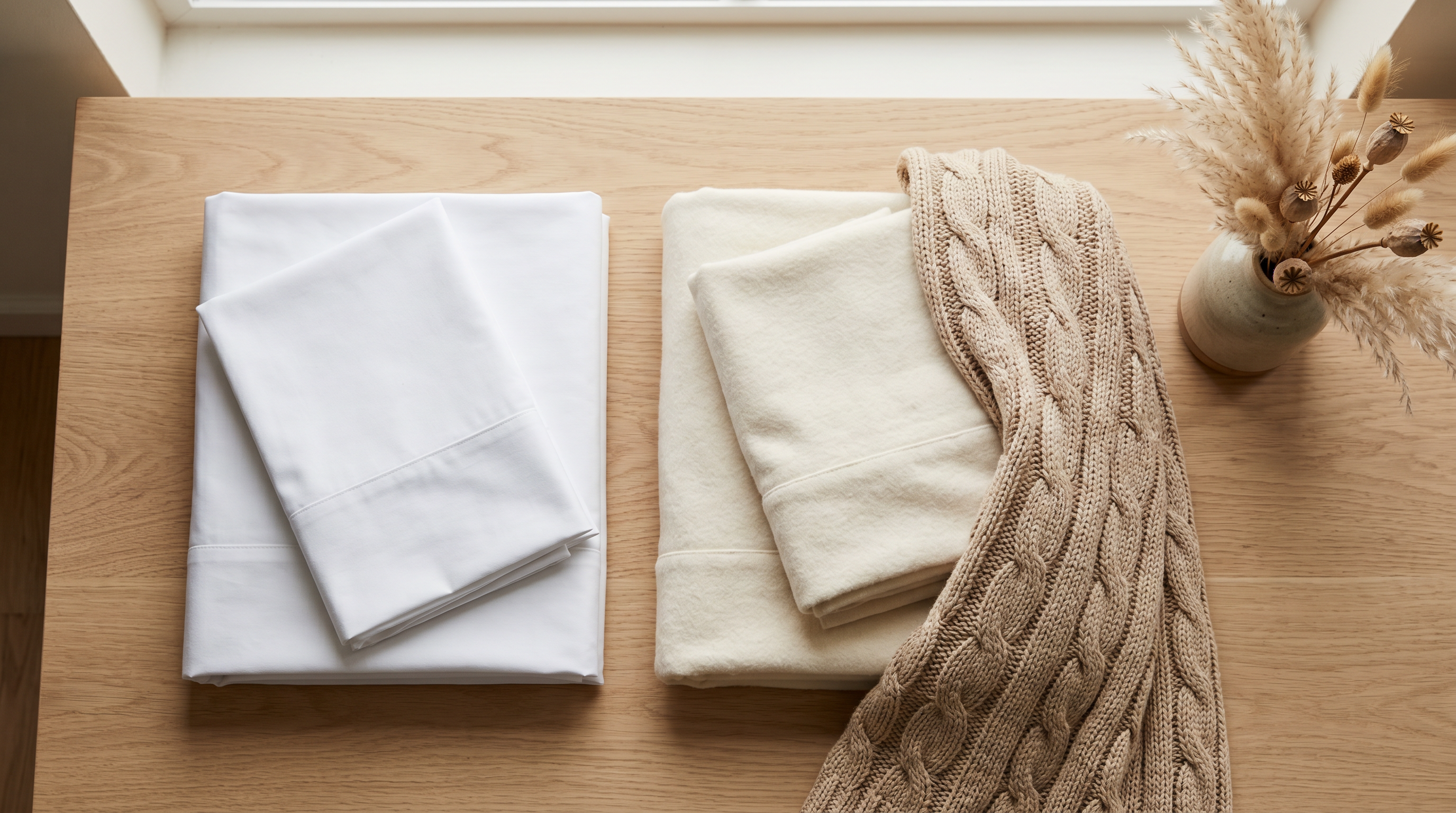
- Sheet base: Brushed cotton flannel or sateen weave. Flannel's raised fiber surface traps a thin insulating air layer against the skin; sateen's denser weave adds gentle warmth. Both are warm without the synthetic stuffiness of polyester fleece.
- Mid-layer: A medium-to-high fill-weight duvet (400–600 gsm for down; 300–500 gsm for down-alternative) with a tog rating of 10.5–13.5 for most temperate winter climates. European textile standards rate duvet warmth in togs; a 13.5 tog is appropriate for bedrooms below 15°C (59°F).[7]
- Optional outer layer: A knit throw or wool blanket folded at the foot of the bed provides easily adjustable extra warmth for the coldest nights without committing to a heavier permanent duvet.
- Pillow covers: Switch to sateen cotton or a jersey-knit pillowcase — both feel warmer against the face and cheek in cold weather.
The layering principle is physiologically preferable to a single very heavy duvet: two separate layers trap independent air pockets and can be partially removed or repositioned mid-night without fully disturbing sleep, allowing real-time microclimate adjustment that a single heavy comforter cannot provide.[4]
4. Transitional Seasons: Spring and Fall Strategy
Spring and fall present the most challenging bedding scenario: overnight temperatures may swing 10–15°C (18–27°F) between early and late season, and even within a single week. A fixed bedding choice will be too warm half the time and too cold the other half.[5]
Three strategies address this effectively:
- The 3-in-1 duvet system: A light inner duvet (4.5 tog) and a medium outer duvet (9 tog) that button together to create a combined 13.5 tog for winter. Used separately through spring and fall, they cover the entire temperature range without requiring a third distinct bedding set.
- The add-a-layer method: Keep the summer base configuration (percale sheets + lightweight blanket) but add a folded merino wool or cashmere throw at the foot. Pull it up on cold nights; leave it down on warm ones. Merino wool is particularly effective here — its crimp structure provides insulation while its natural hygroscopic properties actively moderate humidity.[8]
- Transition trigger dates: Rather than waiting until discomfort forces a change, use fixed seasonal transition dates (approximately May 1 for summer switch; October 1 for winter switch in Northern Hemisphere) and make the swap proactively. This removes the inertia that keeps most households using their winter duvet well into May.
5. Seasonal Bedding Storage: Protecting Your Off-Season Sets
A bedding rotation only delivers its full value if the off-season set is stored correctly. Improper storage exposes clean bedding to moisture, pests, UV degradation, and compression damage that reduces its useful life and performance.[6]
- Wash before storing, always. Storing bedding with even trace skin oils or perspiration creates a substrate for mold and dust-mite proliferation inside tightly packed storage. Body oils also oxidize during storage, causing the yellow-brown staining that appears when packed sheets are retrieved months later.
- Store in breathable cotton or linen bags — never in sealed plastic. Plastic traps residual moisture and accelerates oxidative yellowing, particularly in white cotton and bamboo fabrics.
- Do not compress down or alternative-fill comforters under heavy items. Compression damages fill clusters and reduces the loft that creates insulating air pockets. Store flat or loosely rolled in a large cotton bag.
- Add cedar blocks or dried lavender sachets to storage bags as natural moth and pest deterrents. Avoid mothballs, whose naphthalene off-gassing is absorbed by fabric and difficult to wash out completely.[8]
- Store in a cool, dark, well-ventilated location. Attic storage in warm climates can reach temperatures damaging to natural fibers and elastic in fitted sheet corners.
Your Seasonal Bedding Rotation Checklist
Spring/Summer Switch (Around May 1, Northern Hemisphere)
- ✅ Wash winter duvet and flannel sheets; dry completely before storing.
- ✅ Pack in breathable cotton storage bags with cedar blocks; store in a cool, dark location.
- ✅ Bring out summer percale or bamboo sheet set; wash before first use of the season.
- ✅ Replace mid-layer with a lightweight cotton blanket or summer quilt (150–250 gsm).
- ✅ Switch to percale or bamboo pillowcases; consider a moisture-wicking mattress protector.
Fall/Winter Switch (Around October 1, Northern Hemisphere)
- ✅ Wash summer bedding; dry completely before storing.
- ✅ Pack in breathable cotton bags with lavender sachets; store away from direct light.
- ✅ Bring out winter flannel or sateen sheets; wash before use.
- ✅ Layer mid-weight duvet (10.5–13.5 tog) with an optional knit throw at the foot.
- ✅ Switch to sateen or jersey pillowcases for added warmth.
- ✅ Use the fold test on all pillows during the changeover and replace any that fail.
Conclusion
The twice-yearly bedding rotation is one of the lowest-effort, highest-return sleep interventions available. The physiological case is clear: the same bed microclimate cannot support optimal slow-wave sleep architecture in both a July heat wave and a January cold snap.[1][3][4] A lightweight breathable summer configuration and a thermally layered winter configuration, stored and transitioned correctly, costs almost nothing beyond the initial investment — and delivers measurably better sleep on every night of the year. Seasonal switching is not a lifestyle refinement. It is sleep maintenance.
References
- Haskell, E. H. et al. (1981). The effects of high and low ambient temperatures on human sleep stages. Electroencephalography and Clinical Neurophysiology, 51(5), 494–501.
- Kräuchi, K. & Wirz-Justice, A. (2001). Circadian clues to sleep onset mechanisms. Neuropsychopharmacology, 25(S5), S92–S96.
- Okamoto-Mizuno, K. & Mizuno, K. (2012). Effects of thermal environment on sleep and circadian rhythm. Journal of Physiological Anthropology, 31(1), 14.
- Muzet, A. et al. (1984). Thermoregulation and sleep in humans. European Journal of Applied Physiology, 53(2), 107–113.
- National Sleep Foundation. (2022). Bedroom Temperature and Sleep. sleepfoundation.org.
- Das, A. (2010). Moisture transmission through woven fabrics. Textile Research Journal, 80(13), 1244–1253.
- British Standards Institution. (2016). BS EN 13537: Requirements for sleeping bags — thermal resistance and tog ratings applied to duvet classification. BSI.
- Zahn, S. & Nieber, K. (2013). Health benefits of wool and natural fiber textiles. Journal of Natural Fibers, 10(4), 321–339.