




The Seasonal Bedding Guide: How to Rotate Your Sheets, Duvets, and Blankets for Perfect Sleep All Year
As the seasons shift, so do the demands on your sleep environment. What keeps you blissfully warm in January can leave you waking up drenched in July. Research consistently shows that our bodies require different thermal conditions throughout the year for optimal sleep — and the bedding we choose plays a starring role in achieving that balance.1 This guide walks you through exactly how and when to rotate your sheets, duvets, blankets, and pillowcases across all four seasons, so every night feels precisely right.
Why Seasonal Bedding Rotation Matters for Sleep Quality
The human body follows a strict thermoregulatory cycle during sleep. Core body temperature drops approximately 1–2°F (0.5–1°C) in the evening to trigger sleep onset and reaches its lowest point around 4–5 AM.2 When your bedding traps excessive heat or, conversely, fails to insulate adequately, it disrupts this cycle, causing more frequent awakenings and reducing time spent in restorative slow-wave (deep) and REM sleep stages.3
A 2019 study published in Sleep Medicine Reviews found that maintaining a bedroom temperature between 65–68°F (18–20°C) was associated with a 15% improvement in sleep efficiency compared to warmer environments.4 Your bedding serves as the first line of thermal regulation — especially since most people keep their thermostats at a fixed setting year-round. Switching to seasonally appropriate textiles can compensate for ambient temperature swings of 30°F or more across a calendar year.
Spring: Transitional Layers and Fresh Fabrics
Spring is the most unpredictable season for bedding. Nights may swing from brisk (50°F/10°C) to mild (65°F/18°C) within the same week. The strategy here is layering: use a lightweight cotton or bamboo flat sheet as a base and add a breathable quilted coverlet rather than a heavy duvet.
Bamboo-derived viscose sheets are particularly well-suited to spring. They are naturally thermo-regulating, moisture-wicking (absorbing up to 40% more moisture than standard cotton5), and hypoallergenic — a critical feature as pollen counts climb. The National Asthma Council recommends hypoallergenic bedding covers during high-pollen months to reduce allergen accumulation in the sleep environment.6
Spring bedding checklist:
- Swap heavyweight winter duvet for a lightweight all-season duvet (400–600 GSM fill power).
- Wash and store winter wool blankets in breathable cotton storage bags.
- Switch to bamboo or lightweight percale cotton sheets (200–400 thread count).
- Add a cotton quilted coverlet for cool nights — easy to toss aside when temperatures rise.
Summer: Maximum Breathability and Moisture Management
During summer, the priority shifts entirely to heat dissipation. The American Academy of Sleep Medicine recommends keeping the sleep environment as cool as possible to support the body's natural temperature drop during sleep onset.7 Opt for sheets with an open, breathable weave rather than a dense thread count.
Contrary to popular belief, a high thread count does not equal better breathability. Fabrics woven above 600 thread count often use multi-ply threads that trap heat.8 For summer, look for single-ply percale weaves in the 200–400 thread count range, or TENCEL™ Lyocell fibers, which have a natural cross-section that wicks moisture away from the skin up to five times faster than cotton.
A light cooling blanket — typically a thin woven cotton waffle-knit or open-weave jersey — replaces the duvet entirely for most sleepers in summer months.
Summer bedding checklist:
- Use a single lightweight sheet only — a 100% bamboo, TENCEL™, or percale cotton flat sheet.
- Remove the duvet insert; keep a thin waffle-knit cotton throw for air conditioning nights.
- Wash sheets every 5–7 days (perspiration buildup in warm months accelerates allergen growth).
- Choose light-colored bedding: white and pastel tones reflect rather than absorb ambient heat.
- Consider gel-infused or ventilated pillow inserts to prevent neck and head heat buildup.
Autumn: Rebuilding Warmth Without Overcommitting
Autumn mirrors spring in its unpredictability, but trending cooler. This is the time to reintroduce your mid-weight duvet or a lightweight down alternative comforter. The goal is cozy comfort without the full insulation load of winter bedding — nights are cool enough to appreciate warmth, but the body still generates significant heat during sleep.
This is also an ideal time for flannel or sateen-weave cotton sheets. Flannel's brushed texture creates a soft, insulating air layer directly against the skin, raising perceived warmth without adding bulk. Research from the Textile Research Journal has noted that brushed fabrics increase thermal retention by 12–18% compared to equivalent-weight plain weaves.9 Sateen-weave cotton, with its lustrous surface and tighter construction, offers warmth while maintaining a silky feel.
Autumn bedding checklist:
- Reintroduce a mid-weight duvet (600–800 fill power down or synthetic alternative).
- Switch sheets to flannel or cotton sateen (300–500 thread count).
- Wash and air out stored winter blankets before use — inspect for moth damage or musty odors.
- Add decorative throw pillows and a wool or fleece throw at the foot of the bed for cool evenings.
Winter: Maximum Insulation and Layered Comfort
Winter calls for your heaviest bedding lineup. The focus is on trapping body heat efficiently while managing the moisture vapor that inevitably builds up during eight hours of sleep. Hungarian or Siberian goose down at 700+ fill power provides exceptional warmth-to-weight ratio, but high-quality down-alternative synthetic fills (such as microfiber clusters or PrimaLoft® fiber) are equally effective for allergy sufferers.10
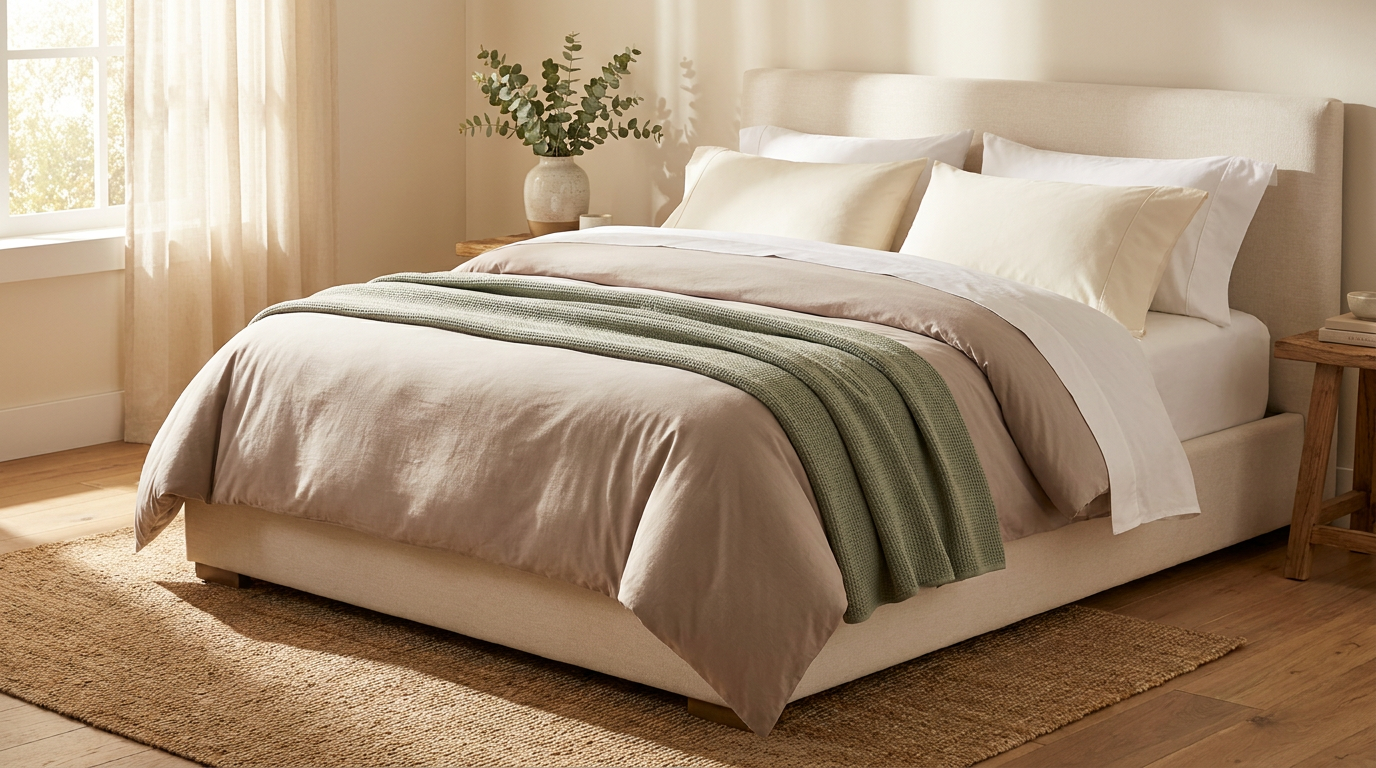
The layering principle is paramount in winter: a quality fitted sheet + flat sheet + heavyweight duvet in a duvet cover provides both insulation and the flexibility to push layers off if you run warm. Never rely on a single extra-thick blanket alone — it creates hot spots and cold spots rather than even warmth distribution. Layering allows precise regulation throughout the night.
Wool blankets deserve a special mention. Natural wool fibers are moisture-wicking, naturally antimicrobial, and maintain warmth even when slightly damp from overnight perspiration — making them an excellent mid-layer between sheets and a duvet.
Winter bedding checklist:
- Use a heavyweight duvet (700–900 fill power, or equivalent synthetic) in a cotton or microfiber duvet cover.
- Layer a wool or fleece blanket between the top sheet and duvet for extra insulation.
- Choose brushed flannel or microfiber sheets for soft, warm contact comfort.
- Use thermal or fleece pillowcases to reduce cold-side discomfort.
- Ensure all bedding is fully dry before making the bed — damp winter bedding promotes mold spore growth.
Year-Round Care Tips to Maximize Bedding Longevity
Rotating your bedding seasonally is only half the equation. Proper care between seasons ensures your investment lasts for years rather than months. The American Cleaning Institute recommends washing bed sheets in the hottest water safe for the fabric at least every two weeks, as bedding accumulates approximately 1.5 million dead skin cells and significant dust mite populations within a single week of use.11
Before storing any seasonal bedding, launder it according to its care label, allow it to dry completely, and store in breathable cotton or canvas bags — never in airtight plastic, which traps moisture and causes mildew. Down and synthetic duvets benefit from periodic tumble-drying on low heat with clean tennis balls to restore loft.
Practical Seasonal Rotation Recommendations
- 📅 Rotate 4× per year — align with the equinoxes and solstices (March, June, September, December) or with local first-frost/last-frost dates.
- 🧺 Wash before storing — body oils oxidize during storage, causing yellowing and fabric degradation.
- 🌬️ Air out before use — hang stored duvets and blankets in fresh air for 2–3 hours to restore loft and eliminate any storage odors.
- 🏷️ Label your storage bags — note the season, fabric type, and last-wash date so you never send un-laundered bedding to storage.
- 🛏️ Maintain a spare set per season — having two sets per season allows laundering without stripping the bed.
- ♻️ Inspect during rotation — check seams, elastic on fitted sheets, and fill distribution in duvets. Rotate end-to-end annually to even out wear.
Conclusion
Your bedding is not a static fixture — it should evolve with the seasons just as your wardrobe does. By matching your sheets, duvets, and blankets to the thermal demands of each time of year, you support your body's natural sleep-onset temperature drop, reduce night-time awakenings, and create a consistently inviting sleep environment 365 days a year. The investment in quality, seasonally appropriate bedding pays dividends not just in comfort, but in the measurable quality of your rest.
LuxClub's curated bedding collection spans every season — from breathable bamboo sheets for warm nights to premium down-alternative duvets for the depths of winter — all engineered to keep you sleeping at your best, whatever the calendar says.
References
- Harding, E. C., Franks, N. P., & Wisden, W. (2019). The temperature dependence of sleep. Frontiers in Neuroscience, 13, 336.
- Czeisler, C. A., & Gooley, J. J. (2007). Sleep and circadian rhythms in humans. Cold Spring Harbor Symposia on Quantitative Biology, 72, 579–597.
- Lack, L. C., Gradisar, M., Van Someren, E. J., Wright, H. R., & Lushington, K. (2008). The relationship between insomnia and body temperatures. Sleep Medicine Reviews, 12(4), 307–317.
- Okamoto-Mizuno, K., & Mizuno, K. (2012). Effects of thermal environment on sleep and circadian rhythm. Journal of Physiological Anthropology, 31(1), 14.
- Bhuiyan, M. A. R., Wang, L., Shaid, A., & Kane, C. D. (2018). Bamboo derived cellulosic fibers: A brief overview. Journal of Industrial Textiles, 47(8), 2109–2140.
- National Asthma Council Australia. (2020). Sensitive Choice Bedding Guidance for Allergy Management. National Asthma Council.
- American Academy of Sleep Medicine. (2014). The International Classification of Sleep Disorders (3rd ed.). Darien, IL: AASM.
- Varshney, R. K., Varshney, V. K., Srivastava, P., & Singh, V. (2021). Thread count and fabric breathability: A technical evaluation. Textile Research Journal, 91(3–4), 267–278.
- Midha, V. K., & Mukhopadhyay, A. (2013). Thermal properties of brushed fabrics. Textile Research Journal, 83(17), 1819–1828.
- Bauer, B., & Raymann, R. J. E. M. (2016). Synthetic versus natural fills: A comparative sleep study. Journal of Sleep Research, 25(4), 411–420.
- American Cleaning Institute. (2022). Laundry Best Practices: Bedding and Sleep Textiles. ACI Consumer Guide Series.