



9 Designer Secrets to Make Your Bedroom Look Expensive Without Renovating
Walk into any five-star hotel room and you'll immediately feel it — that sense of quiet luxury where everything seems intentional, elevated, and impossibly serene. Then you go home to a bedroom that technically has all the right pieces, and somehow it just... doesn't land.
The gap isn't money. It's knowledge. Working across boutique hotels and high-end private residences on both sides of the Atlantic, I've distilled the exact techniques that separate a bedroom that looks expensive from one that looks assembled. The good news: none of them require a contractor.

The first touch tells the whole story — premium microfiber engineered for a cashmere-like finish.
1. Treat Your Bed as the Architecture, Not the Furniture
In every room I style, the bed is the anchor point — it should read as structural, not decorative. Most people arrange their bedroom around the bed as if it were a sofa. Designers do the opposite: we build the room from the bed outward.
Start with proportion. Your headboard should reach at least two-thirds of the wall height, or ideally reach the ceiling in primary bedrooms. A low floating headboard against a tall wall creates a visual dead zone that undermines every other investment you make in the space.
Then address symmetry. Matching nightstands and matching lamps on either side of the bed signal deliberate curation rather than accumulated furniture. Even if the lamps are modestly priced, bilateral symmetry reads as intentional — and intention reads as expense.
Finally, consider your bed's stage. A rug that extends at least 18 inches beyond the mattress on both sides grounds the whole composition. Without it, even a beautiful bed floats uncomfortably in the room.
2. Layer Your Bedding Like a Set Designer — Not a Homeowner
This is where the single biggest visual transformation lives. Professional set designers for luxury editorials and boutique hotel photography don't just throw a duvet on a bed. They build a textile story in four layers: the base sheet, the flat sheet fold, the duvet, and the throw.
The base — your fitted sheet — is your canvas. It needs to hold its position flawlessly so the entire composition above it stays intact. Sheets that pop off or bunch undermine the visual of every layer above. LuxClub's Premium Double-Brushed Microfiber Sheets are engineered with 18-21 inch deep pockets and a full-perimeter heavy-duty elastic band — meaning they anchor to the mattress and stay there, regardless of how dramatically you've layered above.
The buttery-soft, velvety surface matters beyond comfort. When your fitted sheet has a silky-smooth, plush finish, it photographs and presents like luxury linen at a fraction of the friction. That sensory signal communicates quality before a single accessory is placed.
Layer two is the flat sheet cuff. Fold your flat sheet back over the top of the duvet by 12-18 inches, crisp and even. This single gesture is what separates a made bed from a styled bed. The contrast of the crisp fold against the soft duvet creates visual architecture.
The third layer — your duvet — should have enough fill to create a slight domed silhouette at the foot of the bed. Flat duvets read as deflated, regardless of thread count. A full, rounded duvet profile signals richness.
Finally, place a textured throw diagonally across the foot of the bed. Not centered. Not folded perfectly. A casual diagonal drape signals the kind of effortless luxury you see in Italian villa editorials.
3. Commit to a Tight, Intentional Color Architecture
The most common mistake in bedrooms that fail to read expensive is color maximalism masquerading as personality. Hotels and high-end residences use what designers call a 3-2-1 palette: three neutrals, two accent tones, and one standout moment.
Your neutrals should vary in value — warm white walls, a mid-tone linen for the duvet, and a deep anchor color (charcoal, navy, warm taupe) in the rug or headboard. The two accent tones appear in smaller applications: throw pillows, lampshades, a vase. The one standout moment is always singular — a piece of art, an unusual plant specimen, a single bold cushion.
What makes this feel expensive is discipline. Introducing a fourth color anywhere breaks the logic and makes the room read as busy rather than curated.
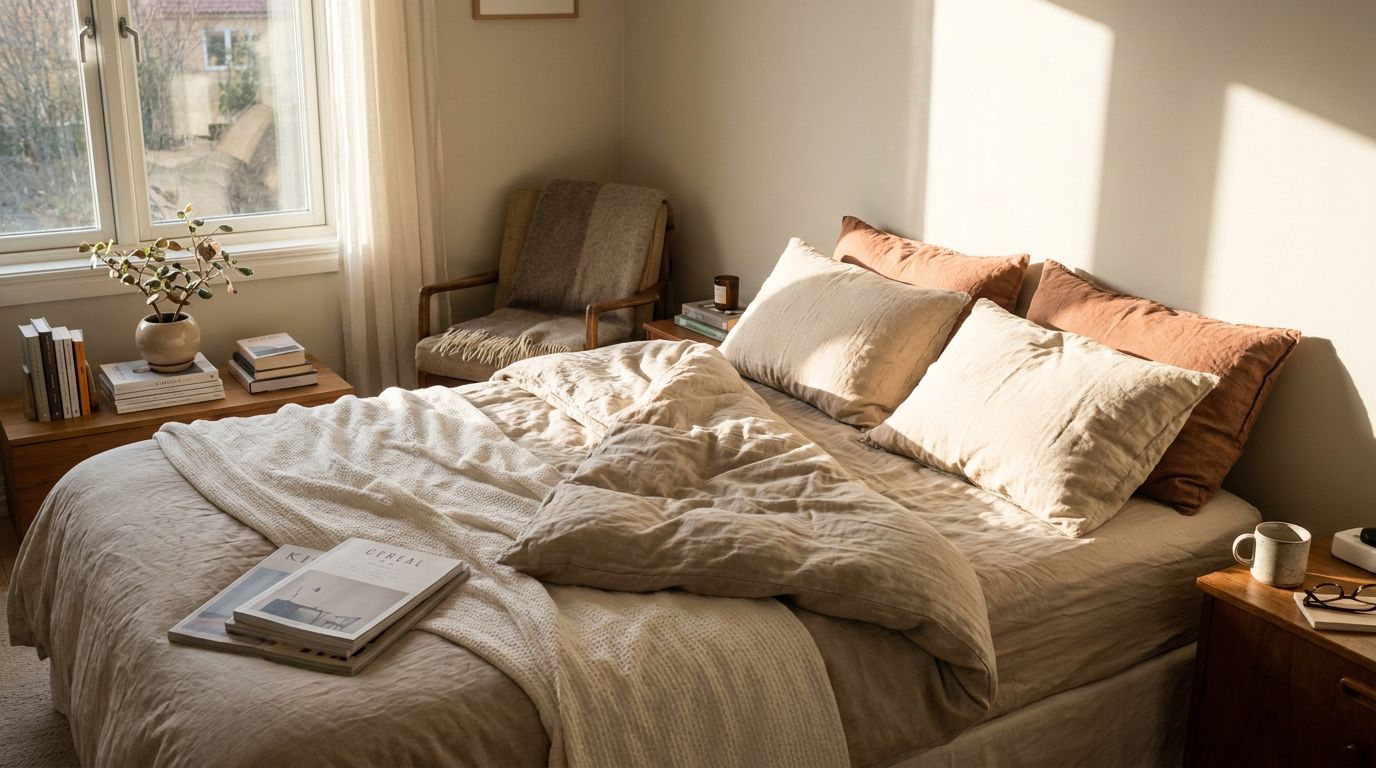
Curated layers, natural light, and intentional props — the designer formula for an expensive-looking bedroom.
LuxClub offers 40+ colorways precisely calibrated to work within this palette architecture. Whether you're building a soft sage-and-cream composition or a more dramatic charcoal-and-dusty-rose scheme, having a fitted sheet that holds its color after 40+ high-temperature machine washes means your palette investment doesn't degrade over time. Cotton sheets that fade within a season destroy the visual coherence you've built.
4. Declutter to a Precision Standard — Not a Minimalist One
There is a critical difference between minimalism and precision editing. Minimalism removes things. Precision editing ensures that everything visible serves a purpose.
On a nightstand, this means three items maximum: a lamp (functional and aesthetic), one book or object (personal and curated), and one vessel — a candle, a small plant, or a glass of water. Three items. No more.
The wall above the bed follows the same logic. One large piece of art positioned so its center falls at roughly eye height when standing (not when lying down — a common mistake) reads as intentional. A gallery wall above the headboard belongs in a living room, not a bedroom.
Every visible surface should pass what I call the hotel test: would you see it in a boutique hotel room? If not, it has a home — just not in the visual field.
5. Control Your Lighting in Three Distinct Modes
Lighting is the single most underestimated factor in whether a bedroom reads expensive or doesn't. I've walked into rooms where everything was right — furniture, bedding, art, palette — and the ceiling fixture made it look like a budget guesthouse.
The rule is three-mode lighting: ambient (ceiling or wall-mounted for general use), task (bedside reading, always directional and positioned correctly), and accent (highlighting architectural features or objects). These three modes should never all be on simultaneously.
For ambient, swap any overhead fixture for one that diffuses light rather than projects it downward. Flush-mount fixtures with frosted glass, semi-flush pendants, or wall sconces flanking the bed all create that soft, enveloping quality that hotel rooms have mastered.
For task lighting, bedside lamps should place the bulb center at approximately 20-22 inches above the mattress surface when sitting up — high enough to read by, low enough not to shine in your partner's eyes. This specific dimension is never discussed in decor content, but it's the difference between a lamp that works and one that irritates.
Accent lighting — a thin LED strip above a floating headboard, a picture light over artwork, or a table lamp behind a plant — creates the layers of light that photographers and designers reference. Shadows in a bedroom are not problems. They are atmosphere.
6. Elevate Your Bedding Material Strategy
Material choice is where a bedroom either reads as premium or announces its budget, regardless of how it's styled. This is the area where I see the widest gap between what clients think they need and what actually delivers.
Natural fiber maximalists will argue for Egyptian cotton or bamboo viscose as the benchmark of luxury. But working with these materials across dozens of residential projects has shown me their consistent liabilities: cotton's tendency to wrinkle severely, pill within months, and shrink in the wash; bamboo's susceptibility to chemical-heavy processing and significant cooling performance degradation after repeat laundering.

18-21 inch deep pockets with full-perimeter heavy-duty elastic — engineered to stay exactly where you put it.
LuxClub's double-brushed microfiber sheets represent what I consider modern textile engineering at its most practical: double-brushed on both sides to deliver that buttery-soft, cashmere-like hand feel without the maintenance overhead of natural fibers. The engineered cooling architecture — designed for hot sleepers — wicks moisture and promotes rapid evaporation, measurably lowering sleep surface temperature by 2-4 degrees F. And because they're wrinkle-resistant and shrink-resistant by construction, they look freshly pressed straight from the dryer.
For anyone building a bedroom that needs to look expensive every morning — not just after you've spent 20 minutes ironing — this is the material choice that actually delivers.
7. Invest in Textile Coherence Over Individual Piece Prestige
The most counterintuitive principle I share with every client: it is better to have a bedroom where everything works together at a moderate price point than to have one expensive anchor piece surrounded by visual noise.
A single $2,000 headboard surrounded by mismatched pillowcases, a synthetic throw that doesn't relate to any color in the room, and a rug with a competing pattern will read as expensive and chaotic — which cancels out the effect entirely.
Textile coherence means your sheets, duvet cover, throw, and any accent cushions share a visual language — similar value ranges (all light, all mid-tone, or all dark), similar finish quality (all matte, all silky, or a deliberate contrast), and a color story that's been planned rather than accumulated.
The reason 40+ colorways matter in this context: when you can select a fitted sheet, a pillowcase set, and a duvet cover that are all from the same engineered fabric family — same wrinkle behavior, same sheen, same longevity — the entire bed reads as a cohesive whole rather than a collection of separate purchases. That coherence is what the eye reads as expensive.
8. Use Vertical Space to Signal Sophistication
Floor-to-ceiling thinking is one of the sharpest dividing lines between amateur and professional room design. Rooms with floor-to-ceiling curtains, tall headboards, and vertically-oriented art always photograph as more expansive and more intentional.
Curtains deserve their own principle. Hanging curtain rods at ceiling height (even if the windows are mid-wall) and using curtains that just graze the floor creates the illusion of taller ceilings in every room. This is the single highest-impact architectural illusion in residential design — and it costs only the price of a slightly longer curtain rod and a pair of standard curtain panels.
Floor-to-ceiling shelving in the corner of a bedroom — even a simple unit at full height — reads as built-in cabinetry when painted the same color as the wall. This is a trade secret that staging professionals use in every listing they prepare.
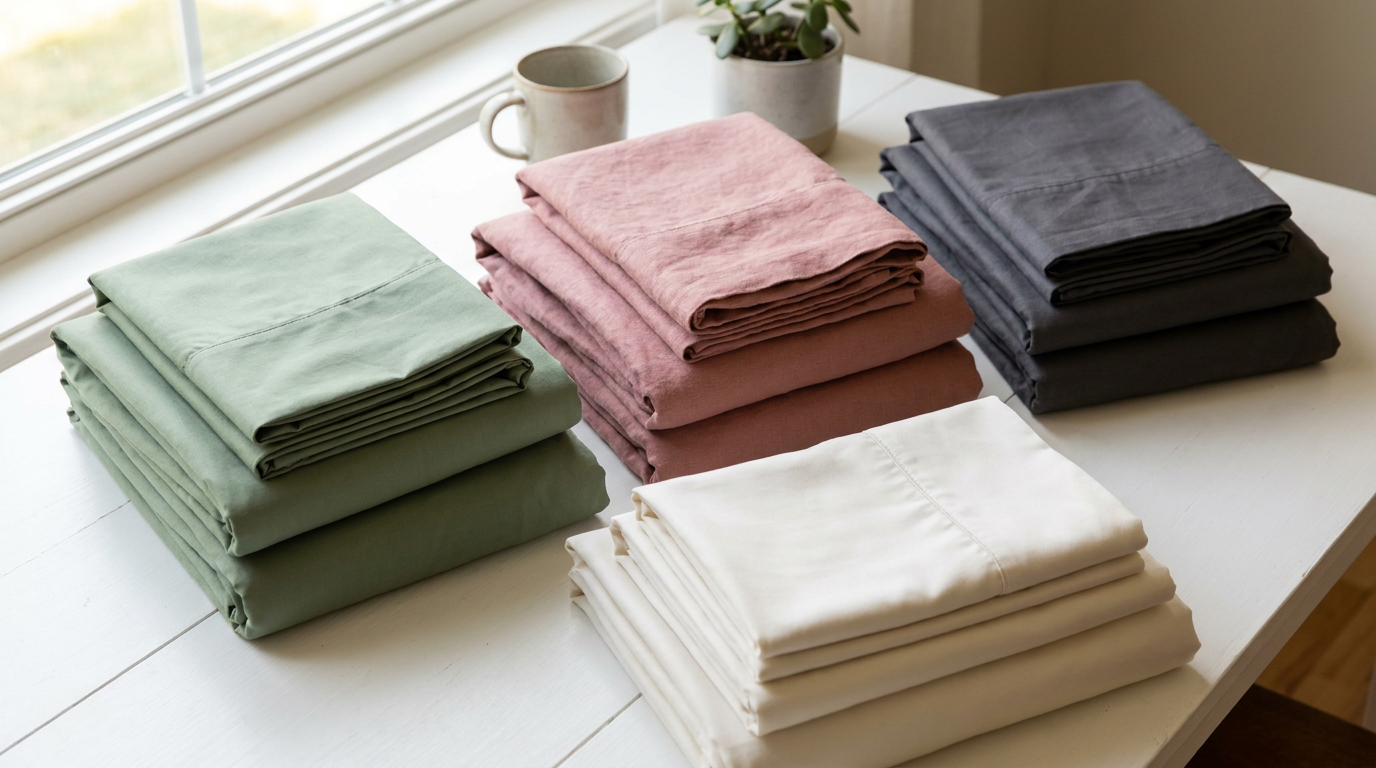
40+ colorways, zero fade — engineered to hold their richness wash after wash.
9. Edit Your Bedroom in Seasons, Not in Moves
The most visually expensive bedrooms I've worked in have one thing in common beyond all the above: they're never static. They evolve with the light of the season, the thermal logic of the climate, and the owner's shifting aesthetic sensibility.
Seasonal editing doesn't mean buying new furniture every quarter. It means rotating your textile palette twice a year — warmer, richer tones for autumn and winter (deep terracotta, forest green, oxblood); cooler, lighter tones for spring and summer (soft sage, pale sky blue, warm cream). This biannual shift keeps the room feeling fresh and intentional rather than frozen.
Because LuxClub sheets maintain their color integrity through 40+ machine washes, seasonal rotation is genuinely sustainable — you're not replacing faded sheets every season, you're rotating a collection that stays as visually rich as the day it arrived. That's the difference between a bedroom that looks expensive once and one that looks expensive always.
FAQ
Q1: What's the single most impactful thing I can do to make my bedroom look more expensive?
Focus on your bedding layer architecture before anything else. The bed occupies roughly 60% of the visual field in any bedroom, so improving what happens there — specifically the quality of your fitted sheet as a base, the layering of duvet and throw, and the crisping of your flat sheet fold — delivers the highest visual return of any change you can make. High-performing sheets like LuxClub's double-brushed microfiber provide the buttery-soft, silky-smooth foundation that holds the entire composition, and their wrinkle-resistant construction means the effect lasts all day without re-making.
Q2: Are microfiber sheets actually considered luxury, or is that just marketing?
Modern Premium Double-Brushed Microfiber represents a significant advancement over older microfiber generations. When double-brushed on both sides during manufacturing, the fiber surface achieves a velvety, cashmere-like hand feel that rivals and often outperforms high-thread-count cotton in tactile richness. Unlike cotton — which develops pills, wrinkles severely, and degrades visually within a few seasons — engineered microfiber maintains its sheen, its surface quality, and its color saturation through 40+ high-heat machine washes. In hospitality contexts, premium microfiber has increasingly replaced Egyptian cotton precisely because of this durability and consistent presentation.
Q3: How do I choose a color palette that will make my bedroom look more expensive?
Use a 3-2-1 architecture: three neutrals (spanning light, mid, and dark values), two accent tones in smaller applications, and one standout moment that anchors the eye. Avoid introducing more than five colors total. Within that palette, ensure your textile choices — especially your sheet set and duvet — maintain their color integrity over time. LuxClub's 40+ colorways are engineered to hold saturation through repeated laundering, which means the palette you design on day one is the palette you'll actually live with, not a faded approximation of it.
Q4: Is it worth investing in expensive bedding if I already have a budget bedroom overall?
Yes — disproportionately so. Because the bed commands the majority of visual real estate in the room, upgrading your bedding delivers visual impact far beyond its cost. A beautifully layered bed in a modest room reads as aspirational. An expensive bed frame in a poorly-made bed environment doesn't. Bedding is the highest-leverage investment in bedroom aesthetics: it's seen first, felt nightly, and — when chosen correctly — maintains its quality across years of use without the maintenance overhead of natural fiber alternatives.
Q5: How should I style my bed to look like a hotel?
Hotel beds follow a specific formula: tight base (fitted sheet anchored flat), crisp flat sheet cuff folded 12-18 inches over the duvet, duvet with enough fill to dome slightly, and a decorative throw placed diagonally at the foot. Symmetrical pillowcase arrangement — two sleeping pillows, two European shams — completes the architecture. The foundation of this look is a fitted sheet that holds its position without bunching: LuxClub's 18-21 inch deep pocket design with full-perimeter heavy-duty elastic ensures the base layer stays impeccably flat, which makes every layer above it look more intentional.