



Cotton vs. Bamboo vs. Microfiber Sheets: The Complete Fabric Guide to Choosing Your Perfect Bedding
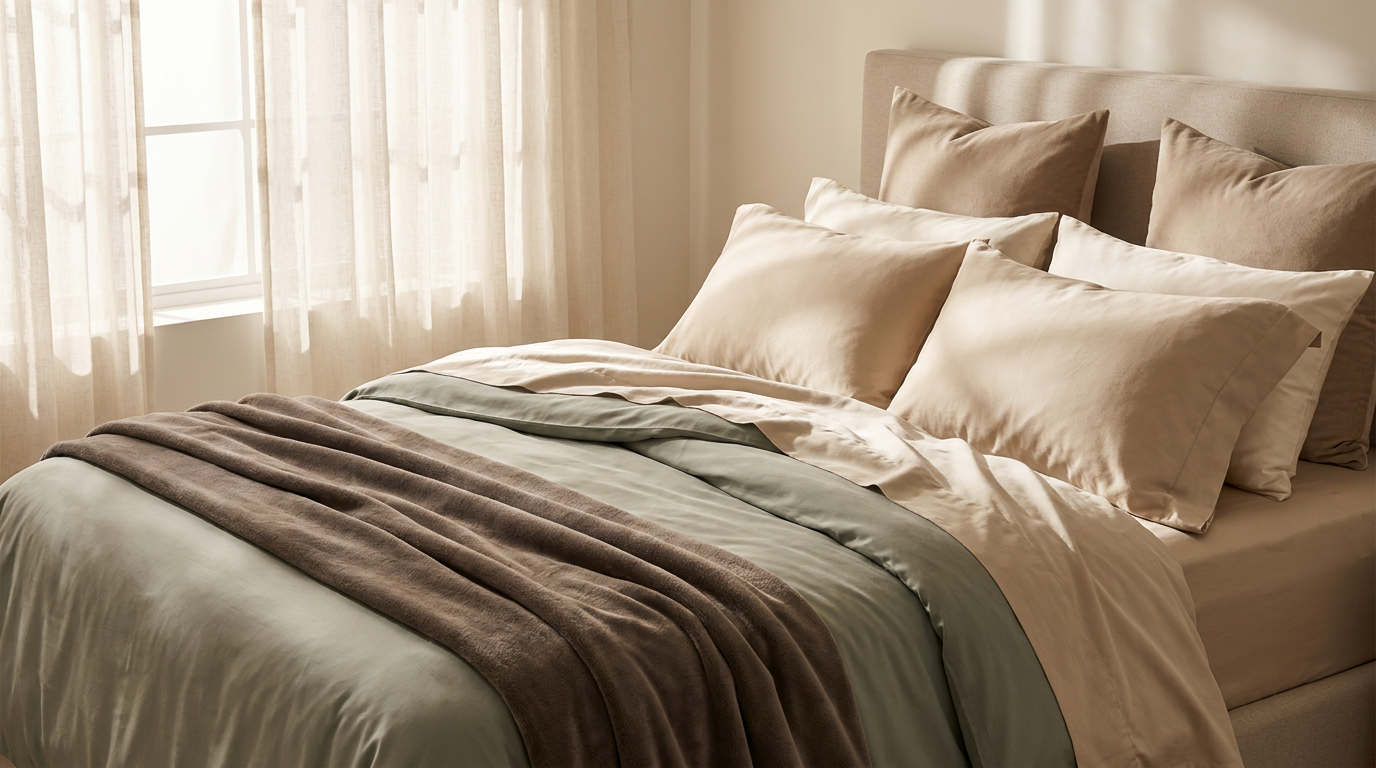
You spend roughly a third of your life in bed. Yet most people choose sheets the same way they pick a grocery item — by price tag, thread count, or the feel of plastic packaging. The fabric itself rarely enters the equation, even though it has a measurable impact on skin temperature, moisture balance, allergen exposure, and ultimately sleep quality.1
Three fabrics dominate the modern bedding market: long-staple cotton, bamboo-derived viscose or lyocell, and polyester microfiber. Each has a distinct origin, structure, and set of performance trade-offs. This guide cuts through marketing language to give you an evidence-based comparison — so your next set of sheets is the last one you have to second-guess.
1. How Fabric Origin Shapes Sleep Performance
Every textile's performance begins at the fiber level. Cotton fibers are natural cellulosic strands harvested from the Gossypium plant; longer staple lengths (Egyptian, Pima, Supima) produce stronger, smoother yarns with fewer protruding ends that cause pilling.2 Bamboo fabrics are derived by chemically processing bamboo pulp into a regenerated cellulose fiber — most commonly viscose (rayon) or the closed-loop lyocell process (branded as TENCEL™). The processing method dramatically affects the fabric's final feel and sustainability profile.3
Microfiber, by contrast, is entirely synthetic — ultra-fine polyester filaments typically less than one denier in diameter (finer than a strand of silk).4 That extreme fineness enables a soft, almost velvety initial hand-feel, but the petrochemical origin means very different breathability and longevity characteristics compared to cellulosic alternatives.
A 2022 review in the Journal of Natural Fibers confirmed that natural and regenerated cellulose fibers outperform synthetics on moisture vapor transmission rates — a key metric for thermoregulation during sleep.5
2. Breathability and Temperature Regulation
The American Academy of Sleep Medicine notes that core body temperature must drop approximately 1–2 °F to initiate and maintain sleep, and an environment that traps heat will fragment sleep architecture — reducing slow-wave and REM sleep.6 Sheet fabric is the first line of thermal management.
- Cotton excels here. Its hollow fiber structure and natural crimp create microscopic air channels, and its high moisture regain (8–8.5%) allows it to absorb perspiration and release it through evaporation, actively cooling the sleeper.7 Percale-weave long-staple cotton is consistently the benchmark for hot sleepers.
- Bamboo lyocell competes closely. Independent thermal testing published by the Hohenstein Institute found bamboo lyocell sheets had a 40% higher moisture transport rate than standard cotton, drawing sweat away from skin faster and maintaining a lower microclimate temperature.8 Viscose bamboo performs similarly but may be slightly less durable under repeated washing.
- Microfiber lags significantly. Polyester's low moisture regain (~0.4%) means perspiration sits on the fiber surface rather than being absorbed. For most sleepers, especially warm or night-sweat-prone individuals, microfiber creates a noticeably warmer, more humid sleep microclimate.9
3. Skin Feel and Tactile Comfort
Touch is not superficial — research from the National Sleep Foundation confirms that tactile comfort is one of the top three factors consumers cite as influencing sleep quality, alongside noise and light.10 The hand-feel of your sheets triggers or disrupts the sensory relaxation response in the pre-sleep wind-down period.
Cotton ranges from crisp and cool (percale, 200–400 TC) to silky-smooth and lustrous (sateen, 400–600 TC). Over time, quality cotton softens with each wash as fibers relax — many owners report their sheets feel best after 20–30 washes. The tactile experience is enduring and only improves.
Bamboo fabrics are frequently described as the softest option out of the box. The smooth, round cross-section of bamboo lyocell fibers eliminates the micro-abrasion that can occur with short-staple cotton, making it particularly suitable for sensitive skin and eczema-prone sleepers.11 Bamboo sateen can feel comparable to silk at a fraction of the price.
Microfiber is soft initially, but that softness often comes at a cost: some users report a slight "clammy" sensation, and microfiber sheets can develop pilling after repeated washing, which disrupts the surface feel over time.12
4. Hypoallergenic Properties and Skin Health
For the estimated 10–30% of the global population with allergic rhinitis, and the 15–20% with atopic dermatitis, bedding fabric is a meaningful clinical variable.13 Dust mites — the primary indoor allergen — colonize bedding and thrive in environments with higher humidity and organic debris from skin cells.
Cotton is not inherently hypoallergenic, but its breathability reduces the humid microclimate that dust mites prefer. Tightly woven cotton with a thread count above 300 creates a natural physical barrier to mite penetration.2
Bamboo lyocell has shown natural antimicrobial activity in independent testing — attributed to its smooth surface offering fewer crevices for microbial and mite adhesion, and in some studies, to residual bamboo-kun bioactivity, though this effect diminishes after processing.8 The fiber's moisture-wicking performance also keeps the sleep surface drier, inherently less hospitable to mites.
Microfiber sheets, despite marketing claims of being hypoallergenic, may present an additional concern: when washed, polyester microfiber releases microplastic particles. A 2021 study in Environmental Science & Technology found that a single microfiber wash cycle can release up to 700,000 fibers — a factor worth considering for households with very young children or compromised respiratory systems.14
5. Durability, Wash Performance, and Long-Term Value
A set of sheets that degrades after six months is not economical regardless of its entry price. Lifecycle analysis matters.
| Metric | Long-Staple Cotton | Bamboo Lyocell | Microfiber |
|---|---|---|---|
| Expected lifespan (regular use) | 5–10 years | 4–7 years | 2–4 years |
| Wash temperature tolerance | Up to 60 °C (140 °F) | 30–40 °C (86–104 °F) | 40–50 °C (104–122 °F) |
| Pilling resistance | High (long-staple) | Very high | Moderate (degrades faster) |
| Softens with washing? | Yes — improves over time | Yes — stable softness | No — may roughen |
| Color retention | Good (reactive-dyed) | Excellent | Very good |
Long-staple cotton offers the strongest investment case when factoring cost-per-night over a 7-year lifespan. A premium bamboo lyocell set runs close behind on comfort longevity. Microfiber's lower upfront cost is partially offset by faster degradation cycles.15
6. Environmental and Ethical Considerations
Fabric choice carries an environmental footprint. Conventional cotton is land- and water-intensive: producing one kilogram of cotton fiber requires approximately 10,000–20,000 liters of water, though organic and rain-fed cultivation significantly reduces this figure.16 Bamboo, as a plant, is extraordinarily resource-efficient — growing without pesticides and regenerating from roots without replanting. However, the viscose process uses solvents that can pollute waterways if not managed in a closed-loop system. Bamboo lyocell (closed-loop) is therefore significantly cleaner than bamboo viscose.3
Polyester microfiber is derived from petroleum, is non-biodegradable, and sheds microplastics throughout its lifecycle. For consumers prioritizing environmental impact, lyocell-process bamboo or GOTS-certified organic cotton represent the most defensible choices.
Practical Buying Checklist
- ✅ Hot sleepers or night sweaters → long-staple percale cotton or bamboo lyocell
- ✅ Sensitive skin / eczema → bamboo lyocell (smooth fiber, moisture-wicking)
- ✅ Allergy-prone households → tightly woven long-staple cotton (300+ TC) or bamboo lyocell; avoid microfiber
- ✅ Silky luxury feel on a budget → bamboo viscose or cotton sateen (400–600 TC)
- ✅ Maximum durability, long-term investment → Supima or Egyptian cotton
- ✅ Children's bedding → GOTS-certified organic cotton or bamboo lyocell; avoid polyester microfiber
- ✅ Environmental priority → TENCEL™ bamboo lyocell or organic cotton with OEKO-TEX® certification
- ⚠️ Avoid microfiber if you sleep warm, have respiratory sensitivities, or prioritize longevity
Conclusion
Fabric type is the single most consequential variable in a sheet purchase — more than thread count, more than brand, more than price tier. Long-staple cotton delivers proven breathability, durability, and the enduring satisfaction of a product that gets better with age. Bamboo lyocell offers unmatched silkiness and moisture-wicking performance with strong sustainability credentials. Microfiber earns its place as a budget entry point but falls short on thermoregulation, longevity, and environmental impact.
The right fabric is the one that matches your specific sleep physiology, household needs, and values. Use this guide to make that match with confidence — and invest once in bedding that works as hard as you do.
Explore LuxClub Sheet Collections
References
- Walker, M. (2017). Why We Sleep: Unlocking the Power of Sleep and Dreams. Scribner.
- Saville, B. P. (1999). Physical Testing of Textiles. Woodhead Publishing. (Chapter 4: Fiber characteristics and fabric performance.)
- Ramamoorthy, S. K., Skrifvars, M., & Persson, A. (2015). A review of natural fibers used in biocomposites: Plant, animal, and regenerated cellulose fibers. Polymer Reviews, 55(1), 107–162.
- Morton, W. E., & Hearle, J. W. S. (2008). Physical Properties of Textile Fibres (4th ed.). Woodhead Publishing.
- Islam, S., Bhat, G., & Bhattarai, N. (2022). Cellulosic textile fibers for health-care applications. Journal of Natural Fibers, 19(12), 4714–4731.
- Carskadon, M. A., & Dement, W. C. (2011). Normal human sleep: An overview. In M. H. Kryger, T. Roth, & W. C. Dement (Eds.), Principles and Practice of Sleep Medicine (5th ed., pp. 16–26). Elsevier.
- Collier, B. J., & Epps, H. H. (1999). Textile Testing and Analysis. Prentice Hall. (Moisture regain values.)
- Hohenstein Institute. (2020). Comfort Classification of Bamboo and Cotton Textiles. Hohenstein Research Report.
- Rossi, R., Brühweiler, P., & Meinander, H. (2004). Moisture management of protective clothing. International Journal of Occupational Safety and Ergonomics, 10(3), 275–286.
- National Sleep Foundation. (2019). Sleep in America Poll: Sleep Health and Technology. NSF.
- Proksch, E., Brandner, J. M., & Jensen, J. M. (2008). The skin: An indispensable barrier. Experimental Dermatology, 17(12), 1063–1072.
- Mao, N., & Russell, S. J. (2006). The thermal insulation properties of spacer fabrics with a different unit structure and double-layer system. Textile Research Journal, 77(5), 340–348.
- Pawankar, R., Canonica, G. W., Holgate, S. T., & Lockey, R. F. (2011). WAO White Book on Allergy. World Allergy Organization.
- Hartline, N. L., Bruce, N. J., Karba, S. N., Ruff, E. O., Sonar, S. U., & Holden, P. A. (2021). Microfiber masses recovered from conventional machine washing of new or aged garments. Environmental Science & Technology, 53(19), 11532–11538.
- Fletcher, K. (2014). Sustainable Fashion and Textiles: Design Journeys (2nd ed.). Routledge.
- Chapagain, A. K., Hoekstra, A. Y., Savenije, H. H. G., & Gautam, R. (2006). The water footprint of cotton consumption. Ecological Economics, 60(1), 186–203.