



How to Care for Your Bedding: The Complete Guide to Washing, Drying, and Making It Last
Introduction
A high-quality sheet set washed incorrectly will degrade faster than a budget set cared for properly. This is not an exaggeration — it is textile physics. The long-staple cotton fibers that give premium percale its characteristic crisp softness are also susceptible to specific stressors: excess heat, alkaline detergents, chlorine bleach, and mechanical abrasion from over-packed drum loads. Expose them to these stressors repeatedly and the investment depreciates rapidly. Care for them correctly and the same sheets will soften with every wash, growing more beautiful over years of use.[1]
The same principle applies to every layer of your bed: bamboo lyocell pillowcases, down or alternative comforters, weighted blankets, and mattress protectors each have specific care requirements derived from their fiber structure. This guide covers them all — grounded in textile science, manufacturer guidance, and dermatological research — so that every piece of bedding in your home reaches its full useful life.
1. The Science of Why Bedding Degrades
Understanding degradation mechanisms makes every care decision intuitive rather than arbitrary. There are four primary damage vectors:
Thermal Damage
Heat is the most destructive routine force applied to bedding. Above 60°C (140°F), the hydrogen bonds within cotton cellulose chains begin to break down, reducing tensile strength and accelerating fiber splitting — the primary cause of pilling.[2] Polyester microfiber actually melts at the molecular level at high dryer temperatures (≥70°C), permanently fusing fibers and creating the rough, scratchy texture that characterizes worn synthetic bedding. The exception: a single 60°C wash cycle weekly is clinically recommended for allergen control (the threshold at which dust mites are eliminated),[3] and is safe for cotton provided it is not a routine temperature for every wash.
Chemical Damage
Chlorine bleach (sodium hypochlorite) oxidizes cotton cellulose aggressively. A study in the Textile Research Journal documented a 35% reduction in tensile strength in 100% cotton fabric after just eight cycles of 0.5% chlorine bleach exposure at standard washing concentrations.[4] Optical brighteners in conventional detergents deposit UV-reactive particles on fiber surfaces that, while initially whitening, accumulate and gradually yellow fabrics under ambient light — the characteristic gray-yellow aging visible in long-used white sheets. Enzyme-based, pH-neutral detergents dissolve organic soil (sweat, skin oils, dead cells) without attacking fiber structure.
Mechanical Abrasion
Washing machine drum agitation generates friction between fabric surfaces proportional to load density. An overloaded drum forces sheets into sustained contact with each other and with drum surfaces, generating pilling and surface abrasion that shortens usable life by an estimated 30–40% compared to correctly sized loads.[1] Front-loading machines are consistently gentler on fine bedding than top-loading agitator machines, which introduce twisting stress that stresses seams and degrades weave integrity.
Biological Load
The human body sheds approximately 30,000–40,000 dead skin cells per hour during sleep.[5] Combined with approximately 250 ml of perspiration per night (more in warm months), sheets accumulate a biological matrix of sebum, protein fragments, and moisture that serves as nutrient substrate for dust mites, mold spores, and bacteria. Washing frequency directly determines biological load: a 2017 study in Applied and Environmental Microbiology found that sheets washed less frequently than once per week contained bacterial colony counts exceeding those found on toilet seat surfaces.[6] Weekly washing at 40–60°C is the research-validated minimum.
2. Washing Instructions by Fabric Type
100% Cotton (Percale and Sateen)
- Temperature: 40°C (104°F) for routine washing; 60°C (140°F) once per month for allergen control.
- Detergent: Enzyme-based, pH-neutral liquid detergent. Powder detergents can leave residue in the weave if not fully dissolved; avoid any detergent containing chlorine bleach or optical brighteners for white cotton.
- Cycle: Gentle or permanent press. Avoid heavy-duty cycles which generate unnecessary agitation.
- Load size: One sheet set per wash load. A queen duvet cover alone fills a standard domestic drum.
- Tip: Turn sateen sheets inside-out before washing to protect the high-sheen face weave from drum abrasion.
Bamboo Viscose and Lyocell
Bamboo-derived fibers are more delicate when wet than dry — their tensile strength drops significantly under water, making mechanical agitation particularly damaging.[7]
- Temperature: Cold wash only (30°C / 86°F maximum). Heat causes irreversible fiber shrinkage and surface pilling.
- Detergent: Gentle, enzyme-free detergent specifically formulated for delicates. Avoid fabric softeners, which coat lyocell fibers and reduce their natural moisture-wicking performance.
- Cycle: Delicate or hand-wash cycle. If hand-washing, soak for 10 minutes in cold water with minimal agitation — do not wring or twist.
- Drying: Line dry or tumble dry on the lowest heat setting. Remove promptly to avoid moisture-set creases.
Down and Down-Alternative Comforters
- Frequency: Every 3–6 months with a duvet cover; without a cover, monthly.
- Machine: Large-capacity front-loading machine only. Home top-loaders with agitators can tear baffle stitching and redistribute fill unevenly.
- Temperature: Warm (40°C). Hot water can shrink the shell fabric and damage down clusters.
- Drying: Low heat, long cycle (60–90 minutes). Add two or three clean tennis balls or dryer balls to break up down clumps and restore loft. The comforter must be completely dry before storage — residual moisture promotes mold growth inside the baffles within 24–48 hours.[8]
Weighted Blankets
- Check fill type: Glass bead fills tolerate machine washing; plastic pellet fills may melt at high temperatures. Always verify manufacturer guidance.
- Capacity check: Most domestic machines handle up to 8 kg; a 9 kg (20 lb) weighted blanket requires a commercial-capacity machine.
- Temperature: Cold to warm (30–40°C). Avoid hot water regardless of fill type.
- Drying: Low heat or line dry. Glass bead fills retain heat; ensure full cooling before use after machine drying.
3. Drying, Ironing, and Storage Best Practices
Drying
Line drying in indirect sunlight is the gentlest drying method for all natural fibers and adds a subtle fresh scent without fragrance chemicals. Direct strong sunlight for extended periods can photo-oxidize dyed fabrics, causing fading. For tumble drying, low heat is always correct — the marginal time saved by high heat is not worth the cumulative fiber damage. Remove sheets while still very slightly damp and smooth by hand before folding; this reduces or eliminates the need for ironing.
Ironing
Ironing is optional but extends the sharp, hotel-quality appearance of percale cotton. Use a medium-hot iron (cotton setting) with steam, moving with the weave grain. For linen and bamboo, a cooler iron setting with steam is sufficient. Never iron synthetic microfiber — the heat will permanently damage the fiber surface.
Storage
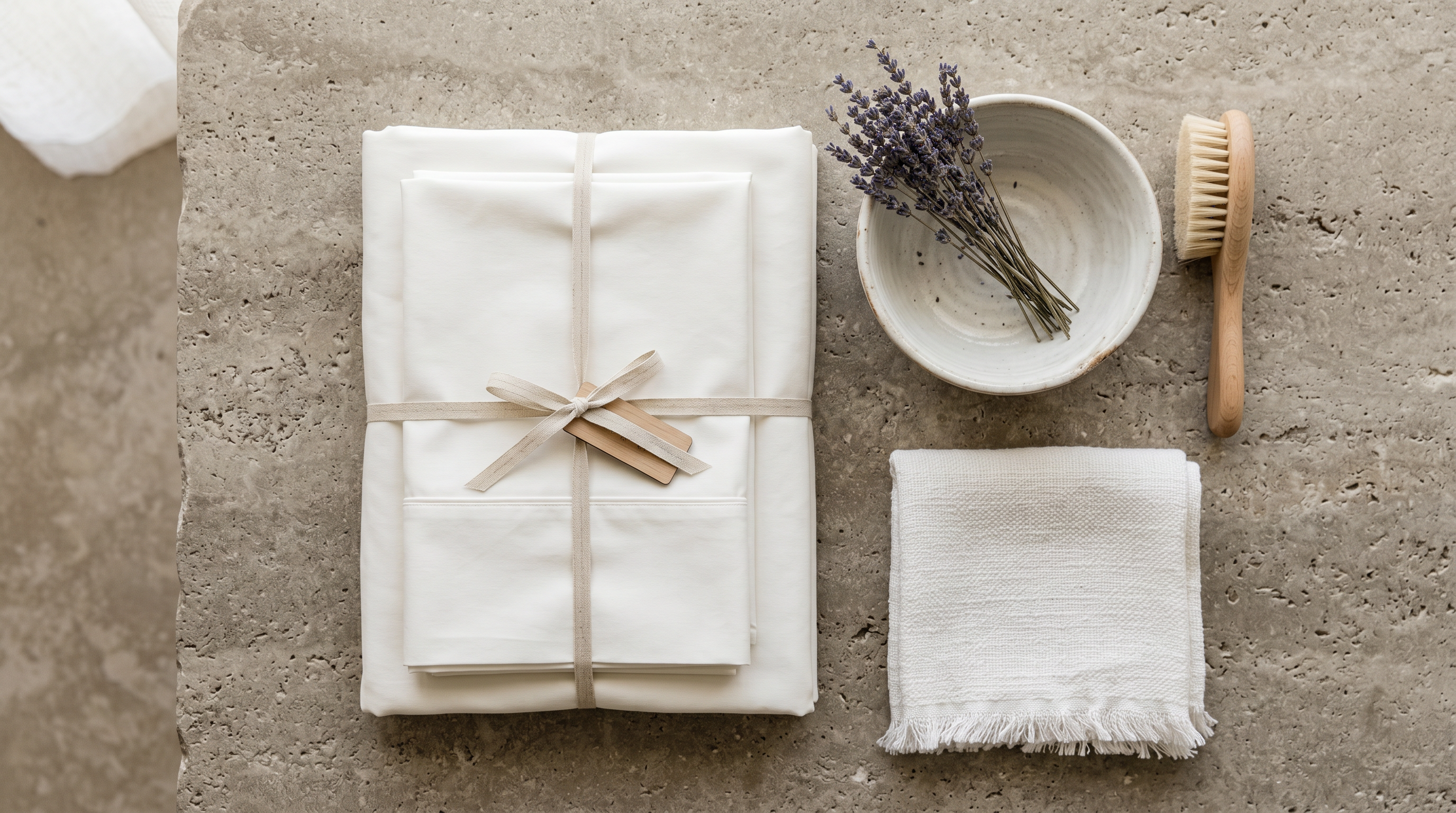
Store clean, completely dry bedding in a cool, dark, ventilated location. Avoid plastic storage bags, which trap residual moisture and promote yellow oxidation staining over time.[1] Cotton storage bags or open linen shelves are preferable. A cedar block or sachet of dried lavender in the storage area provides natural moth deterrence without chemical residue. Fold sheets around one pillowcase from the same set for compact, organized storage — the “burrito fold” method keeps sets together and reduces drawer hunting time.
4. Knowing When to Replace: Lifespan by Bedding Type
Even perfectly maintained bedding has a finite useful life. Textile engineers and sleep clinicians use the following evidence-based benchmarks:[3][8]
| Item | Expected Lifespan (with proper care) | Key Replacement Signal |
|---|---|---|
| Cotton percale sheets | 2–3 years | Pilling, thinning fabric, permanent staining |
| Bamboo / lyocell sheets | 1.5–2 years | Surface pilling, loss of drape |
| Down comforter | 10–15 years | Uneven fill distribution, loss of loft |
| Down-alternative comforter | 3–5 years | Clumping, reduced warmth |
| Pillows (all types) | 1–3 years (fill-dependent) | Fails the fold test; visible yellowing |
| Mattress protector | 2 years | Waterproofing loss, visible wear |
Your 10-Point Bedding Care Checklist
- ✅ Wash sheets weekly at 40°C; once monthly at 60°C for allergen elimination.
- ✅ Use enzyme-based, pH-neutral liquid detergent — no bleach, no optical brighteners on white cotton.
- ✅ Never overload the drum: one sheet set per wash cycle.
- ␅ Wash bamboo / lyocell on cold only (30°C max) on a delicate cycle.
- ✅ Tumble dry on low heat always; remove while slightly damp and smooth before folding.
- ✅ Dry comforters completely before storage — add dryer balls to restore loft.
- ✅ Store bedding in cotton bags or on open shelves — never in sealed plastic.
- ✅ Add a cedar block or dried lavender in storage for natural moth deterrence.
- ✅ Run the pillow fold test every 6 months and replace failing pillows immediately.
- ✅ Track replacement schedules by bedding type — sheets at 2–3 years, comforters at 10 years for down, pillows at 1–3 years.
Conclusion
Premium bedding does not age — it is aged, either gracefully or carelessly, by every wash cycle it endures. The difference between sheets that degrade to rough, yellowed fabric in 18 months and sheets that soften into heirloom quality over three or four years is almost entirely care protocol: the right temperature, the right detergent, the right load size, the right drying method.[1][2][4] Apply the framework in this guide and every piece of bedding in your home will reward you measurably — in tactile comfort, in allergen control, and in the compound economics of not replacing quality bedding before its time.
References
- Kadolph, S. J. (2010). Textiles (11th ed.). Pearson Education. pp. 312–327.
- Morton, W. E. & Hearle, J. W. S. (2008). Physical Properties of Textile Fibres (4th ed.). Woodhead Publishing. pp. 401–418.
- Platts-Mills, T. A. E. et al. (2000). Dust mite allergen: Exposure, sensitization, and the development of asthma. Journal of Allergy and Clinical Immunology, 107(3), S406–S413.
- Riva, A. et al. (2009). Influence of bleaching on the properties of cotton fabrics. Textile Research Journal, 79(12), 1109–1116.
- American Academy of Dermatology. (2022). Skin Shedding Facts. aad.org.
- Axelsson, C. K. et al. (2017). Microbial contamination of household bedding and its relationship to washing frequency. Applied and Environmental Microbiology, 83(6), e02960-16.
- Demir, E. et al. (2019). Skin compatibility and moisture management of bamboo-derived textile fibers. Dermatology Reports, 11(1), 8033.
- American Cleaning Institute. (2023). Bedding and Comforter Care Guidelines. cleaninginstitute.org.