




How to Create a Minimalist Bedroom That Feels Expensive, Not Empty
Most people get minimalism wrong. They remove the clutter, strip the shelves, pare back the color—and end up with a room that feels sterile rather than serene, sparse rather than intentional. True minimalist bedroom design is not about subtraction for its own sake. It is about choosing every remaining element with enough precision that nothing needs to compete for attention—and everything that stays earns its place.
This guide breaks down the eight design moves that separate a genuinely calm, expensive-feeling minimalist bedroom from one that simply looks unfinished. Each principle scales from a studio apartment to a master suite, and most require zero renovation.

The silky-smooth, flat-woven surface of LuxClub's double-brushed microfiber — exactly what a minimalist bed needs as its primary visual field.
Why Most Minimalist Bedrooms Fail (and What Actually Creates the Calm)
The core error in most minimalist bedrooms is confusing visual noise with visual information. Removing objects is only half the equation. The other half is ensuring the surfaces that remain communicate quality loudly enough to carry the room on their own.
Interior designers who specialize in high-end residential work use a concept called “material richness.” In a room with few objects, each remaining surface carries proportionally more visual weight. A flat-painted wall with no texture reads as a budget choice. The same wall in a warm linen or limewash finish reads as a considered design decision. The same logic applies to every surface in the room—including, critically, the bedding.
The psychological research on minimalism reinforces this. A 2019 study from Princeton University's Neuroscience Institute confirmed that visual clutter competes for neural resources, raising cortisol and reducing the brain's ability to focus and relax. But removing clutter without replacing it with deliberate material quality simply shifts the problem: the brain now fixates on visual emptiness rather than visual chaos. The goal is a room where the eye travels naturally between a small number of high-quality surfaces, rests on each one, and finds satisfaction.
8 Design Moves for a Minimalist Bedroom That Feels Expensive
1. Commit to a Three-Value Palette—Not Just Neutral Colors
Minimalist bedrooms fail when designers interpret “neutral” as “beige.” True material restraint uses a three-value system: one dominant field (typically 60% of the room's visible surface area), one secondary tone (30%), and one sharp accent or contrast point (10%). The values—light, mid, and dark—do more work than the hues themselves.
A warm white ceiling and walls (light field) paired with a slate-grey linen duvet (mid value) and a charcoal throw or dark wood side table (accent) creates depth without pattern. The eye reads the room as complete and intentional because the value hierarchy is clear. Without this structure, even a perfectly curated monochromatic room looks washed out rather than refined.
For 2026, the palette direction that aligns most naturally with minimalist bedroom ideas is what designers are calling “tonal warmth”—off-whites, warm greys, clay, and sage, all kept at similar saturation levels but differentiated by value. These shades photograph beautifully in natural light and transition between seasons without requiring changes to furniture or art.
2. Make the Bed the Structural Anchor, Not a Side Note
In a minimalist bedroom, the bed is not one piece of furniture among several—it is the architectural centerpiece that every other element orbits. Designers size the bed to the room, not the other way around: in a room where visual mass is intentionally reduced, a too-small bed creates a proportional void that makes the space feel abandoned.
The bedding surface also needs to justify the visual real estate it occupies. Fabric that wrinkles instantly after making, pills after ten washes, or fades within a season undermines the entire aesthetic—because minimalism depends on every surface being pristine. A sheet set that requires daily ironing to maintain the clean horizontal line of a crisply made bed is functionally incompatible with the lifestyle minimalism represents.
LuxClub's Double-Brushed Microfiber sheets are engineered for exactly this context. The bilateral mechanical brushing process creates a silky-smooth, wrinkle-resistant surface that emerges from the dryer looking pressed—no ironing, no pre-treatment. For a minimalist bedroom where the bed is the visual centerpiece and imperfect sheets have nowhere to hide, that wrinkle-resistance is not a convenience feature. It is a design requirement.
3. Use Texture Contrast Instead of Color Contrast
When you remove color variety from a room, you must replace that visual differentiation with texture variety—otherwise the space becomes monochromatic in the worst sense: flat and dimensionless. The rule in minimalist design is one smooth surface for every matte or woven surface.
Crisp smooth bedding pairs with a linen or waffle-knit throw. A flat plaster wall pairs with a rough-woven area rug. A sleek lacquer side table pairs with a ceramic lamp base. Each contrast creates visual depth through material rather than color, which keeps the palette controlled while preventing the visual fatigue that comes from an entirely seamless surface environment.
The texture of the base layer matters most because it occupies the largest flat surface in the room. Premium double-brushed microfiber reads as smooth and silky against the flat weave—the bilateral brushing lays the fiber surface in one direction, creating a subtle sheen that catches morning light differently from a matte cotton sheet. That subtle directional surface is exactly what the minimalist palette needs as its primary field.
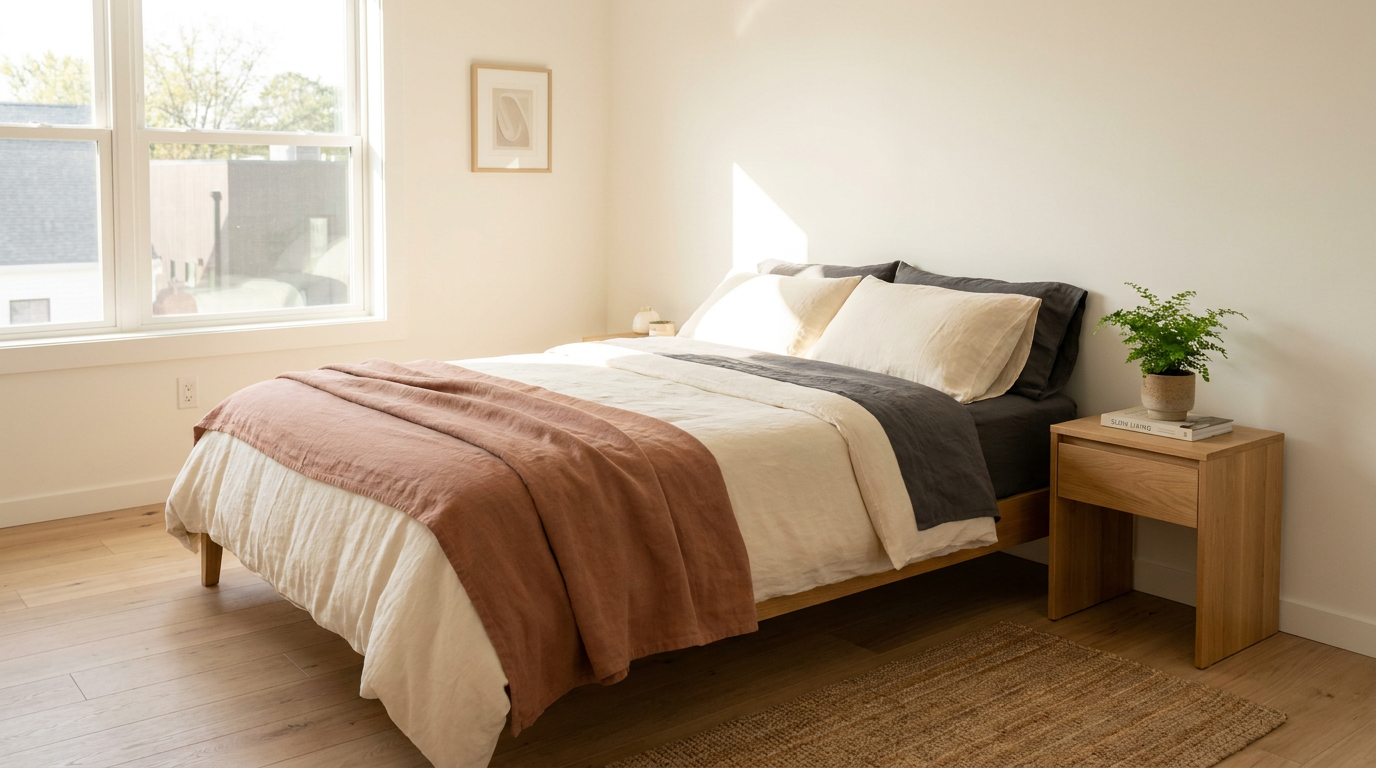
A minimalist bedroom working at its best: three-value palette, one natural element, clean bed as the structural anchor.
4. Treat Empty Space as a Design Material
Professional designers call negative space “the white canvas of the room”—but for most homeowners it triggers anxiety rather than confidence. The instinct to fill a shelf, add a lamp, or hang another print is strong. Resisting it is the single hardest skill in minimalist bedroom design, and also the most important.
The practical guideline is the 1-in-3 rule for flat surfaces: any shelf, tabletop, or ledge should have at least one-third of its surface completely clear. This applies to nightstands—which most people overload with books, chargers, glasses, and small objects—just as much as it applies to dressers. A nightstand with one lamp, one book, and clear space reads as designed. The same nightstand with seven objects reads as a staging area.
Empty floor space matters even more. The eye interprets open floor between furniture as breathing room for the entire room, not just that corner. Moving a piece of furniture even eight inches from a wall creates the perception of a larger, more intentional space. Interior photographers have documented this repeatedly: rooms that appear generous in images almost always have more floor clearance than the actual square footage would suggest.
5. Lock In a Single Bedding System That Looks Intentional at Every Stage
A minimalist bedroom requires bedding that looks good unmade, half-made, and fully made—because the bed is always visible and perfection takes time. Systems that depend on multiple decorative pillows, precise folds, or a specific arrangement sequence are incompatible with the lifestyle.
The hotel-inspired flat system works best: fitted sheet, flat sheet cuffed over the duvet, one or two pillows, and a throw at the foot. No Euro squares, no decorative scatter cushions. Every element folds or stores neatly, and the bed looks composed in under two minutes. The duvet or comforter should be a single solid color that anchors the three-value palette.
Fit at the foundation level determines whether the system holds. A fitted sheet with a weak elastic or a shallow pocket creates constant visual disruption: bunched corners, visible mattress gaps, and the perpetual re-tucking that minimalism's low-maintenance promise depends on eliminating. The 18-to-21-inch deep pocket plus full-perimeter heavy-duty elastic band in a properly engineered sheet maintains clean tension across all four mattress edges through the night, keeping the base layer visually intact from morning until the next evening.

18-to-21-inch deep pocket + full-perimeter heavy-duty elastic: the engineering that keeps a minimalist bed looking composed all day.
6. Control Lighting at Three Heights
Minimalist bedrooms with a single overhead source always look flat because the light reveals no volume or depth in the surfaces. Layered lighting—ceiling, mid-height (sconce or table lamp), and low or accent—creates the dimensional quality that makes sparse rooms feel rich rather than empty.
The practical three-height formula for a minimalist bedroom: one ambient source at ceiling height (ideally recessed or flush, not a decorative pendant that adds visual mass), one warm table lamp at nightstand height (2700K–3000K color temperature), and one intentional low element—either floor-level uplighting or a candle cluster on a tray. The candles or uplights serve a compositional purpose as much as a functional one: they add warmth and grounding at the base level that balances the ceiling source.
Designers increasingly specify warm-toned LEDs rather than daylight bulbs for bedroom applications—color temperature affects melatonin production directly, and light at 2700K (warm amber) suppresses significantly less melatonin than light at 4000K (cool white) or above. In a minimalist bedroom where lighting is also doing architectural work, choosing the right color temperature is not just an aesthetic decision.
7. Choose One Natural Element and Let It Do All the Work
Every great minimalist bedroom has a single organic or natural material that prevents the space from reading as clinical. Traditionally this is a live plant, but it can also be a branch in a tall vase, an unpolished stone object, a woven basket, or a piece of raw ceramic. The object does not need to be large—in fact, smaller is usually more effective because it creates a point of deliberate contrast without becoming a focal piece.
The rule is one: not three plants on a shelf, not a wood accent wall plus a woven rug plus a rattan basket. One natural element, placed with intentionality, signals that the room's restraint is a choice rather than a default. That distinction is what separates designed minimalism from student-apartment minimalism.
This principle extends to textile materials as well. The ongoing debate between natural fibers and performance textiles in minimalist design has shifted measurably in the last decade. Cotton once held the perceived quality advantage—but its need for ironing, its tendency to pill and yellow, and its performance limitations for warm sleepers have eroded that position in design-conscious circles. Premium double-brushed microfiber has replaced it as the preferred base layer in high-end residential styling for the same reason performance linen replaced raw cotton in window treatments: it looks better longer with less effort, and in a minimalist context, that matters more than fiber origin.
LuxClub's 40+ colorway selection is built to serve exactly this palette-first approach—with muted sage, clay, warm white, and slate grey options that hold their color through 40 high-temperature machine wash cycles. The colors you choose to anchor your three-value palette will not fade into something off-brand after a season of regular washing.
8. Edit Ruthlessly, Then Stop Editing
The final principle is procedural rather than aesthetic: minimalist bedroom design has an endpoint, and recognizing that endpoint is a skill. Most people remove too much and then add back the wrong things in the wrong quantities, cycling between sparse and cluttered without ever landing on intentional.
The designer's test is simple: stand at the doorway and let your eyes travel around the room. If the eye completes a natural circuit—moving from the bed to the window to the wall to the nightstand and back—the room is working. If the eye catches or snags on any object, surface, or gap, that is a signal, not a starting point for accumulation. The question is not “what should I add here?” but “what is pulling the eye?”
Bedding that performs consistently—that looks the same on day one and day forty, that holds its color and its surface texture through the wash cycle—removes one of the most common visual disruptions in this test. When the bed is always the compositional anchor it was designed to be, the editing process focuses on everything around it rather than the bedding itself.
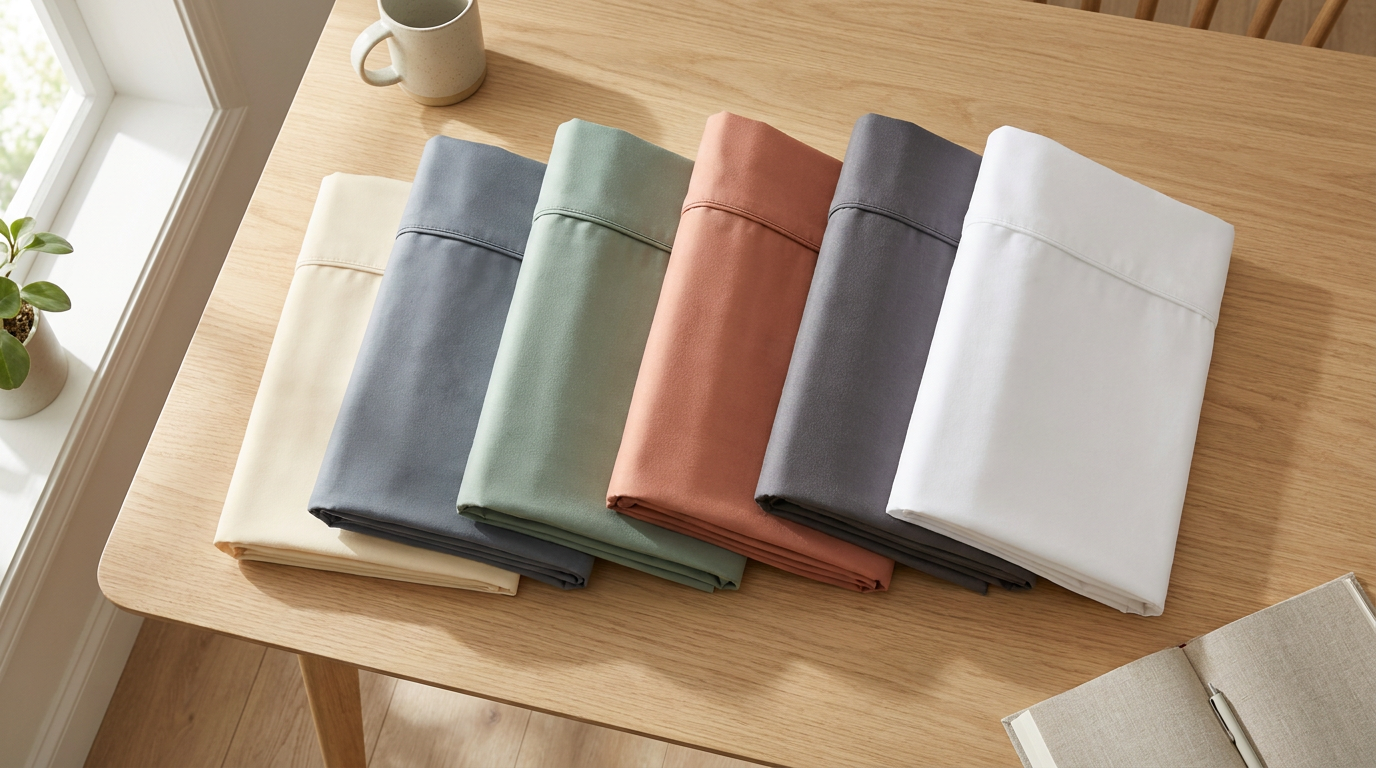
40+ colorways built for the minimalist palette—tested through 40 high-temperature wash cycles with no fading.
FAQ
Q1: What are the most important minimalist bedroom ideas to start with?
Begin with the bed as the structural anchor—it occupies the most visual real estate in the room and sets the register for every other design decision. Choose bedding in a single solid color that anchors your three-value palette, and ensure the fitted sheet has a deep enough pocket to stay taut on your mattress. From there, reduce nightstand objects to three or fewer, clear at least one-third of any shelf surface, and let natural light do the work of a second design layer. Premium double-brushed microfiber bedding is the most practical starting point because its wrinkle-resistant surface maintains the crisp bed line a minimalist room depends on without daily ironing.
Q2: How do I make a minimalist bedroom look expensive without spending a lot?
The single highest-leverage change is replacing low-quality bedding with a high-performance sheet set in a deliberate color. In a minimalist room with few objects, the bed surface occupies the dominant visual field—if the sheets look inexpensive, pill-prone, or perpetually rumpled, the entire room reads as unfinished regardless of other investments. Double-brushed microfiber bedding at the mid-price tier outperforms most premium cotton sets on wrinkle resistance, color fastness, and long-term surface quality, which are the three variables that determine whether a bed looks expensive after three months rather than just on day one.
Q3: What colors work best for a minimalist bedroom in 2026?
The 2026 palette direction centers on tonal warmth—warm whites, soft clay, muted sage green, and warm grey. These shades share similar saturation levels but differ in value (lightness), creating depth without pattern or contrast. Avoid cool-toned whites and bright stark neutrals, which read as clinical rather than serene. For bedding specifically, choose a mid-value anchor—sage, clay, or slate—as your 30% secondary tone against warmer white walls, with one darker accent piece completing the three-value structure. LuxClub offers all of these in colorways tested for 40-wash fade resistance, so the palette holds through every season.
Q4: Can minimalist bedrooms still feel cozy?
Yes—and the key is texture contrast rather than object accumulation. A minimalist bedroom that uses smooth bedding against a matte wall, a fine-woven sheet against a chunky knit throw, and a sleek lamp against a rough ceramic base achieves warmth through material differentiation rather than visual clutter. The most common mistake is removing texture along with objects, which produces coldness rather than calm. A double-brushed microfiber fitted sheet—with its silky-smooth, flat-woven surface—creates a natural tactile anchor for the bed that feels warm and inviting without requiring layered decorative elements.
Q5: How many pillows should a minimalist bed have?
Two standard pillows—matching the pillowcases to your sheet set—is the baseline for a minimalist setup. If the bed width allows, one additional lumbar or bolster pillow in a complementary solid color adds compositional depth without crossing into decorative excess. Euro squares are generally incompatible with strict minimalist styling because they add visual height and require a specific arrangement to look intentional. For a king-size bed, two king pillows plus one lumbar creates the correct proportion: the pillow section occupies roughly one-third of the total visible bed height, which is the designer standard for a composed, restrained arrangement.