




Safe Sleep for Babies & Toddlers: The Complete Guide to Nursery Bedding
Every parent wants their baby to sleep safely and soundly. Yet the journey to creating the perfect sleep environment involves far more than picking a cute crib set. From mattress firmness to sheet breathability, the bedding choices you make in a nursery carry genuine safety implications — as well as long-term consequences for the quality of your child's rest. This guide draws on current pediatric research and safe sleep guidelines to help you make confident, well-informed decisions for your little one.
Why Safe Sleep Guidelines Exist — and What They Mean for Bedding
Sudden infant death syndrome (SIDS) remains one of the leading causes of death in infants under one year of age in the United States, accounting for approximately 3,400 sleep-related infant deaths annually.[1] Decades of research have established a clear link between the sleep environment and risk: loose bedding, overly soft sleep surfaces, and overheating are each associated with elevated SIDS risk.[2]
The American Academy of Pediatrics (AAP) recommends that infants sleep on a firm, flat, non-inclined surface in their own sleep space, free of pillows, loose blankets, bumper pads, and soft objects.[3] These guidelines, first introduced in the 1990s and updated most recently in 2022, have contributed to a more than 50% reduction in SIDS rates since their inception.[1] Understanding the "why" behind each rule makes it far easier to apply them consistently.
Choosing the Right Fitted Sheet: Safety Comes First
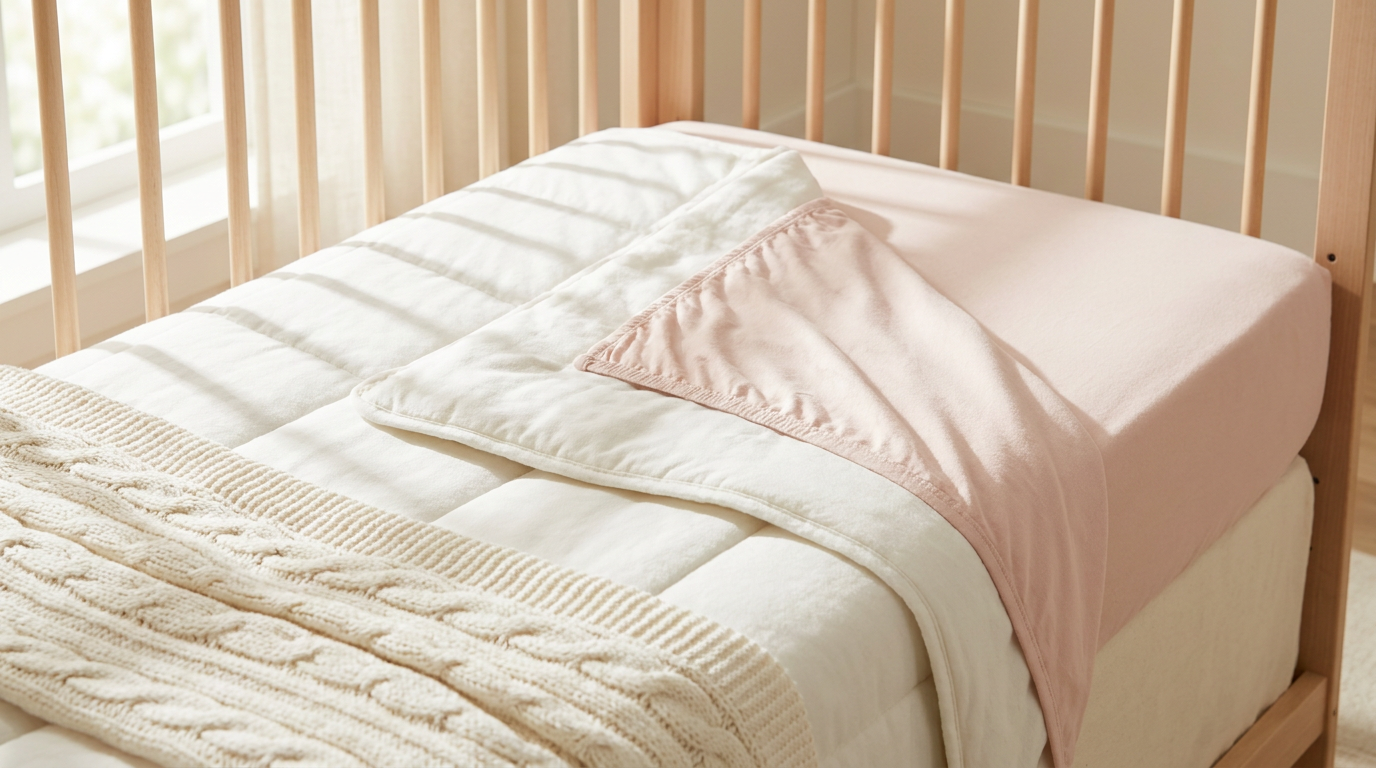
The fitted crib sheet is one of the few bedding items the AAP does permit in the sleep environment — but only if it meets strict criteria. A safe fitted sheet must:
- Fit snugly over the mattress without any loose fabric or bunching.
- Be made from a breathable, lightweight material that does not trap heat.
- Stay securely in place without shifting, which could create a suffocation hazard.[3]
Thread count matters less than material composition for infants. High-thread-count percale cotton is a popular choice because it is both breathable and durable. Organic cotton — certified to GOTS (Global Organic Textile Standard) standards — is especially worth considering, as it is grown and processed without the synthetic pesticides or chemical finishes that may irritate a newborn's sensitive skin.[4] Bamboo-derived fabrics (viscose or lyocell from bamboo) are another option valued for their natural moisture-wicking properties, which can help regulate a baby's body temperature during sleep.
Temperature Regulation: The Hidden Safety Factor
Overheating during sleep is an independent risk factor for SIDS.[2] Infants are far less capable than adults of regulating their own body temperature, making the thermal properties of their bedding environment critical. The AAP recommends keeping the nursery between 68–72°F (20–22°C), and advises dressing babies in no more than one additional layer than an adult would wear comfortably in the same room.[3]
Sleep sacks (wearable blankets) have largely replaced loose blankets as the preferred solution for keeping infants warm without introducing loose fabric into the sleep space. Research published in JAMA Pediatrics found that sleep sacks were not associated with an increased risk of unintentional injury and reduced the likelihood of caregivers covering infants with loose bedding during the night.[5] For toddlers who have transitioned out of the crib around 18–24 months, a lightweight knit blanket becomes appropriate — but still benefits from being made of breathable, temperature-regulating fabric.
Material Safety: What to Look for (and What to Avoid)
When selecting any bedding item that will be in contact with a child's sleep environment, material safety goes beyond softness. Consider the following:
Certifications to look for:
- OEKO-TEX Standard 100 — tests for over 100 harmful substances including formaldehyde, heavy metals, and certain dyes, confirming the fabric is safe for skin contact.[6]
- GOTS (Global Organic Textile Standard) — covers the entire supply chain from raw fiber to finished product for organic textiles.
- GREENGUARD Gold — used primarily for mattresses and hard goods, but indicates low chemical emissions.
Materials to approach with caution:
- Fleece and synthetic polyester pile fabrics can trap heat, potentially contributing to overheating.
- Heavily treated "wrinkle-free" or "stain-resistant" sheets may use chemical finishes (such as formaldehyde-based resins) that are not ideal for infant skin contact.[6]
- Synthetic waterproofing layers that cover the entire sheet surface (rather than a mattress protector underneath) can reduce breathability.
Worth noting: LuxClub's bamboo sheet sets carry OEKO-TEX certification, making them a reference point when evaluating whether a sheet's chemical safety profile meets infant-safe standards — even as they are designed with all-ages use in mind.
Transitioning to a Toddler Bed: Updated Bedding Rules
Most children transition from a crib to a toddler bed or low bed between 18 months and 3 years of age, often prompted by climbing out of the crib. This transition also marks a shift in safe sleep guidelines. By 12 months, the risk of SIDS declines substantially, and the most stringent restrictions around loose bedding become less critical.[7]
For toddlers, age-appropriate bedding considerations include:
- Size and fit: Toddler beds use crib mattresses; fitted sheets should still fit snugly. Twin-size sheets on a crib mattress are a common and preventable safety hazard.
- Pillow readiness: The AAP notes that small, flat pillows designed for toddlers may be introduced after age 2, though many pediatricians suggest waiting until 18–24 months at minimum.[7]
- Lightweight blankets: A single, lightweight blanket appropriate for room temperature is suitable. Heavy comforters or quilts remain unnecessary and can cause overheating.
- Durability for washability: Toddlers are hard on bedding. Fabrics that maintain their integrity through frequent hot washing — at least 60°C/140°F to eliminate dust mites — are strongly preferred.[8]
Allergy and Skin Sensitivity Considerations
Children with eczema, allergies, or sensitive skin benefit from bedding that minimizes exposure to common irritants. House dust mites — microscopic organisms that thrive in bedding — are among the most prevalent triggers of childhood asthma and allergic rhinitis.[8] The American College of Allergy, Asthma & Immunology recommends washing all bedding in hot water weekly and using allergen-barrier covers on mattresses and pillows for sensitized children.[8]
Natural fiber sheets that can withstand regular high-temperature washing without pilling or degrading are a practical investment for allergy-prone households. Tightly woven fabrics with a high thread count are also less hospitable to dust mite colonization than loosely woven alternatives.
Practical Checklist: Safe Sleep Bedding at Every Stage
Newborn to 12 months:
- ✓ Firm, flat mattress with a properly fitted sheet — nothing else in the sleep space.
- ✓ Breathable, OEKO-TEX or GOTS certified sheet fabric.
- ✓ Sleep sack in place of any loose blanket.
- ✓ Room temperature maintained at 68–72°F.
- ✓ No bumper pads, pillows, positioners, or stuffed animals in the crib.
12 to 24 months (transition period):
- ✓ Continue sleep sack use if the child tolerates it.
- ✓ If transitioning to a blanket, choose a lightweight, breathable option.
- ✓ Still no pillow until 18–24 months minimum.
Toddler (2–5 years):
- ✓ Age-appropriate pillow — small, flat, and washable.
- ✓ Single lightweight blanket; avoid heavy comforters.
- ✓ Wash all bedding weekly in hot water (60°C/140°F) for allergy prevention.
- ✓ Replace sheets showing signs of wear (pilling, thinning) — worn fabric loses structural integrity and breathability.
Conclusion
Creating a safe sleep environment for a baby or toddler is one of the most impactful things a parent or caregiver can do. The research is consistent: a firm, uncluttered sleep surface with properly fitted, breathable bedding dramatically reduces sleep-related risk in infancy — and sets the foundation for healthy sleep habits that persist into childhood. As children grow, the rules evolve, but the core principle remains the same: choose bedding that is safe, breathable, and easy to keep clean.
Sleep science continues to reinforce what parents instinctively feel — that the details of the sleep environment matter. If you're reviewing your child's sleep setup and want a starting point for certified, breathable fabric options, it might be worth exploring what's available across the bedding category. We've found that looking for OEKO-TEX certified natural fiber sheets — such as those in LuxClub's bamboo collection — provides a useful quality benchmark when evaluating whether a product meets the breathability and material safety standards worth applying to a child's sleep space.
References
- Moon RY, Carlin RF, Hand I; AAP Task Force on Sudden Infant Death Syndrome. "Sleep-Related Infant Deaths: Updated 2022 Recommendations for Reducing Infant Deaths in the Sleep Environment." Pediatrics. 2022;150(1):e2022057990.
- Hauck FR, Tanabe KO. "International Trends in Sudden Infant Death Syndrome: Stabilization of Rates Requires Further Action." Pediatrics. 2008;122(3):660–666.
- American Academy of Pediatrics. "Safe Sleep." AAP Policy Statement, 2022. Available at: https://www.aap.org/safesleep
- Global Organic Textile Standard (GOTS). "GOTS Version 7.0." GOTS, 2023. Available at: https://global-standard.org
- Wilson CA, Taylor BJ, Laing RM, et al. "Clothing and Bedding and Its Relevance to Sudden Infant Death Syndrome: Further Results from the New Zealand Cot Death Study." Journal of Paediatrics and Child Health. 1994;30(6):506–512.
- OEKO-TEX Association. "OEKO-TEX Standard 100." OEKO-TEX, 2024. Available at: https://www.oeko-tex.com/en/our-standards/oeko-tex-standard-100
- American Academy of Pediatrics. "Toddler Sleep." HealthyChildren.org, 2023. Available at: https://www.healthychildren.org
- American College of Allergy, Asthma & Immunology. "Dust Mite Allergy." ACAAI, 2023. Available at: https://acaai.org/allergies/allergens/dust-mite-allergy