



Safe Sleep for Babies and Children: The Complete Bedding Safety Guide for Parents
Introduction
Choosing bedding for a baby or young child is one of the most consequential purchasing decisions a parent makes — yet it is also one of the most confusing. Retail shelves and online marketplaces are filled with beautifully presented crib sets, soft bumpers, decorative pillows, and plush comforters designed to appeal to parents’ instincts toward softness and comfort. Many of these products are directly contraindicated by pediatric safety guidelines. The gap between what looks safe and what is safe is wide, and the stakes are serious: the Centers for Disease Control and Prevention (CDC) reports that approximately 3,500 infants die annually in the United States from sleep-related causes, with the majority attributable to unsafe sleep environments.[1]
This guide translates the current evidence base — led by the American Academy of Pediatrics (AAP), the Consumer Product Safety Commission (CPSC), and peer-reviewed pediatric sleep research — into clear, actionable bedding decisions for every developmental stage from newborn through school age. Safety is the foundation; quality and comfort build from there.
1. The ABCs of Infant Safe Sleep: What the Evidence Requires
The AAP’s safe sleep guidelines, most recently updated in 2022, center on a single mnemonic that captures the non-negotiable baseline: Alone, Back, Crib.[2]
- Alone: Infants should sleep alone in their own sleep surface, without bed-sharing. Room-sharing (the infant’s crib or bassinet in the parents’ room) is recommended for at least the first 6 months and ideally the first year. Room-sharing without bed-sharing reduces the risk of SIDS by up to 50%.[2]
- Back: Every sleep, every time, on the back. The back-sleeping recommendation, introduced broadly in 1994 through the AAP’s “Back to Sleep” campaign (now “Safe to Sleep®”), has been associated with a 50% reduction in SIDS rates in the decades since its adoption.[3]
- Crib: A firm, flat, safety-standard-approved sleep surface — a crib, bassinet, or play yard meeting CPSC standards. The surface must be firm: a soft mattress allows the infant’s face to sink and create a rebreathing pocket of exhaled CO₂, which is a primary mechanism in positional asphyxia.[1]
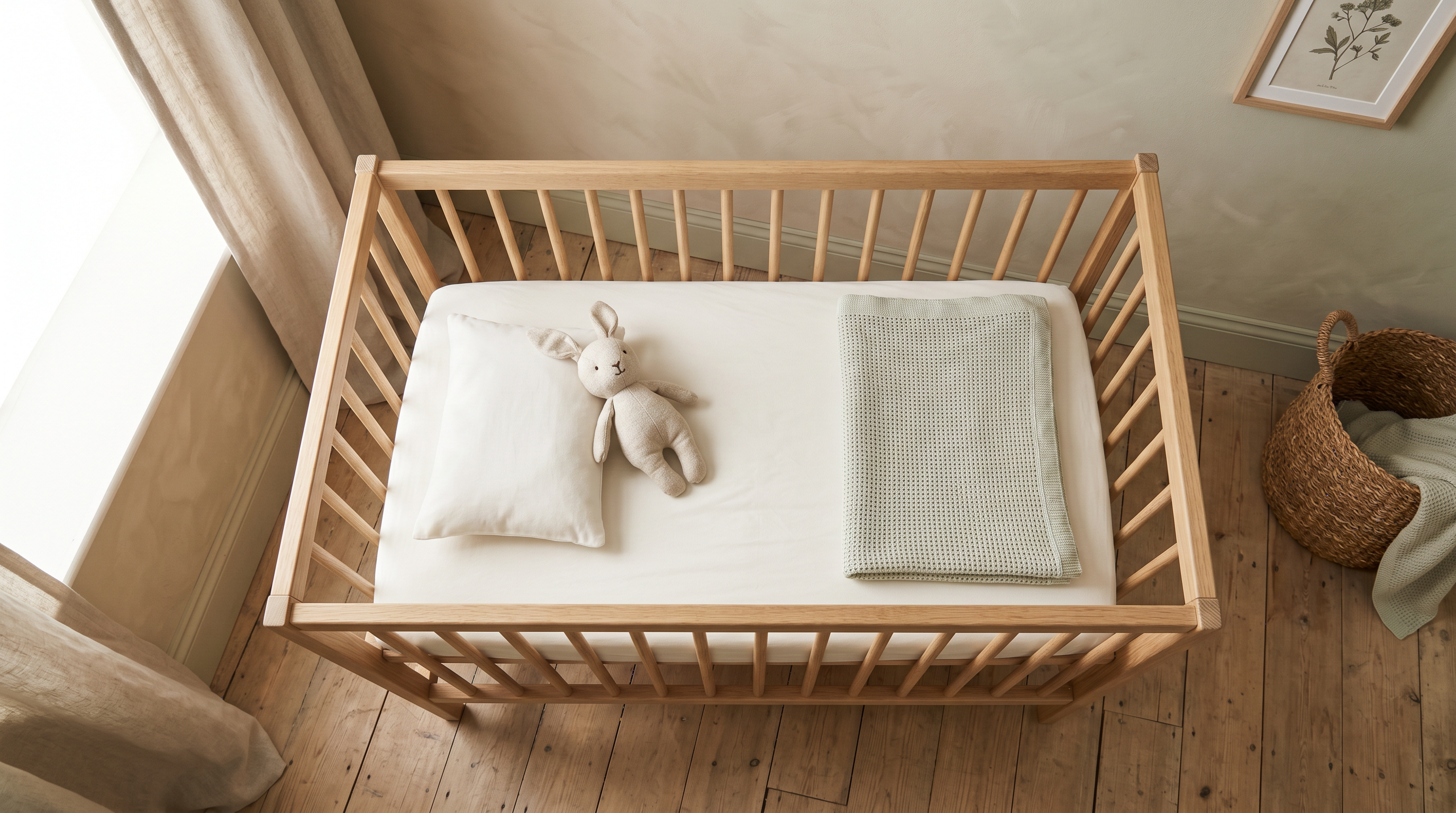
The AAP further specifies that the sleep surface should be completely bare for infants: no pillows, no loose blankets, no bumper pads, no stuffed animals, no positioners. This guidance is absolute for newborns through the first 12 months and remains strongly recommended through 18 months.[2]
2. Infant Bedding: What Belongs in the Crib (and What Does Not)
The Only Required Bedding Item: A Fitted Sheet
For infants under 12 months, the complete bedding specification is a single item: a firm-fitting crib sheet that conforms exactly to the mattress with no excess fabric. Loose-fitting sheets can pull free and bunch around the infant’s face during sleep. The CPSC mandates that crib mattresses meet ASTM F2933 firmness standards; fitted sheets for those mattresses must meet ASTM F1917 to ensure proper elastic tension.[4]
Fabric Recommendations for Infant Sheets
Given the proximity of the sheet to an infant’s skin for 14–16 hours per day, fabric selection carries genuine health implications:[5]
- GOTS-certified organic cotton is the gold-standard recommendation from pediatric dermatologists. Conventional cotton agriculture uses approximately 16% of the world’s insecticides; residual pesticide traces on non-organic cotton fabric are a documented skin irritant for neonates whose skin barrier is 30% thinner and more permeable than adult skin.[5]
- OEKO-TEX® Standard 100 certified fabrics (any fiber, including bamboo lyocell or conventional cotton) have been tested for 100+ potentially harmful substances and meet stringent limits appropriate for baby products (Class I certification, the strictest tier).[6]
- Avoid: Polyester microfiber (thermal retention, chemical finishing agents), flame-retardant-treated fabrics unless the retardant is non-chemical (e.g., inherently flame-resistant wool or modacrylic), and any fabric with added fragrance or antimicrobial chemical treatments.
Temperature Management Without Loose Blankets
Without a blanket, how does an infant stay warm enough? The answer is wearable sleep clothing — specifically, a sleep sack (wearable blanket) or footed sleeper rated to the ambient room temperature. The Lullaby Trust (UK) and AAP both recommend room temperature for infant sleep between 16–20°C (61–68°F) and using a 1 TOG sleep sack at the higher end of this range, a 2.5 TOG at the lower end.[7] Sleep sacks eliminate the loose-blanket asphyxia risk entirely while providing appropriate thermal comfort.
3. Transitioning to Toddler Bedding: Ages 1–3
The transition from infant safe sleep to toddler bedding is not a single event but a gradual progression tied to developmental milestones, not calendar age. The AAP notes that most children can safely use a thin blanket from approximately 12 months, when motor control is sufficient to self-reposition if the face becomes covered.[2] However, this transition should be made conservatively: continue room monitoring, use only lightweight blankets initially, and avoid pillows until the child transitions to a toddler or full-size bed (typically 18–24 months or later).
Toddler Bed Transition Checklist
- Mattress: A toddler mattress should still be firm — slightly less so than a crib mattress, but not the plush-top mattresses marketed to adults. ASTM F1917 fitted sheet standards still apply.
- First blanket: Lightweight, cellular-weave cotton (the open mesh construction allows air circulation even if the face is briefly covered) or a thin quilted cotton blanket. Maximum fill weight of 200 gsm at this age.
- First pillow: A low-loft (2–3 inches), firm toddler pillow — not an adult pillow. Adult pillows are too large and too soft for toddler neck anatomy and present suffocation risk in younger toddlers.[3]
- Stuffed animals: One or two small stuffed animals are acceptable from 12 months. Remove decorative pillows, large plush items, and bumper pads entirely.
4. School-Age Children’s Bedding: 3 Years and Beyond
From age 3 onward, the acute safety risks of infancy have passed and bedding selection shifts toward comfort, allergen management, and sleep quality. However, several safety and health considerations remain relevant:
Allergen Management
Childhood asthma affects approximately 6 million children in the United States, and house dust mite allergen (Der p 1) exposure in the sleep environment is the primary indoor trigger for atopic disease onset in genetically predisposed children.[8] Evidence-based strategies for children’s bedding allergen control:
- Encase mattress and pillow in dust-mite-barrier covers with pore size ≤6 microns (the size of Der p 1 allergen particles). A Cochrane Review found mattress encasings reduced detectable allergen levels by 98% compared to uncovered surfaces.[8]
- Wash all bedding weekly at 60°C — the temperature at which dust mites are reliably eliminated.
- Choose washable pillow and comforter fills (synthetic down alternative, bamboo, or cotton) over natural down, which harbors mold spores and resists thorough washing.
Size and Proportionality
Children’s bedding should be sized to the bed, not borrowed from the adult linen closet. An adult queen fitted sheet on a twin bed creates excess fabric that can bunch and create entanglement risks, particularly for active sleepers. Most children sleep adequately on twin or full-sized beds with appropriately fitted sheets through adolescence.
Fabric Comfort and Durability
Children’s bedding endures significantly higher wash frequency than adult bedding — illness episodes, night sweats, and accidents demand weekly or more frequent laundering. Long-staple cotton percale, which softens with every wash and maintains structural integrity through 200+ wash cycles, delivers better long-term value than lower-cost synthetic alternatives that degrade within 30–50 washes.[6]
5. Certifications to Look for When Buying Children’s Bedding
The bedding market is dense with vague safety claims. These certifications are independently verified and carry specific meaning:
- GOTS (Global Organic Textile Standard): Certifies that at least 95% of fiber content is certified organic and that processing chemicals meet strict environmental and health limits. The only globally credible organic textile certification.
- OEKO-TEX® Standard 100, Class I: The strictest OEKO-TEX tier, specifically designed for products in direct contact with baby skin. Tests for 100+ harmful substances including pesticide residues, formaldehyde, heavy metals, and allergenic dyes.
- GREENGUARD Gold: Certifies low chemical emissions from finished products — particularly relevant for mattresses, mattress protectors, and waterproofing layers.
- ASTM F1917 / CPSC standards: Structural and dimensional compliance for crib sheets and sleep surfaces. Required by US federal law for items marketed as infant bedding.
Your Children’s Bedding Safety Checklist
Infants (0–12 months)
- ✅ Firm, flat, CPSC-approved sleep surface only — no soft mattress toppers.
- ✅ One ASTM-compliant fitted sheet, snugly fitted. Nothing else in the crib.
- ✅ Choose GOTS organic cotton or OEKO-TEX® Class I certified sheets.
- ✅ Use a TOG-rated sleep sack instead of any loose blanket.
- ✅ Maintain room temperature at 16–20°C (61–68°F).
- ✅ No bumpers, pillows, positioners, or stuffed animals under 12 months.
Toddlers (12–36 months)
- ✅ Introduce a single lightweight blanket (≤200 gsm) from 12 months.
- ✅ Add a low-loft, firm toddler pillow (2–3 inches) when transitioning to a toddler bed.
- ✅ One or two small stuffed animals are acceptable; remove all oversized soft items.
- ✅ Continue using OEKO-TEX® or GOTS certified fabrics nearest to skin.
School Age (3+ years)
- ✅ Encase mattress and pillow in allergen-barrier covers (≤6 micron pore size).
- ✅ Wash all bedding weekly at 60°C for dust-mite control.
- ✅ Use appropriately sized sheets for the bed — avoid adult-size sheets on smaller beds.
- ✅ Choose long-staple cotton or bamboo lyocell for durability across high wash frequency.
Conclusion
Children’s bedding safety is not about choosing the softest or the prettiest product in the category — it is about matching developmental stage to evidence-based guidelines, and backing every product choice with verified safety certification. The AAP’s bare-crib standard for infants is absolute and supported by decades of SIDS reduction data.[2][3] From toddlerhood onward, the goal shifts to allergen management, appropriate sizing, and the durable, chemically clean fabrics that support healthy skin and genuine sleep quality through the years of childhood growth. Every choice made at the point of purchase compounds across thousands of nights. Make them with the evidence in hand.
References
- Centers for Disease Control and Prevention. (2023). Sudden Unexpected Infant Death and Sudden Infant Death Syndrome. cdc.gov.
- Moon, R. Y. & AAP Task Force on Sudden Infant Death Syndrome. (2022). Safe sleep and healthy sleep environments. Pediatrics, 150(1), e2022057990.
- Willinger, M. et al. (1998). Factors associated with the transition to nonprone sleep positions of infants in the United States: The national infant sleep position study. JAMA, 280(4), 329–335.
- Consumer Product Safety Commission. (2022). ASTM F1917: Standard Consumer Safety Specification for Soft-Sided Infant and Toddler Products. cpsc.gov.
- Fluhr, J. W. et al. (2010). Skin barrier function in the newborn. Pediatric Dermatology, 27(4), 337–343.
- OEKO-TEX® Association. (2023). OEKO-TEX® Standard 100 Certification Criteria. oeko-tex.com.
- The Lullaby Trust. (2023). Safe Sleep Guidance for Parents. lullabytrust.org.uk.
- Gotzsche, P. C. & Johansen, H. K. (2008). House dust mite control measures for asthma: Systematic review. Allergy, 63(6), 646–659.