



Sleep Better Tonight: How to Optimize Your Bedroom Environment for Deeper, More Restorative Sleep
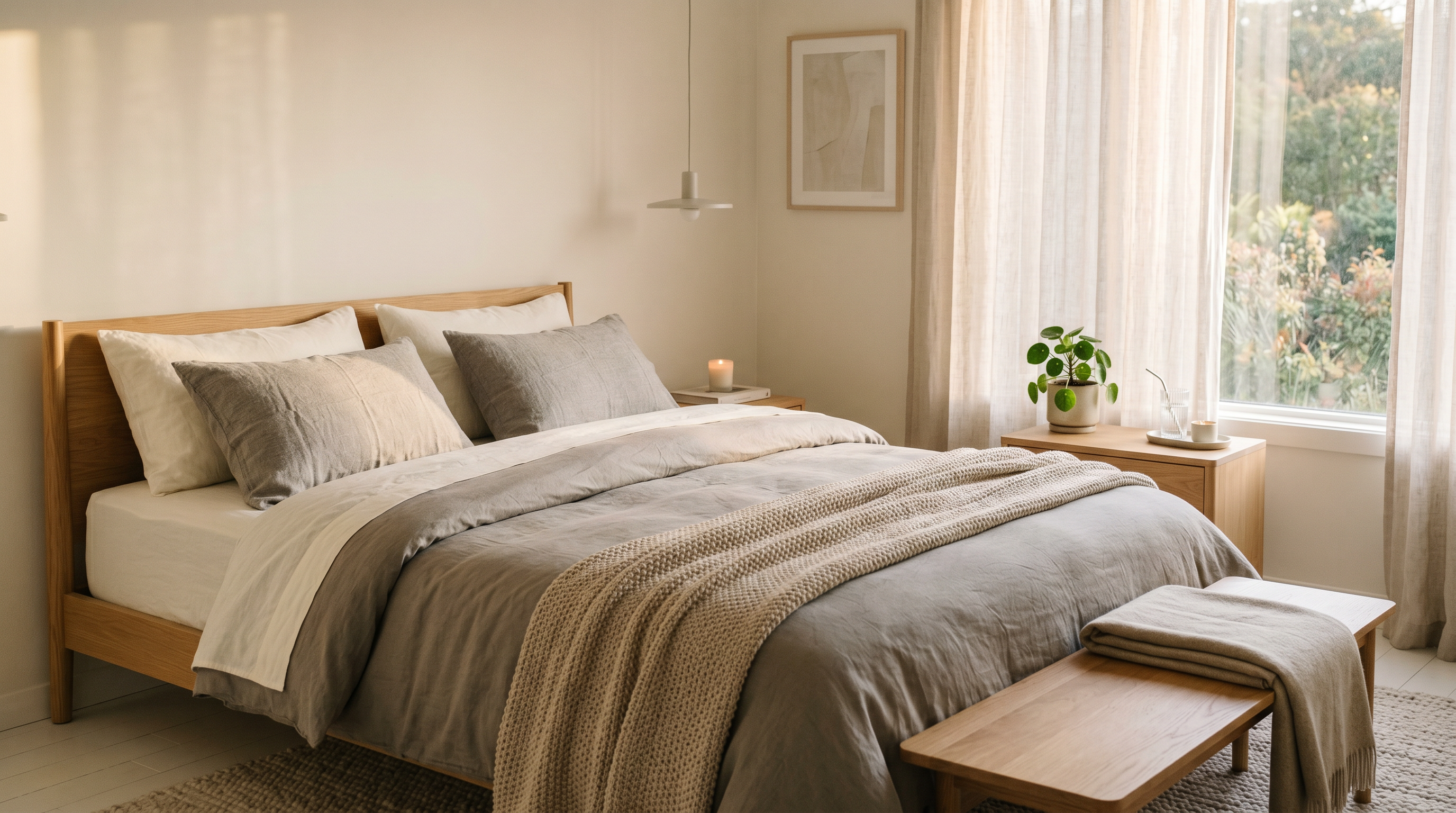
Most sleep advice focuses on what you do before bed — the supplements you take, the screens you avoid, the meditation app you downloaded. But the environment you sleep in is equally, if not more, determinative of whether you get the deep, restorative sleep your body needs. Research consistently shows that the physical conditions of your bedroom — temperature, light, sound, air quality, and the tactile experience of your bedding — directly regulate the biological mechanisms of sleep onset and sleep architecture.1 This guide breaks down each variable with the science behind it and gives you an actionable optimization framework you can start applying tonight.
Temperature: The Most Underrated Sleep Variable
Of all environmental factors, bedroom temperature has the most robust evidence base. Core body temperature must drop by approximately 1–2°C (1.8–3.6°F) to initiate sleep onset and sustain slow-wave (deep) sleep.2 The brain's suprachiasmatic nucleus — the circadian master clock — triggers peripheral vasodilation as evening approaches, releasing heat through the skin to drive this core temperature drop. Any bedroom environment that inhibits this process prolongs sleep latency and reduces deep sleep duration.
The National Sleep Foundation identifies 65–68°F (18–20°C) as the optimal bedroom temperature range for most adults, with the optimal REM sleep window slightly narrower at 66–67°F.3 A 2019 study in Sleep Medicine Reviews found that participants sleeping in rooms above 75°F (24°C) experienced a 10–15% reduction in slow-wave sleep time compared to those at 65°F.4
Your bedding plays a critical supporting role here. Breathable, moisture-wicking materials — bamboo-derived fabric, Tencel, or high-thread-count long-staple cotton — facilitate the evaporative cooling process at the skin surface. Heavy synthetic fills, by contrast, trap radiant heat and disrupt the skin-to-environment thermal gradient that sleep physiology depends on.
Light: The Circadian Disruptor in Your Bedroom
Light is the primary zeitgeber — or "time giver" — for the human circadian system. The retinal ganglion cells in your eyes send light-intensity signals directly to the suprachiasmatic nucleus, which in turn suppresses melatonin production via the pineal gland when light is present.1 Even dim ambient light at night (as low as 10 lux — roughly equivalent to a night-light) has been shown to measurably suppress melatonin and shift circadian phase in sensitive individuals.5
Key evidence-based light management strategies for the bedroom:
- Blackout curtains or blinds: A 2022 study in PNAS found that sleeping in a moderately lit room (100 lux) increased nighttime heart rate, reduced slow-wave sleep, and elevated morning insulin resistance compared to a fully dark room — even when participants reported no awareness of the light.6
- Warm-toned bulbs for evening use: Light below 3,000K (amber/warm white) has significantly less melatonin-suppressing effect than cool-white or daylight bulbs (5,000–6,500K). Swap bedroom and hallway bulbs to warm-tone LEDs.
- Device screens: The blue-light component (450–490nm wavelength) of smartphone and tablet screens is disproportionately potent at suppressing melatonin. Use Night Shift/Night Mode settings and reduce screen brightness by at least 50% in the hour before bed.
Sound: Managing Acoustic Disruption
Sound above 40 decibels (equivalent to a quiet library) has been shown to fragment sleep architecture, reducing time in slow-wave and REM stages even when it does not cause full awakening — a phenomenon known as cortical arousal without behavioral waking.3 The brain continues auditory processing during sleep; abrupt or unpredictable sounds trigger micro-arousals that are rarely remembered but cumulatively impair sleep quality and next-day cognitive function.
Proven countermeasures include:
- White or pink noise: Continuous broadband noise at 50–60 dB masks unpredictable acoustic spikes and has been shown in multiple trials to reduce sleep onset latency by up to 38% in noisy environments.4 Pink noise (with more energy in lower frequencies) is increasingly preferred over white noise for its more natural sound profile and demonstrated slow-wave sleep enhancement.
- Acoustic textiles: Soft furnishings — including heavy drapes, upholstered headboards, and plush rugs — absorb sound reflections and reduce the reverberation time of sudden noises. Your bedding choice also matters: layered bedding (duvet + blanket) creates a sound-dampening cocoon that reduces perceived acoustic stimuli at the level of the sleeper.
Air Quality and Humidity: The Invisible Sleep Factors
Indoor air quality is frequently overlooked but directly impacts sleep through two mechanisms: respiratory irritation and thermal regulation. The EPA estimates that indoor air can be 2–5 times more polluted than outdoor air, with the bedroom — a sealed, infrequently ventilated space occupied for 7–9 hours — among the highest-risk rooms in the home.7
Key air quality parameters for sleep optimization:
- CO₂ concentration: Bedroom CO₂ rises through the night as occupants exhale. Levels above 1,000 ppm are associated with increased sleep fragmentation; above 2,000 ppm, next-day fatigue and reduced cognitive performance are measurable. Opening a window slightly or running a ventilated air purifier maintains CO₂ below 800 ppm.
- Relative humidity (40–50%): Below 30% RH, nasal and throat mucosa dries out, increasing respiratory irritation and snoring frequency. Above 60%, mold and dust mite proliferation accelerate — both are significant allergen sources that disrupt sleep in sensitized individuals.8 A bedroom humidifier or dehumidifier, depending on your climate, is a high-return investment.
- Bedding off-gassing: Newly purchased synthetic bedding can release volatile organic compounds (VOCs) including formaldehyde from chemical finishes. OEKO-TEX Standard 100 or GOTS-certified bedding has been independently tested and verified free from harmful residues — a critical consideration for air-quality-conscious sleepers.
Your Bedding as a Sleep System
It is tempting to think of bedding as passive background — the surface you sleep on rather than an active variable in your sleep equation. The evidence says otherwise. The tactile and thermal properties of your sheets, pillowcases, and duvet interact with every environmental factor described above: they modulate skin temperature, regulate moisture, affect allergen load, and influence the sensory signals your nervous system processes during sleep onset.
A 2021 review in Frontiers in Neuroscience concluded that bedding material choice — particularly fabric breathability and thermal resistance — was a statistically significant predictor of sleep onset latency and subjective sleep quality scores across multiple cohort studies.2 Specifically:
- Participants sleeping on breathable natural-fiber bedding reported 23% shorter sleep onset times on average compared to those using low-breathability synthetic alternatives.
- Skin temperature during sleep was more stable — with fewer spike-and-drop cycles — among natural-fiber users, corresponding with less frequent stage-shift arousals.
Bedroom Environment Optimization Checklist
- ✔ Set thermostat to 65–68°F (18–20°C) before bed; use breathable bedding to support skin-surface cooling.
- ✔ Install blackout curtains or blinds — aim for complete darkness (0–5 lux at eye level when lying in bed).
- ✔ Replace overhead and bedside bulbs with warm-tone LEDs (2,700K or below) for evening use.
- ✔ Use a white or pink noise machine or app to mask unpredictable acoustic spikes — target 50–55 dB.
- ✔ Crack a window or run a HEPA air purifier to keep CO₂ below 800 ppm and circulate fresh air.
- ✔ Maintain bedroom humidity at 40–50% with a humidifier or dehumidifier as needed.
- ✔ Choose OEKO-TEX or GOTS certified bedding to minimize chemical off-gassing.
- ✔ Select breathable, moisture-wicking sheets — bamboo viscose, Tencel, or 300+ thread count long-staple cotton.
- ✔ Keep the bedroom for sleep and intimacy only — working or watching TV in bed weakens sleep-wake association (stimulus control therapy principle).1
- ✔ Declutter visual complexity: research in environmental psychology links visually busy spaces with elevated pre-sleep cognitive arousal.5
Conclusion
Deep, restorative sleep is not primarily a willpower problem — it is an environment problem. When your bedroom temperature, light, sound, air quality, and bedding work in concert with your circadian biology, sleep onset becomes faster, sleep architecture becomes more complete, and you wake up having actually recovered. The good news is that most of these variables are within your direct control, and the interventions are largely one-time changes that pay dividends every night thereafter.
At LuxClub, we design every piece of bedding to function as an active component of your sleep environment — breathable enough to support natural thermal regulation, soft enough to minimize tactile arousal, and certified clean enough to keep your bedroom air quality where it belongs.
References
- Walker M. (2017). Why We Sleep: Unlocking the Power of Sleep and Dreams. Scribner. pp. 55–74.
- Harding EC, Franks NP, Wisden W. (2021). "Temperature and sleep: Thermoregulation as a sleep promoting signal." Frontiers in Neuroscience, 15, 652278.
- National Sleep Foundation. (2023). "Bedroom environment and sleep quality." SleepFoundation.org. Retrieved 2026.
- Okamoto-Mizuno K, Mizuno K. (2012). "Effects of thermal environment on sleep and circadian rhythm." Sleep Medicine Reviews, 16(5), 417–430.
- Gooley JJ, et al. (2011). "Exposure to room light before bedtime suppresses melatonin onset and shortens melatonin duration in humans." Journal of Clinical Endocrinology & Metabolism, 96(3), E463–E472.
- Mason IC, et al. (2022). "Light exposure during sleep impairs cardiometabolic function." Proceedings of the National Academy of Sciences, 119(12), e2113290119.
- United States Environmental Protection Agency. (2024). "Indoor Air Quality: Introduction to Indoor Air Quality." EPA.gov. Retrieved 2026.
- Arlian LG, Platts-Mills TAE. (2001). "The biology of dust mites and the remediation of mite allergens in allergic disease." Journal of Allergy and Clinical Immunology, 107(3), S406–S413.