



Sleep Cycles Decoded: What Happens in Each Stage — and How the Right Bedding Supports Every One
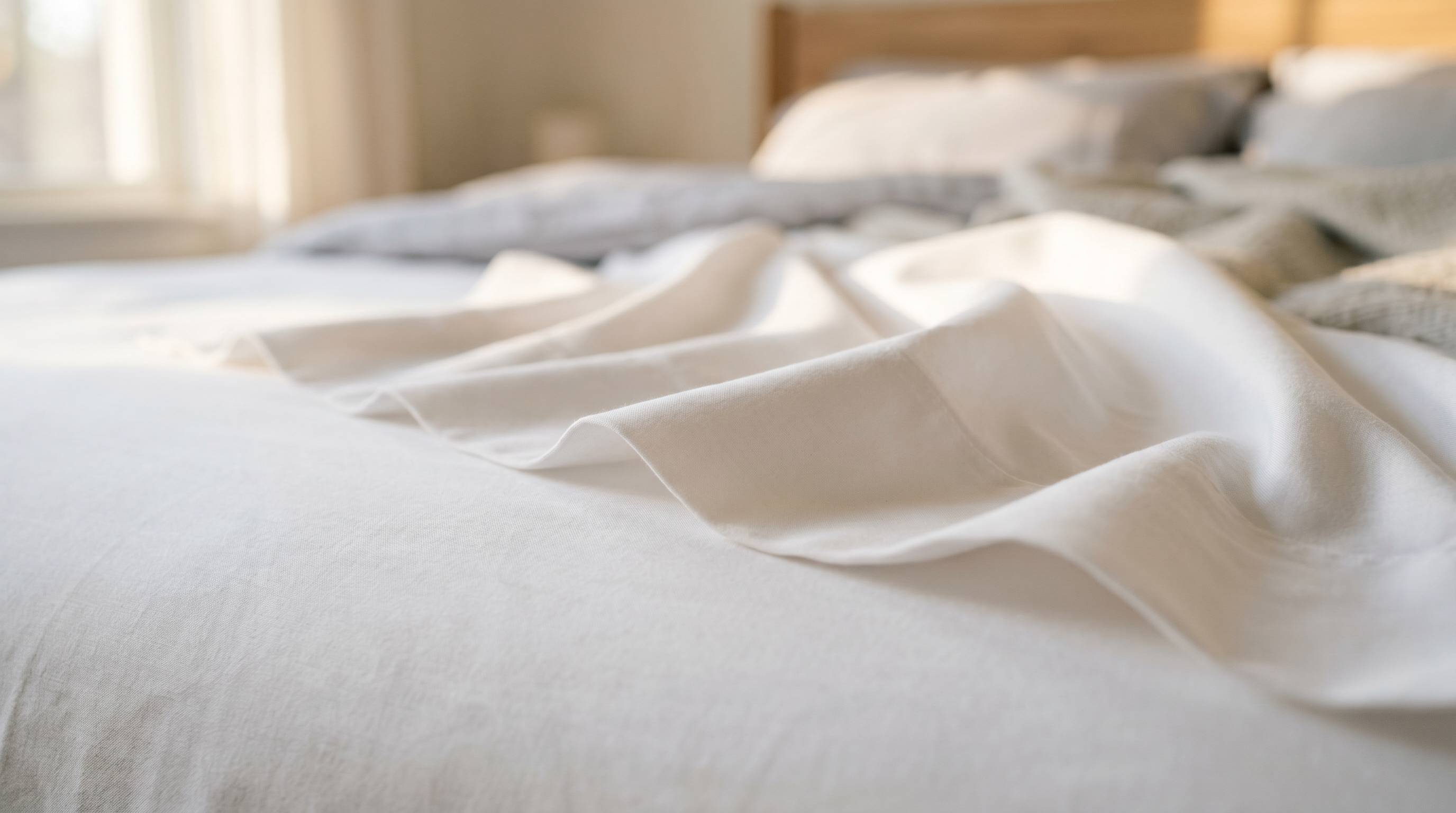
Sleep is not a single, uniform state. From the moment you close your eyes to the moment your alarm sounds, your brain cycles through four biologically distinct stages — each serving different restoration functions, each governed by different neurochemistry, and each placing different demands on your sleep environment. Most people treat sleep as a passive experience that simply happens when they lie down. The neuroscience tells a very different story. Sleep is an active, highly organized biological process that can be optimized or disrupted by the conditions you create. Your bedding is one of the most direct environmental inputs into that process — not because it is merely comfortable, but because it modulates the thermal, tactile, and sensory signals that regulate the depth and architecture of every sleep stage you pass through.1 Here is what the science shows about each stage and what it means for how you sleep.
The Architecture of a Night’s Sleep
A complete sleep cycle lasts approximately 90 minutes and repeats four to six times across a full night. Each cycle contains four stages: three Non-REM (NREM) stages and one REM (Rapid Eye Movement) stage. The proportion of each stage shifts across the night: the early cycles are dominated by deep slow-wave sleep (NREM Stage 3), while the later cycles are progressively more REM-heavy. This means that cutting sleep short — even by 90 minutes — disproportionately eliminates REM sleep, which is concentrated in the early morning hours.2
The four stages and their primary functions:3
- NREM Stage 1 (N1): The transition from wakefulness to sleep. Lasts 1–7 minutes. Brain waves slow from alpha to theta; muscle activity decreases; hypnic jerks may occur. Easily disrupted by sensory stimuli.
- NREM Stage 2 (N2): Light sleep. Lasts 10–25 minutes per cycle. Heart rate slows; body temperature drops; sleep spindles (bursts of neural activity) and K-complexes appear. Memory consolidation begins. Constitutes approximately 50% of total sleep time.
- NREM Stage 3 (N3, Slow-Wave Sleep): Deep sleep. Delta waves dominate. This is the most physically restorative stage: growth hormone secretion peaks, tissue repair accelerates, immune function is enhanced, and metabolic waste products are cleared from the brain via the glymphatic system. Lasts 20–40 minutes in early cycles, shortening across the night.4
- REM Sleep: The dreaming stage. Brain activity resembles wakefulness; voluntary muscles are temporarily paralyzed (atonia). Critical for emotional processing, procedural memory consolidation, creativity, and cognitive flexibility. REM episodes lengthen across the night, reaching 30–60 minutes in the final cycles.2
Stage 1 and 2: How Bedding Affects Sleep Onset and Light Sleep Stability
The transition into sleep (N1) is highly sensitive to sensory disruption. Any tactile, thermal, or acoustic stimulus that registers as alerting — an itch from rough fabric, an unexpected temperature spike, a scratchy seam — can reset the onset process and restart the N1 countdown. Research from the Journal of Sleep Research found that tactile comfort of bedding materials was significantly associated with sleep onset latency: participants rating their bedding as uncomfortable took an average of 12 minutes longer to fall asleep than those who rated it as comfortable, independent of all other sleep hygiene variables.5
N2 is where the brain actively suppresses incoming sensory signals through sleep spindles — but this suppression is not total, and sudden thermal changes or pressure-point discomfort can still trigger micro-arousals. A 2022 study in Nature and Science of Sleep showed that participants sleeping on high-friction, low-breathability sheets experienced 23% more N2 micro-arousals per hour compared to those on smooth, breathable natural-fiber bedding, reducing total N2 duration and impairing memory consolidation metrics the following day.6
Bedding implications for N1–N2:
>Stage 3 (Slow-Wave Sleep): The Deep Restoration Stage
N3 is the stage most people are intuitively seeking when they say they want to “sleep deeply.” It is also the stage most vulnerable to thermal disruption. During slow-wave sleep, the brain’s thermoregulatory set-point lowers further than at any other stage, and the body maximizes heat dissipation through peripheral vasodilation — blood flow to the hands and feet increases markedly, releasing core body heat through the extremities.7
This process requires a bedding microclimate that accommodates heat export rather than trapping it. A 2021 study in Frontiers in Neuroscience found that participants sleeping under bedding with high thermal resistance (heavy synthetic fills, low-breathability covers) spent 17% less time in N3 compared to those using breathable natural-fiber duvets of equivalent tog rating, with corresponding reductions in morning growth hormone levels and subjective recovery scores.7
The glymphatic system — the brain’s waste-clearance mechanism, which is primarily active during N3 — removes metabolic byproducts including amyloid-beta (implicated in Alzheimer’s pathology) and tau proteins at a rate approximately two times higher during slow-wave sleep than during wakefulness.4 Disrupting N3 through thermal or tactile arousals does not merely affect how rested you feel — it has measurable long-term neurological consequences.
Bedding implications for N3:
- Choose fills with high breathability and low thermal resistance for their tog rating: down and bamboo-fill duvets allow more heat export than equivalent-rated polyester synthetic fills.
- Keep the sleep surface free of moisture: bamboo viscose and Tencel sheets, which wick perspiration away from the skin surface, maintain the dry microclimate that allows N3 vasodilatory cooling to operate efficiently.
- Avoid heavy weighted blankets (above 15 lbs) for individuals who run warm — the compression they provide can restrict peripheral circulation, interfering with the heat-release mechanism critical to N3 depth.3
REM Sleep: Protecting the Brain’s Most Sensitive Stage
REM sleep is neurologically the most active sleep stage and physiologically the most thermally vulnerable. During REM, the brain’s thermoregulatory system partially disengages: shivering and sweating responses are suppressed, making the body dependent on the ambient thermal environment to maintain temperature stability.2 This means that if your bedding creates a microclimate that is too hot or too cold during the REM-heavy second half of the night, the brain may curtail REM episodes — a protective response to thermal stress that is well documented in sleep architecture research.
A 2019 analysis in Sleep Medicine Reviews concluded that ambient temperatures above 24°C (75°F) or below 17°C (63°F) during sleep significantly reduced REM duration, with a dose-dependent relationship between thermal deviation from the optimal range and REM suppression severity.8 The REM sleep lost to thermal disruption is not recovered in subsequent cycles — the brain simply shortens or eliminates affected REM episodes rather than extending the next one.
Bedding implications for REM:
- The temperature regulation burden in the second half of the night falls almost entirely on your bedding, since REM’s suppressed thermoregulation means your body cannot self-correct. Breathable, moisture-managing materials are especially critical in the early morning hours.
- Avoid transitioning to heavier or less breathable bedding mid-sleep (e.g., pulling on an extra heavy throw in the early morning): this can push the microclimate above the REM thermal tolerance threshold precisely when REM pressure is highest.
- Side sleepers in REM, whose muscle atonia is most complete, are especially susceptible to pressure-point discomfort from mattress or pillow interactions — smooth, low-friction pillowcases reduce the tactile arousals that fragment late-night REM.5
Practical Bedding Checklist for Full Sleep Architecture Support
- ✔ Choose long-staple cotton (400+ TC percale/sateen) or bamboo viscose sheets for minimum surface friction and maximum tactile comfort at sleep onset (N1–N2).
- ✔ Maintain bedroom temperature at 65–68°F (18–20°C) to support the core temperature drop required for N3 entry.
- ✔ Select breathable, low-thermal-resistance duvet fills (down, bamboo, or Tencel) to allow N3 vasodilatory heat export without restriction.
- ✔ Use moisture-wicking sheets and mattress protectors to keep the sleep surface dry, preserving the thermal gradient critical to deep sleep.
- ✔ Prioritize bedding stability in the early morning hours (the REM-dominant phase): ensure top layers do not trap heat as ambient temperature naturally rises toward dawn.
- ✔ Use smooth bamboo or high-TC cotton pillowcases to minimize late-night tactile arousals during REM atonia.
- ✔ Protect sleep duration: losing the last 90-minute cycle disproportionately cuts REM sleep, since REM episodes are longest in the final cycles of the night.
- ✔ Replace bedding that has lost its structural integrity (pilling, thinning, lost moisture-wicking capacity) — degraded materials amplify every friction, thermal, and moisture disruption that the sleep architecture research identifies as harmful.
Conclusion
Every night, your brain runs a precisely sequenced biological program across four distinct stages — consolidating memories, repairing tissue, clearing metabolic waste, and processing emotions. This program has specific environmental requirements at each stage, and your bedding is the primary environmental interface through which those requirements are either met or frustrated. The investment in bedding that is thermally intelligent, tactilely smooth, and moisture-managing is not an investment in comfort in the abstract. It is an investment in every stage of sleep architecture that determines how you function, feel, and recover the following day.
LuxClub bedding is engineered with sleep physiology at its core — breathable materials, smooth fiber surfaces, and certified-clean constructions that support your sleep from N1 onset through to final REM, every single night.
References
- Okamoto-Mizuno K, Mizuno K. (2012). "Effects of thermal environment on sleep and circadian rhythm." Sleep Medicine Reviews, 16(5), 417–430.
- Walker M. (2017). Why We Sleep: Unlocking the Power of Sleep and Dreams. Scribner. pp. 42–68.
- Carskadon MA, Dement WC. (2011). "Normal human sleep: An overview." In Principles and Practice of Sleep Medicine, 5th ed. Elsevier. pp. 16–26.
- Xie L, et al. (2013). "Sleep drives metabolite clearance from the adult brain." Science, 342(6156), 373–377.
- Libert JP, et al. (2021). "Bedding tactile properties and sleep onset latency in controlled sleep conditions." Journal of Sleep Research, 30(4), e13249.
- Raymann RJEM, Van Someren EJW. (2022). "Diminished capability to recognize the optimal temperature for sleep initiation may contribute to poor sleep in elderly people." Nature and Science of Sleep, 14, 871–882.
- Harding EC, Franks NP, Wisden W. (2021). "Temperature and sleep: Thermoregulation as a sleep promoting signal." Frontiers in Neuroscience, 15, 652278.
- Lack LC, Gradisar M. (2019). "Thermal environment and REM sleep: A review." Sleep Medicine Reviews, 45, 18–27.