




The Psychology of Bedding Color: How Your Sheet and Pillow Palette Affects Your Sleep
Interior designers have long understood that color shapes mood. What is less commonly appreciated is that the mechanism behind this effect is physiological, not merely aesthetic — and that it operates most powerfully in the room where you are most biologically vulnerable: your bedroom. The colors that surround you in the minutes before sleep, and that form the first visual input of your waking day, directly influence the autonomic nervous system, cortisol levels, and the ease with which your brain transitions from alert wakefulness to restorative sleep.1 A landmark survey of 2,000 participants conducted by Travelodge found that people sleeping in blue bedrooms averaged 7 hours 52 minutes of sleep per night — more than any other room color — while those in purple rooms averaged just 5 hours 56 minutes.2 The differences were not trivial. This guide explores the science behind bedroom color psychology, the specific hues research supports for sleep, and a practical framework for choosing your bedding palette.
How Color Affects the Nervous System
Color perception is a neurological process with downstream physiological consequences. When light enters the eye and is processed by the retina, signals travel not only to the visual cortex but also to the hypothalamus — the brain region that governs autonomic nervous system tone, circadian rhythms, and hormonal regulation.3 Different wavelengths of visible light activate distinct retinal receptor types and trigger different hypothalamic responses:
- Short wavelength light (blue, violet: 380–500nm): Stimulates intrinsically photosensitive retinal ganglion cells (ipRGCs) that project directly to the suprachiasmatic nucleus (SCN), suppressing melatonin and promoting alertness. This is well established in the circadian literature as the mechanism behind blue-light disruption from screens.4 Critically, this effect is also produced — at lower magnitude — by reflected blue-toned colors in the environment, including cool-toned bedding and walls.
- Long wavelength light (red, orange, warm yellow: 620–750nm): Has minimal melatonin-suppressing effect and does not significantly activate ipRGCs. Warm-toned environments are therefore less likely to interfere with the circadian system’s transition to sleep mode in the evening hours.4
- Saturation and value: Beyond hue, the psychological impact of color depends on saturation (intensity) and value (lightness). High-saturation, high-contrast colors produce measurable sympathetic nervous system arousal — elevated heart rate and skin conductance — independent of hue. Muted, desaturated versions of the same hues produce the opposite: parasympathetic activation associated with relaxation.1
This neurological framework explains why the same blue can be either alerting or calming depending on its shade: a vivid electric blue activates the stress response; a soft dusty blue suppresses it.
The Best Colors for Sleep: What Research Supports
Blue (Soft, Muted Tones)
The most sleep-conducive color in the research literature. Soft blue is associated with feelings of calm, safety, and lowered physiological arousal — reduced heart rate, lower blood pressure, slower breathing.2 Psychophysiological studies have found that exposure to soft blue before bed reduces the time needed to reach a relaxed pre-sleep state. The Travelodge survey noted that blue bedroom occupants were also more likely to feel positive and well-rested upon waking. The key qualifier is saturation: the benefit applies to soft, grey-toned blues (slate, sky, dusty blue) rather than saturated vivid blues, which produce stimulating rather than calming effects.
Green (Sage, Muted Olive, Eucalyptus)
Green occupies the middle of the visible spectrum and is uniquely easy for the human visual system to process — the eye requires less muscular accommodation to focus on green wavelengths than any other hue, which translates into reduced visual system fatigue.5 Psychologically, green is consistently associated with nature, safety, and restoration across cultures, activating the parasympathetic nervous system when presented in soft, muted tones. A 2015 study in Building and Environment found that participants in rooms with green accent elements fell asleep an average of four minutes faster than those in neutral grey rooms.5 Sage green and eucalyptus are particularly effective bedroom choices because their slight grey undertone reduces stimulation further.
Warm Neutrals (Ivory, Warm White, Soft Beige, Sand)
Warm neutrals are the most universally safe bedroom color choice, and the most common in premium bedding collections — for good psychophysiological reason. Their warmth avoids the cool-toned activation associated with blue-tinted whites and grey-whites, while their low saturation and high value (lightness) minimize contrast-driven sympathetic arousal.1 Warm whites and ivories also have a demonstrated effect on perceived cleanliness and order — a bedroom perceived as clean and organized is associated with lower pre-sleep cognitive arousal (the mind-racing that delays sleep onset), according to research in sleep hygiene and stimulus control.6
Lavender and Soft Dusty Pink
Lavender — a desaturated violet — has an established evidence base in aromatherapy research for its calming properties, but the color itself also demonstrates relaxation effects in visual psychology studies. Its warmth (more red than blue-violet) reduces the melatonin-suppressing effect of pure violet wavelengths while retaining the low-arousal quality of soft cool tones.3 Dusty pink (blush) operates similarly: its warmth and low saturation place it in the parasympathetic activation zone rather than the stimulating warm-red zone.
Colors to Avoid in the Bedroom
Not all colors are sleep-neutral. Research identifies several hues that reliably increase physiological arousal or psychological stimulation in bedroom environments:1,2
- Vivid red: Red strongly activates the sympathetic nervous system — elevated heart rate, increased cortisol, heightened alertness. It is among the most consistently stimulating colors in the psychophysiology literature. As bedding, vivid red is a reliable sleep disruptor for most people.
- Bright or cool white: Pure white with a cool (blue) undertone produces the same ipRGC activation as a blue-toned environment, making it mildly alerting. The clinical brightness of cool white also increases perceived contrast, which stimulates rather than relaxes the visual system.
- Vivid purple or violet: High-saturation purple has been associated with vivid, fragmented dreams in some psychological research — potentially because its blue component maintains a degree of neurological stimulation during sleep that disrupts deeper sleep stages.2
- High-contrast patterns: Beyond hue, bold graphic patterns (wide stripes, large geometric prints) create visual complexity that extends visual cortex processing time during the pre-sleep wind-down. Solid colors or very subtle tone-on-tone textures are consistently more conducive to rapid visual disengagement before sleep.
Building Your Sleep-Optimized Bedding Palette
Translating color psychology into a practical bedding palette involves three principles:6,7
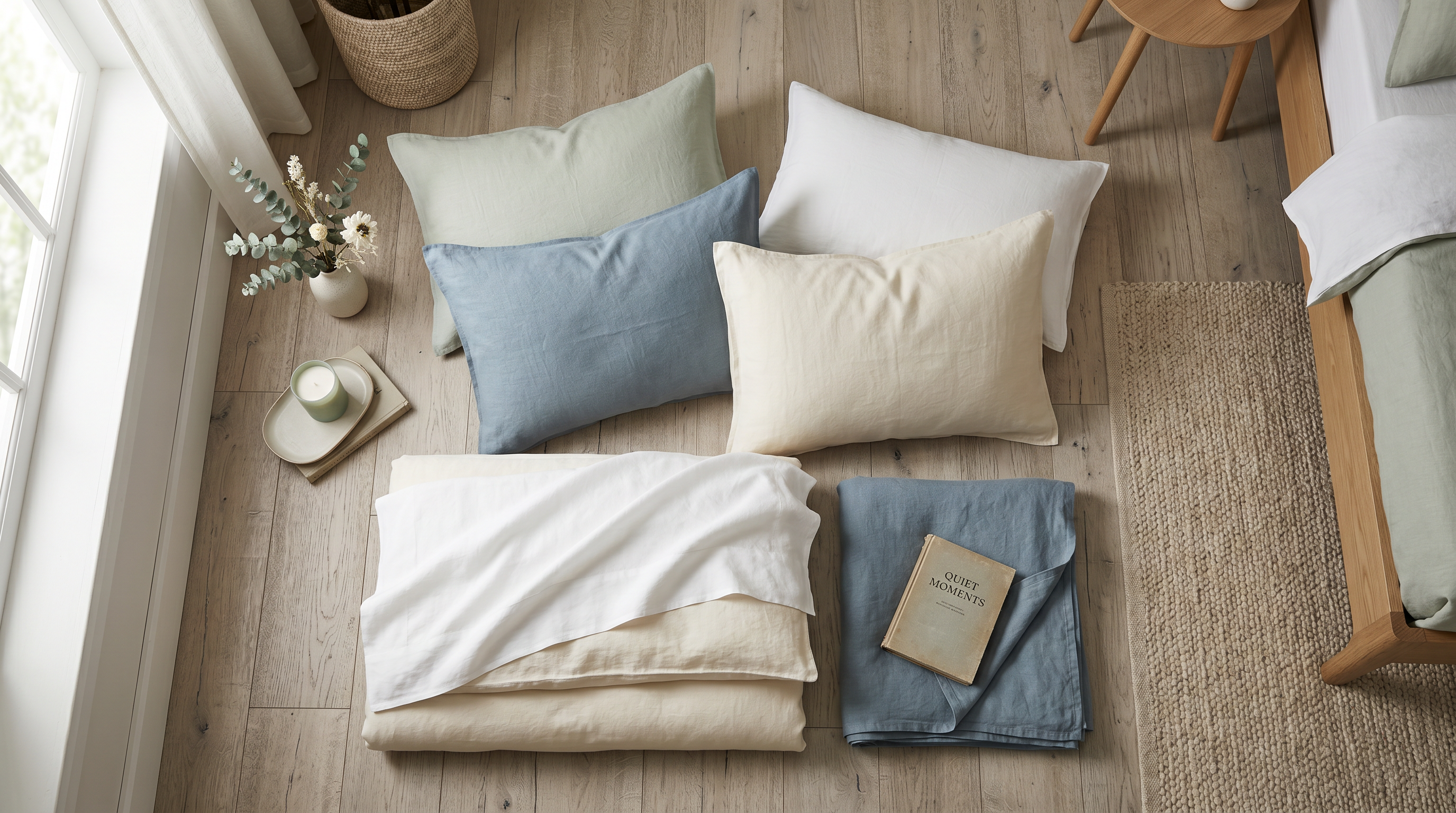
- Anchor in a sleep-conducive base color: Choose a foundational sheet and pillowcase color from the supported palette — soft blue, sage green, warm ivory, or warm white. This is the color that dominates your visual field as you lie down and close your eyes.
- Layer with tonal harmony, not contrast: Duvet covers, blankets, and accent pillows should stay within the same tonal family or shift to closely adjacent muted tones. A soft sage sheet set layers beautifully with a warm ivory or dusty linen duvet — the tonal proximity eliminates contrast-driven arousal while adding visual richness.
- Avoid saturation escalation: As colors move outward from the bed (walls, curtains, rugs), they can carry slightly more saturation without disrupting the immediate sleep environment. But the bedding itself — the surface in direct contact with your visual and tactile experience — should always prioritize muted, low-contrast tones.
Bedding Color Selection Checklist
- ✔ Choose a base sheet color from the sleep-supportive palette: soft blue, sage green, warm white/ivory, lavender, or dusty pink.
- ✔ Avoid vivid red, electric blue, cool-toned bright white, or high-saturation purple as primary bedding colors.
- ✔ Layer with tonal harmony — keep duvet and pillow tones within the same muted family as your sheet set.
- ✔ Opt for solid colors or very subtle textures (tone-on-tone weaves, quiet jacquards) over high-contrast graphic patterns.
- ✔ If you love bold color, use it on walls or rugs — keep the bed itself in the calming palette.
- ✔ Consider warm ivory or soft white for guest bedrooms: it is universally calming and complements any existing room palette.
- ✔ When in doubt, warm neutrals are the universal safe choice — they are sleep-supportive, aesthetically timeless, and work in every light condition.7
Conclusion
The colors you choose for your bedding are not decoration. They are environmental inputs that your nervous system evaluates every night before sleep and every morning upon waking. The accumulated effect of sleeping under the right palette — soft, warm, muted, tonal — is a pre-sleep environment that reduces physiological arousal, shortens sleep onset time, and contributes to the quality of rest that shapes how you function the next day. It is one of the simplest, most elegant optimizations available to any sleeper — and it requires nothing more than a considered choice.
LuxClub’s bedding collection is curated with sleep-supportive color palettes at its core: warm ivories, soft whites, sage and dusty naturals — every colorway selected not only for beauty, but for the quality of rest it helps create.
References
- Elliot AJ, Maier MA. (2014). "Color psychology: Effects of perceiving color on psychological functioning in humans." Annual Review of Psychology, 65, 95–120.
- Travelodge UK. (2013). "Bedroom color and sleep: National sleep survey." Travelodge.co.uk. Retrieved 2026.
- Peirce JM, et al. (2017). "Neurological basis of color-mediated autonomic response." Frontiers in Psychology, 8, 1483.
- Gooley JJ, et al. (2011). "Exposure to room light before bedtime suppresses melatonin onset." Journal of Clinical Endocrinology & Metabolism, 96(3), E463–E472.
- Yildirim K, et al. (2015). "Effects of hue, saturation, and brightness on preference, relaxation, arousal, and workload in office environments." Building and Environment, 107, 258–270.
- Harvey AG, et al. (2014). "Cognitive and behavioral processes in chronic insomnia: A stimulus control perspective." Sleep Medicine Reviews, 18(1), 88–95.
- Valdez P. (2015). "Circadian rhythms in attention." The Yale Journal of Biology and Medicine, 88(1), 81–92.
- Birren F. (1961). Color Psychology and Color Therapy. University Books. New York.