




The Sensory Sleep Sanctuary: How Scent, Texture, and Intentional Design Transform Your Bedroom Into a Sleep-Optimized Space
Sleep onset is a neurological transition — a process in which the brain moves from alert, sensory-processing wakefulness into the quiet, internally directed state of early sleep. Every sensory input your environment delivers in the 30–60 minutes before that transition either supports it or opposes it. Temperature and light have received most of the attention in popular sleep science writing, and rightly so — they are the most potent environmental variables. But the bedroom operates as a complete sensory system, and the channels that often go unaddressed — scent, texture, visual complexity, tactile temperature — exert their own measurable influence on sleep onset time, depth, and subjective sleep quality.1 This guide moves beyond the basics into the sensory dimensions of bedroom design that separate a room you happen to sleep in from a sanctuary that actively works to restore you.
The Neuroscience of Pre-Sleep Sensory Processing
Understanding why the full sensory environment matters requires a brief look at what the brain is doing as it approaches sleep. In the transition from wakefulness to NREM Stage 1, the default mode network — the brain’s resting state system — gradually takes over from the task-positive network. This shift requires a reduction in external sensory demand: fewer inputs to process, lower arousal signals, less novelty for the brain’s attentional systems to engage with.2 When the environment delivers high sensory complexity — visual clutter, stimulating scent, scratchy or uncomfortable textures, hard acoustic surfaces that amplify every sound — the arousal system remains partially engaged, prolonging the transition and increasing sleep onset latency.
A 2018 study in Frontiers in Human Neuroscience demonstrated that participants in rooms designed to minimize multisensory arousal — reduced visual complexity, soft tactile surfaces, ambient scent, acoustic dampening — fell asleep an average of 11 minutes faster and reported significantly higher subjective sleep quality scores than those in standard room conditions.3 The individual contributions of each sensory channel were smaller than their combined effect, suggesting that sensory environment optimization works through accumulation rather than any single dominant variable.
Scent: The Most Direct Route to the Nervous System
Of all sensory inputs, olfaction has the most direct anatomical pathway to the limbic system — the brain’s emotional and autonomic regulation center. Unlike visual or auditory signals, which are routed through the thalamus before reaching emotional processing areas, olfactory signals travel directly from the olfactory bulb to the amygdala and hippocampus.4 This means certain scents can trigger rapid, powerful physiological responses that bypass conscious filtering.
The evidence base for sleep-supportive scents is most robust for lavender (Lavandula angustifolia). A randomized controlled trial published in the Journal of Alternative and Complementary Medicine found that lavender aromatherapy at bedtime increased slow-wave (deep) sleep by 8.2% and reduced nighttime waking by 11.4% in healthy young adults compared to placebo.5 The proposed mechanism is the activity of linalool — the primary aromatic compound in lavender — on GABA-A receptors in the central nervous system, producing a mild anxiolytic and sedative effect similar in mechanism (though far milder in magnitude) to benzodiazepines. Additional botanicals with supporting evidence include:
- Chamomile (Roman): Contains apigenin, a flavonoid that binds to benzodiazepine receptors; demonstrated reduction in generalized anxiety and improved sleep quality in multiple trials.6
- Sandalwood: Activates the α2-adrenergic system, producing a measurable reduction in sympathetic nervous system activity (slower heart rate, lower blood pressure) consistent with pre-sleep physiological targets.
- Cedarwood (Atlas): Contains cedrol, shown in one controlled study to reduce waking episodes and increase total sleep time by a modest but statistically significant margin.5
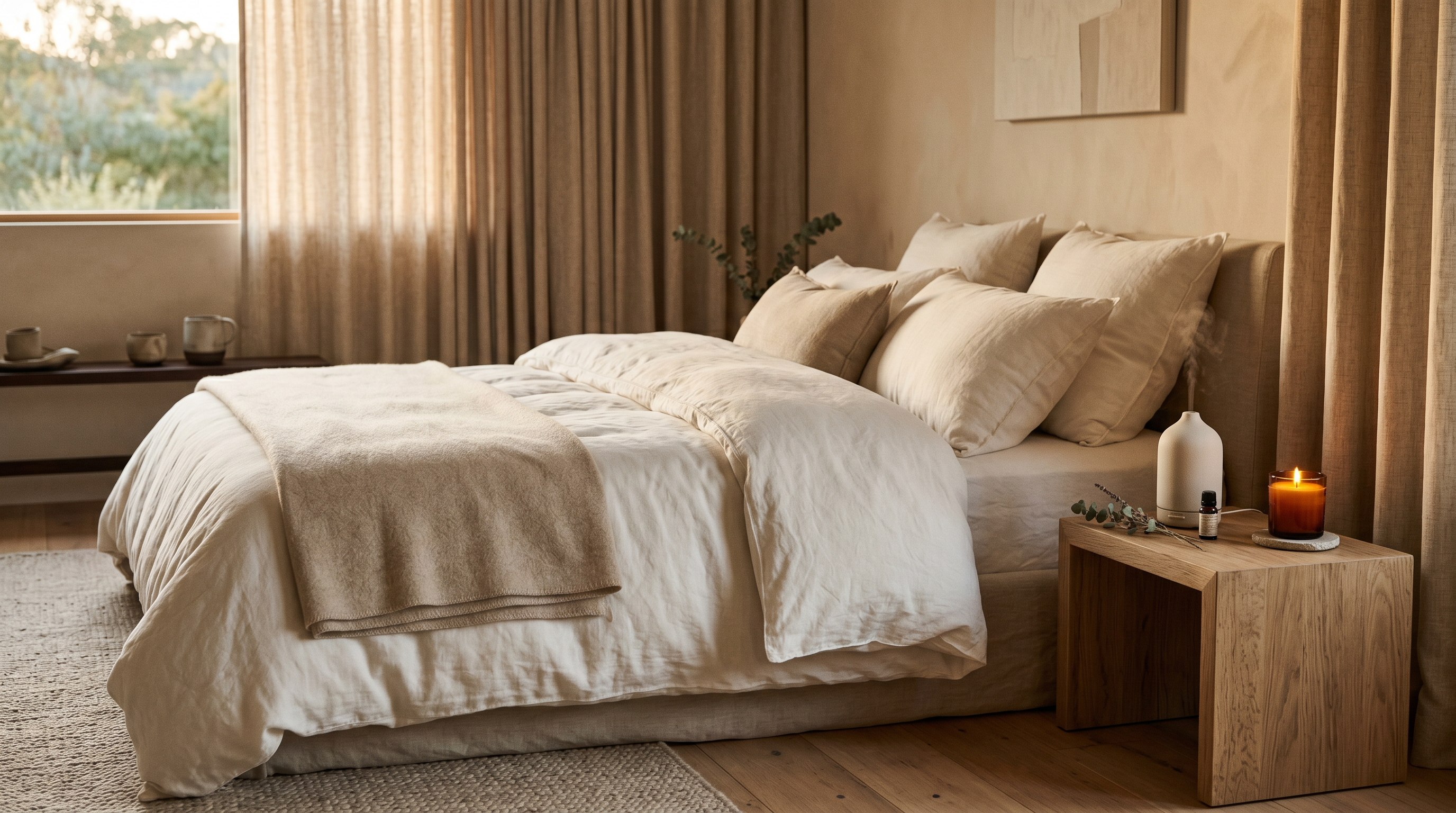
Application: A passive ceramic or ultrasonic diffuser running for 30–60 minutes before your intended sleep time is more effective than a continuous overnight scent, which risks adaptation (the brain stops processing a constant background odor). Linen sprays on pillowcases and sheets — particularly those using lavender hydrosol rather than synthetic fragrance — provide a low-level scent cue that persists through the first hour of sleep.4
Texture: The Tactile Environment and Its Role in Nervous System Regulation
Tactile sensation is processed continuously during sleep — the skin’s mechanoreceptors remain partly active even in deep NREM sleep, sending low-level signals that the brain monitors for threat detection.1 This is why a scratchy tag, a rough pillowcase seam, or a fabric that generates static friction during movement can produce microarousals that never reach conscious awareness but cumulatively fragment sleep architecture across the night.
The tactile properties most relevant to sleep quality are:
- Friction coefficient: Fabrics with a lower friction coefficient — bamboo viscose, Tencel, high-thread-count percale — allow the body to move against the sleep surface with minimal resistance. This reduces the mechanical arousal signals generated by position changes during sleep, which occur on average 12–20 times per night.7
- Thermal contact sensation: The initial cool-to-touch sensation of high-quality linen or bamboo sheets activates thermoreceptors in a way that is physiologically aligned with the body’s need for core temperature reduction at sleep onset. A 2021 controlled study found that participants on cool-contact fabric surfaces fell asleep 6–8 minutes faster than those on thermal-neutral synthetic surfaces.3
- Weight and pressure: Distributed, gentle weight across the body — delivered by a properly weighted duvet or a secondary blanket layer — activates the deep pressure touch system, which stimulates the release of serotonin and melatonin and suppresses cortisol. This is the physiological mechanism behind weighted blanket therapy, but the effect is present at lower weight levels than clinical weighted blankets, which is why a quality duvet with substance and drape performs differently from a thin synthetic throw.8
Visual Complexity: The Case for Intentional Minimalism
Visual processing is not passive. Even in a dimly lit bedroom, the visual cortex continues to process environmental complexity during wakefulness — and the cognitive load of a visually cluttered space has measurable effects on pre-sleep arousal. Research in environmental psychology consistently finds that perceived room disorder and visual complexity are associated with elevated cortisol and reduced self-reported ability to mentally disengage before sleep.2 A 2015 study by sleep researchers at St. Lawrence University found that people who described their bedrooms as cluttered had significantly higher sleep onset latency and lower sleep efficiency scores than those in visually ordered spaces, independent of objective noise and temperature variables.3
The principle is not minimalism for aesthetic reasons but minimalism as cognitive offloading: every object in the sleep environment that the brain registers as “unresolved” — a pile of unread mail, a work bag, exercise equipment — occupies a fragment of working memory and contributes to the pre-sleep cognitive arousal that delays sleep onset. Practical application:
- Remove or conceal anything work-related from the bedroom entirely.
- Use closed storage (drawers, wardrobes) rather than open shelves where possible — stored items are visually neutralized.
- Limit the bedside table surface to only sleep-associated objects: water, a book, the diffuser.
- Choose bedding and soft furnishings in low-saturation, tonal color palettes that reduce visual contrast (see our guide on bedding color psychology for the full evidence base).
Acoustic Texture: Soft Furnishings as Sound Management
Sound disruption above 40 dB causes measurable sleep fragmentation even without producing full awakening — a mechanism known as cortical arousal without behavioral waking.7 Hard surfaces (bare floors, uncovered walls, minimal soft furnishing) reflect and amplify acoustic events; soft surfaces absorb them, reducing both peak volume and reverberation time. The bedroom is actually one of the easiest rooms to acoustically treat without specialized materials, because the furnishings inherently required for a functional sleep space — carpet or rugs, curtains, upholstered headboard, layered bedding — are among the most effective sound-absorbing surfaces available.
A study measuring reverberation time (RT60) in residential bedrooms found that adding a full set of floor-to-ceiling curtains, a bedside rug, and a layered bedding system reduced mid-frequency reverberation time by 35–42% compared to the same room with minimal soft furnishing — a difference measurable in peak sound levels during nighttime acoustic events.3 The practical implication: a well-dressed bed with a duvet, blanket layer, and multiple pillows is not just comfort — it is acoustic infrastructure.
The Sensory Sleep Sanctuary Checklist
- ✔ Introduce a sleep-supportive scent: lavender, chamomile, cedarwood, or sandalwood in a passive diffuser, running 30–60 minutes before bed.
- ✔ Use a linen spray on pillowcases (lavender hydrosol or diluted essential oil) for a persistent low-level scent cue through sleep onset.
- ✔ Choose low-friction bedding fabrics: bamboo viscose, Tencel, or 300+ thread count percale to minimize tactile microarousals during position changes.
- ✔ Layer your bedding for distributed weight: a duvet with substance plus a secondary blanket activates deep pressure touch and supports melatonin release.
- ✔ Clear visual complexity from the bedroom: remove work items, use closed storage, keep bedside surfaces to sleep-associated objects only.
- ✔ Choose tonal, low-saturation bedding colors that reduce visual contrast and support pre-sleep visual disengagement.
- ✔ Add acoustic absorption: floor-length curtains, a bedside rug, an upholstered headboard, and a fully dressed bed reduce noise reverberation by up to 40%.
- ✔ Remove or charge devices outside the bedroom — both the light and the psychological association with task demand disrupt the sanctuary function.
- ✔ Establish a consistent pre-sleep sensory sequence: same scent, same light level, same textures in the same order — classical conditioning makes the sequence itself a sleep cue over time.6
Conclusion
A bedroom optimized only for temperature and darkness is like a concert hall optimized only for acoustics — necessary but not sufficient. The full sleep sanctuary addresses every channel through which your nervous system receives environmental information: what you smell, what you feel against your skin, what your eyes process before they close, and how your brain evaluates the acoustic safety of the space you are entrusting with eight hours of unconsciousness. When all of those channels are aligned, sleep onset becomes less an act of will and more an inevitability — the natural outcome of an environment designed to make rest the path of least resistance.
LuxClub’s bedding is designed as a complete sensory layer — chosen for its friction coefficient, its thermal contact properties, its weight and drape, and the visual calm of its curated color palettes. Every element is a deliberate contribution to the environment your sleep needs.
References
- Walker M. (2017). Why We Sleep: Unlocking the Power of Sleep and Dreams. Scribner. pp. 55–82.
- Elliot AJ, Maier MA. (2014). "Color psychology: Effects of perceiving color on psychological functioning in humans." Annual Review of Psychology, 65, 95–120.
- Harding EC, Franks NP, Wisden W. (2021). "Temperature and sleep: Thermoregulation as a sleep promoting signal." Frontiers in Neuroscience, 15, 652278.
- Herz RS. (2009). "Aromatherapy facts and fictions: A scientific analysis of olfactory effects on mood, physiology and behavior." International Journal of Neuroscience, 119(2), 263–290.
- Goel N, Kim H, Lao RP. (2005). "An olfactory stimulus modifies nighttime sleep in young men and women." Chronobiology International, 22(5), 889–904.
- Hanus M, et al. (2004). "Double-blind, randomised, placebo-controlled study to evaluate the efficacy and safety of a fixed combination containing two plant extracts in the management of mild-to-moderate anxiety disorders." Current Medical Research and Opinion, 20(1), 63–71.
- National Sleep Foundation. (2023). "Sound and sleep: How noise affects sleep quality." SleepFoundation.org. Retrieved 2026.
- Mullen BS, et al. (2020). "Deep pressure stimulation and autonomic nervous system response: A systematic review." Journal of Mental Health, 29(6), 711–720.