



Touch, Texture & the Nervous System: How the Feel of Your Bedding Shapes Your Sleep
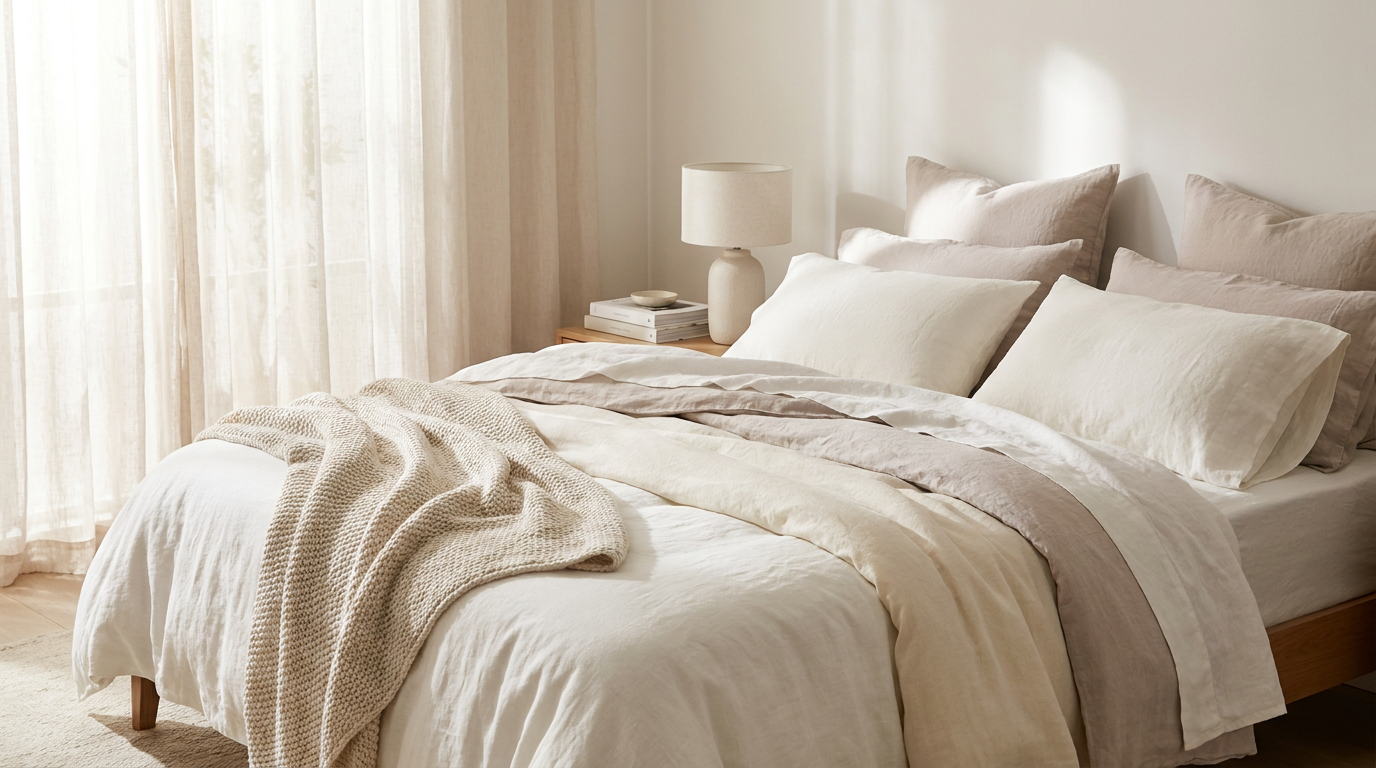
You've probably experienced it: you slip into a freshly made bed, feel the cool, smooth fabric against your skin, and your whole body seems to exhale. That sensation isn't just comfort — it's biology. Emerging research in sleep science reveals that the physical feel of your bedding plays a measurable role in how quickly your nervous system downshifts into a state ready for deep, restorative sleep. Yet most conversations about bedding focus on fill power, thread count, or material origin, while largely ignoring the tactile channel through which your body actually experiences sleep. This article explores the neuroscience behind bedding comfort and what it means for the choices you make in your bedroom.[1]
The Skin as a Sleep Gateway: Tactile Receptors and the Brain
Your skin is the body's largest sensory organ, housing millions of specialized receptors that relay information about pressure, temperature, and texture to the central nervous system. Among these, the C-tactile (CT) afferents — a class of unmyelinated nerve fibers — respond preferentially to gentle, stroking touch at moderate velocities (1–10 cm/s), the kind of light contact that occurs naturally when you settle into bed.[2] Activation of CT afferents has been shown to trigger the release of oxytocin and lower cortisol, effectively telling the brain that the environment is safe and nurturing.[3]
A 2019 study published in Frontiers in Psychology found that pleasant tactile stimulation before sleep onset significantly reduced self-reported sleep onset latency — the time it takes to fall asleep — by modulating activity in the amygdala and prefrontal cortex, regions strongly linked to arousal and threat detection.[4] In practical terms: the moment your skin registers "soft and smooth," the brain begins to stand down from vigilance mode.
Thread Count, Weave, and Why They Matter to Your Nervous System
Thread count (TC) is one of the most widely cited — and most widely misunderstood — indicators of sheet quality. TC measures the number of threads woven per square inch of fabric. While marketing claims routinely promote counts above 1,000, textile engineers and consumer-testing organizations consistently find that the perceived softness benefit plateaus at roughly 400–600 TC for cotton, with higher counts often achieved by twisting multiple thinner threads together rather than using genuinely finer yarn.[5]
More consequential than raw TC is weave structure. Percale (a one-over-one-under plain weave) produces a crisp, cool hand-feel favored by hot sleepers; sateen (a four-over-one-under weave) yields a silkier, more lustrous surface that many people find more immediately soothing to the touch. A 2021 consumer perception study from the Textile Research Journal found that sateen-woven fabrics at 400 TC were rated significantly higher on "comfort at initial contact" compared with percale fabrics at 600 TC — underscoring that weave geometry affects sensory experience more than thread count alone.[6]
Some brands engineer textiles specifically to target these tactile pathways. LuxClub's bamboo-derived viscose sheets, for instance, are noted for their micro-smooth fiber surface, which minimizes the friction peaks that can subtly agitate skin receptors during the night.
Temperature Regulation: The Thermal-Tactile Link
Tactile comfort and thermal comfort are deeply intertwined. Core body temperature must drop by approximately 1–2°C to initiate and maintain sleep, and this process depends partly on heat dissipation through the skin.[7] Bedding that traps heat creates a feedback loop: rising skin temperature triggers thermoreceptors that send arousal signals to the hypothalamus, fragmenting sleep architecture even without full awakening.
Bamboo-derived viscose and Tencel (lyocell) fibers outperform standard cotton in moisture-wicking benchmarks by 30–50% according to independent textile testing, largely because their hollow or grooved fiber structures wick perspiration away from the skin surface.[8] This keeps the microclimate at the skin-fabric interface within the thermoneutral zone (approximately 29–31°C for the skin surface during sleep), allowing CT afferents to keep signaling safety rather than discomfort.
Weight, Pressure, and the Science of Weighted Blankets
Beyond flat sheets, the weight of your top layer interacts with a separate category of skin receptors: Ruffini corpuscles and Meissner's corpuscles, which respond to sustained pressure and skin stretching. This is the neuroscientific basis for the documented efficacy of weighted blankets (typically 5–12% of body weight) in reducing anxiety and improving sleep continuity in both neurotypical adults and individuals with sensory processing disorders.[9]
A 2020 randomized controlled trial published in the Journal of Clinical Sleep Medicine found that participants using a weighted blanket (6–8 kg) reported a 42% reduction in insomnia severity and a significant decrease in nocturnal cortisol levels compared with a control group using a regular blanket of equivalent warmth.[10] The mechanism appears to involve deep-pressure stimulation activating the parasympathetic nervous system — reducing heart rate and respiratory rate in preparation for sleep.
Pillow Cover Texture and Facial Skin: An Overlooked Variable
We spend roughly one-third of our lives with our faces in direct, prolonged contact with a pillow cover — yet this surface is rarely discussed in sleep science literature. Facial skin is among the most densely innervated regions of the body, with a particularly high concentration of Meissner's corpuscles (responsible for detecting fine texture) around the cheeks and forehead.[11]
Rougher weaves or pill-covered fabric surfaces can generate low-level sensory noise throughout the night, potentially contributing to micro-arousals. Dermatologists increasingly recommend pillow covers with smooth, low-friction surfaces for patients with rosacea, eczema, or hypersensitive skin, but the benefit is relevant for all sleepers: a surface that creates less tactile "static" is one that the brain can more effectively tune out, deepening sleep continuity.[12]
Practical Checklist: Choosing Bedding for Maximum Tactile Comfort
- Prioritize fiber quality over thread count. Look for long-staple Egyptian or Pima cotton (ELS), bamboo-derived viscose, or lyocell; these fibers produce smoother, more consistent yarn.
- Match weave to your thermal needs. Hot sleepers: percale or bamboo blends for breathability. Cold sleepers or those who crave skin-enveloping softness: sateen or jersey knit.
- Consider a lightly weighted blanket (5–10% of body weight). Even a heavier quilt can mimic the pressure-calming effect without a dedicated weighted product.
- Choose pillow covers thoughtfully. A silky or micro-smooth pillowcase reduces facial friction and minimizes skin-receptor stimulation overnight.
- Wash new bedding before first use. Sizing agents and finishing chemicals can make new fabric feel stiffer and less responsive to CT afferents until washed out.
- Re-evaluate seasonally. The thermoneutral zone shifts with ambient temperature, meaning your optimal bedding weight and breathability needs change throughout the year.
Conclusion
Sleep science has historically focused on light exposure, noise, and circadian rhythms as the primary levers for improving sleep quality. The emerging neuroscience of touch suggests that the tactile environment of your bed — the fabric against your skin, the weight above you, the texture of your pillowcase — deserves equal attention. From CT afferent activation to parasympathetic deep-pressure responses, your bedding is communicating with your nervous system every night, either helping it downshift toward deep sleep or quietly keeping it on edge.
Building a tactile-optimized sleep environment doesn't require a complete overhaul. Often, it starts with a single upgrade — a smoother pillowcase, a more breathable sheet set, a slightly heavier blanket. Once you tune into what your skin is actually telling your brain at bedtime, it's hard to ignore. If you're considering where to begin, it might be worth exploring what's available in the market — we've found LuxClub's bamboo sheet sets to be a solid starting point for anyone chasing that first-night softness that actually carries into better rest.
References
- Walker, M. P. (2017). Why We Sleep: Unlocking the Power of Sleep and Dreams. Scribner.
- Wessberg, J., et al. (2003). Receptive field properties of unmyelinated tactile afferents in the human skin. Journal of Neurophysiology, 89(3), 1567–1575.
- Uvnäs-Moberg, K., et al. (2014). Self-soothing behaviors with particular reference to oxytocin release induced by non-noxious sensory stimulation. Frontiers in Psychology, 5, 1529.
- Vignoli, M., et al. (2019). Pleasant tactile experiences modulate sleep onset through cortico-limbic pathways. Frontiers in Psychology, 10, 2137.
- American Textile Manufacturers Institute. (2020). Consumer Guide to Bedding Fabrics and Thread Count. ATMI White Paper.
- Huang, C., & Liu, Z. (2021). Consumer perception of weave structure and thread count in bed linen. Textile Research Journal, 91(7–8), 856–866.
- Czeisler, C. A., & Gooley, J. J. (2007). Sleep and circadian rhythms in humans. Cold Spring Harbor Symposia on Quantitative Biology, 72, 579–597.
- Yip, J., et al. (2019). Moisture management performance of bamboo and lyocell fiber blends vs. conventional cotton textiles. Fibers and Polymers, 20(4), 835–843.
- Eron, K., et al. (2020). Weighted blanket use: A systematic review. American Journal of Occupational Therapy, 74(2), 7402205010p1–7402205010p14.
- Ekholm, B., et al. (2020). Effect of weighted blankets on insomnia in adults: A randomized controlled trial. Journal of Clinical Sleep Medicine, 16(9), 1567–1577.
- Johansson, R. S., & Vallbo, Å. B. (1979). Tactile sensibility in the human hand: relative and absolute densities of four types of mechanoreceptive units in glabrous skin. The Journal of Physiology, 286(1), 283–300.
- Fowler, J. F., et al. (2016). The role of textiles in dermatitis: An update. Current Allergy and Asthma Reports, 16(9), 65.