



What to Look for When Buying Sheets: 7 Things the Industry Does Not Want You to Know
Shopping for bed sheets looks simple—until you're standing in the linen aisle paralyzed by thread counts, confusing fiber claims, and vague marketing language designed to obscure rather than inform. Most buyers spend more time researching a $40 phone case than the fabric they'll spend 2,500 hours a year pressed against their skin. That imbalance matters, because the wrong sheets don't just feel uncomfortable—they trap heat, pop off your mattress at 3 a.m., and pill into a scratchy mess within months.
This guide breaks down what to look for when buying sheets with the precision of textile engineers, not marketing departments. Seven criteria, ranked by impact, explained with the science behind them.
1. Fiber Architecture: The Single Most Important Decision You'll Make
Before thread count, before color, before price—fiber selection is the structural decision that determines every downstream property of your sheets. Two fiber families dominate the premium market, and understanding their molecular behavior explains why one consistently outperforms the other for modern sleepers.
Natural cellulosic fibers like cotton are hydrophilic. Their molecular structure contains abundant hydroxyl groups that bond readily with water molecules. This means cotton sheets absorb sweat and hold it—which sounds like a good thing until you realize a cotton sheet saturated with moisture becomes a warm, damp compress against your skin, accelerating heat buildup rather than dissipating it. Thread-count-inflated cotton also tends to pill from fiber-tip abrasion, shrink 3-7% per wash cycle from hydrogen-bond disruption, and wrinkle severely without ironing.
Bamboo viscose (also sold as "bamboo rayon") carries a seductive green narrative but an inconvenient chemical reality. The transformation from bamboo pulp to wearable fiber requires intensive alkali dissolution and acid regeneration processing—the identical viscose route used for generic rayon. The resulting fiber is chemically indistinguishable from standard viscose. Its initial soft hand deteriorates as chemical processing residues break down, its hydrophilic saturation mirrors cotton's heat-trapping behavior, and its dimensional stability under repeated washing is poor.
Premium double-brushed microfiber—the fiber architecture behind LuxClub's sheet collections—operates on entirely different physical principles. Sub-denier polyester filaments (below 1.0 denier per fiber) create surface area-to-mass ratios that enable hydrophobic wicking: moisture is moved away from the skin surface via capillary action and distributed for rapid evaporation, rather than absorbed and held. The fiber is inherently preshrunk at the molecular level—no heat-induced contraction, no wash-cycle degradation, no ironing required.
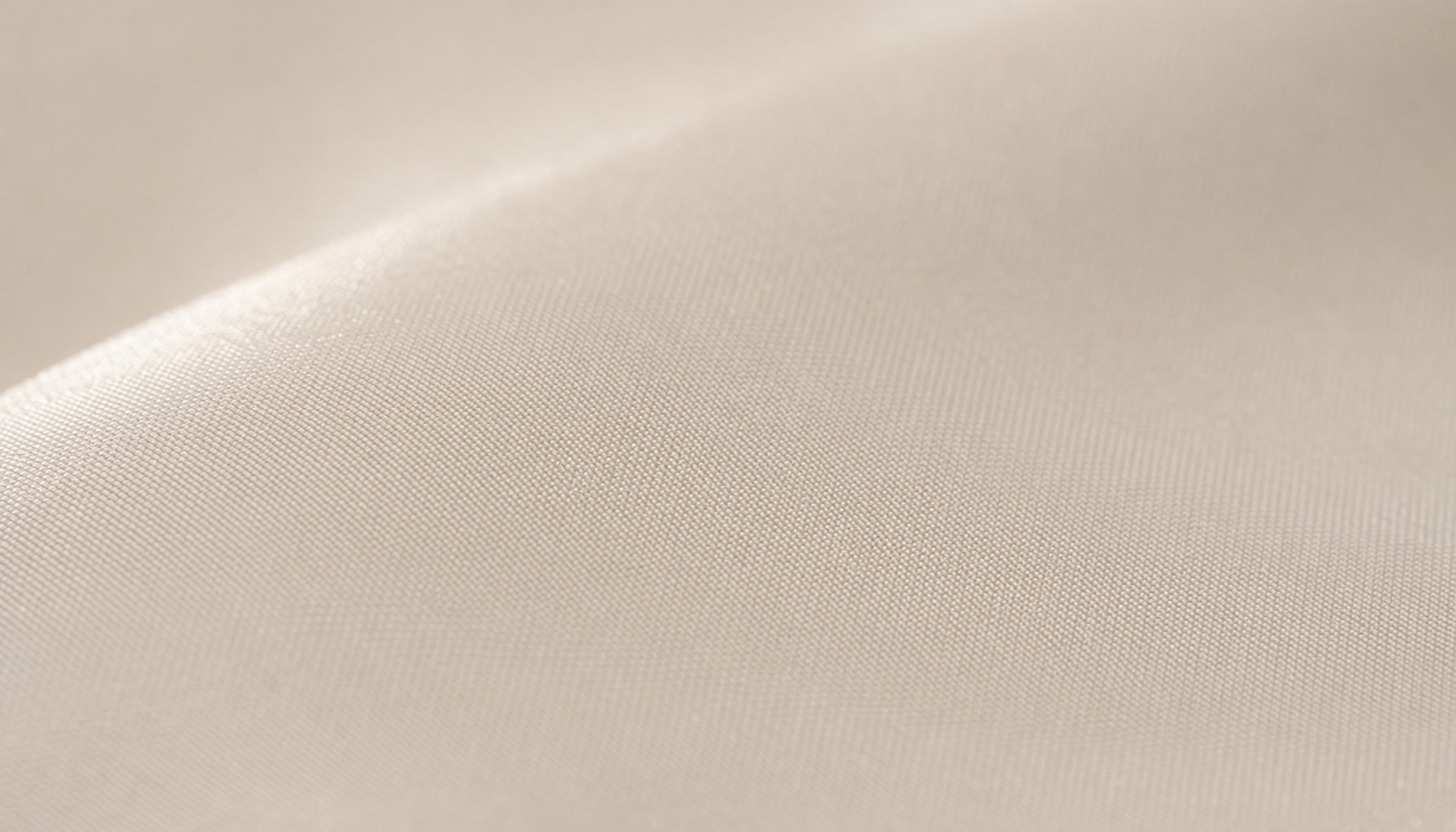
The buttery-soft, silky-smooth pile of premium double-brushed microfiber—engineered at the sub-denier level for cashmere-like texture.
2. Brushing Technique: Why "Double-Brushed on Both Sides" Is a Non-Negotiable Specification
Most sheet manufacturers brush only the sleeping surface—the side that faces the consumer during inspection in-store. The underside that contacts your fitted sheet's elastic band and the mattress receives no brushing at all. This is a deliberate cost-reduction practice, not a consumer-forward choice.
Mechanical brushing raises and softens the fiber pile on a sheet's surface. When only one side receives this treatment, you experience inconsistent texture depending on how the sheet lands on the bed, and the unbrushed face creates friction inconsistency against other textiles in your bedding stack. The tactile difference between a single-brushed and double-brushed sheet is immediately perceptible—run your hand across both surfaces of a bargain microfiber set and you'll feel the asymmetry.
True bilateral brushing—applied to both faces of the fabric—requires two mechanical processing passes and increases production cost. The result is a sheet with identical buttery-soft texture on every surface: the sleeping face, the structural face, and every edge fold. When you make the bed and the sheet reverses itself, the feel is consistent. This specification signals a manufacturer's commitment to genuine engineering rather than aesthetic marketing, and it's one of the first questions to ask when evaluating any microfiber sheet.
3. Thermal Performance Engineering: The 2-4°F Difference That Separates Good Sleep From Great Sleep
Sleep architecture research consistently demonstrates that body core temperature drop of 1-2°F within the first 90 minutes of sleep onset is a reliable predictor of rapid entry into slow-wave (deep) sleep stages. Your sleep surface is either accelerating or impeding that thermal drop.
Hydrophobic microfiber with sub-denier filaments creates what textile engineers call micro-ventilation zones—interstitial air channels between the engineered fiber bundle structure that facilitate convective airflow across the skin surface. Combined with capillary moisture wicking that removes perspiration before it can accumulate, this architecture measurably reduces the perceived sleep surface temperature by 2-4°F compared to saturated cotton or bamboo viscose. That delta may seem modest until you understand that the human thermoregulatory system is sensitive to differences of less than 1°F in skin temperature, making a 2-4°F advantage physiologically significant.
Cotton's hydrophilic saturation creates the opposite effect: as sweat accumulates and the fiber reaches absorption saturation, the sheet's thermal resistance increases, creating what sleep researchers call a "heat dome" effect at the skin-textile interface. Micro-arousal events—brief incomplete awakenings that fragment sleep architecture without reaching full consciousness—are strongly associated with thermal discomfort spikes. Most people who believe they "sleep lightly" are actually experiencing heat-induced micro-arousals, not inherent light-sleeping physiology.
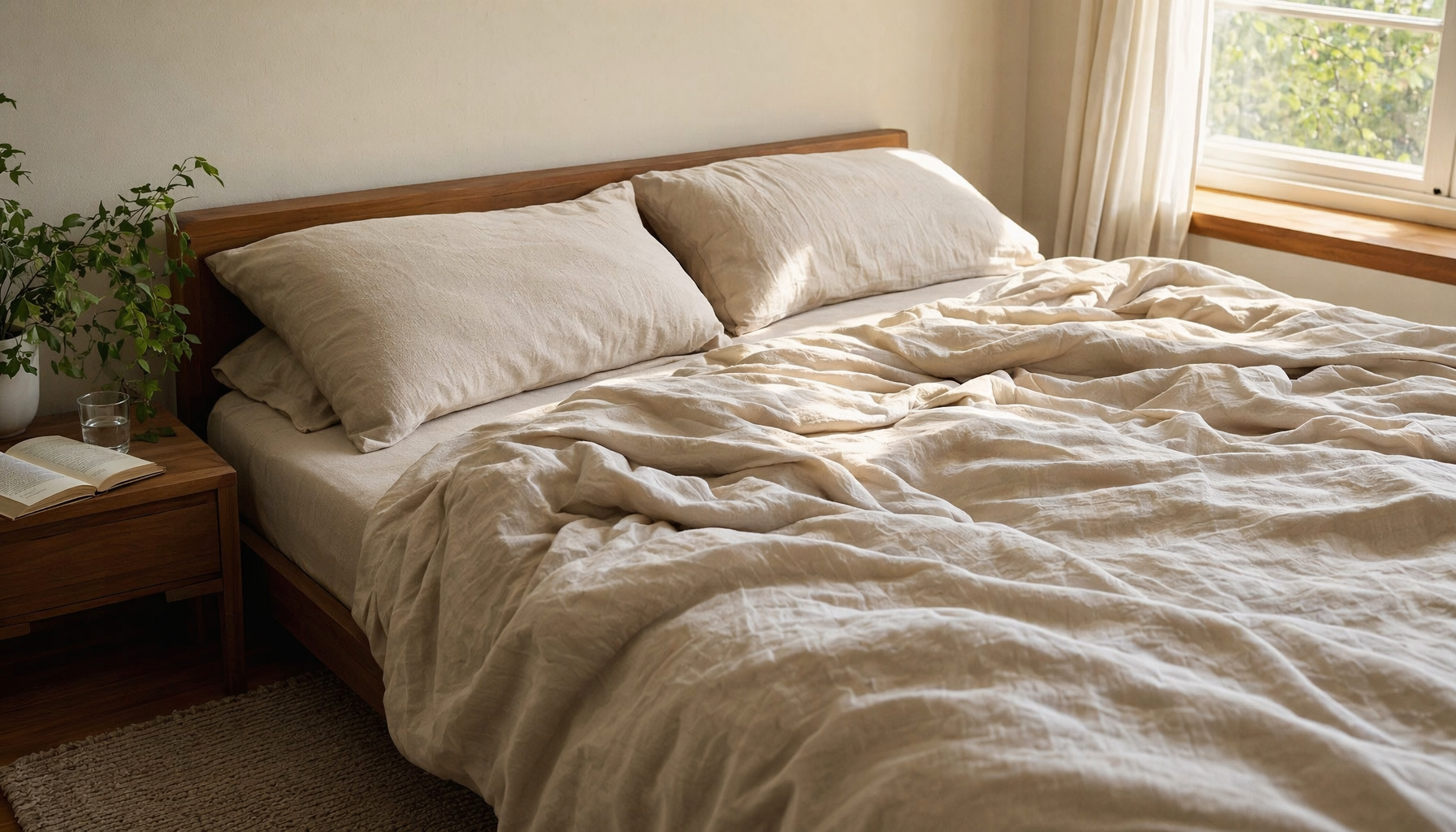
Real bedroom, real comfort—microfiber sheets that keep sleep surfaces cooler and nights genuinely more restful.
4. Pocket Depth and Elastic Architecture: The Engineering Beneath Your Mattress
The fitted sheet is the most mechanically stressed component in your entire bedding system. It must accommodate a mattress, survive being stretched and released thousands of times annually, and maintain grip against physical movement forces from a sleeping body. Most fitted sheets fail this test within 12-18 months—not because the fabric wears out, but because the elastic architecture was never designed to last.
Standard fitted sheets use corner-only elastic inserts—narrow bands of elastic at each of the four corners, leaving the long sides of the sheet unsupported. This design relies entirely on the corner elastic to hold the entire sheet in tension across the mattress surface. As corner elastic fatigues and stretches permanently, the sheet begins to migrate, bunch, and ultimately pop off. Modern mattresses—particularly memory foam, hybrid, and pillow-top constructions—frequently exceed 16 inches in depth, and many budget sheet manufacturers haven't updated their pocket specifications since the 14-inch mattress standard of a decade ago.
The engineering solution is full-perimeter heavy-duty elastic—a continuous elastic band sewn around the entire circumference of the fitted sheet, combined with an 18-21 inch pocket depth that accommodates contemporary mattress constructions including deep toppers. LuxClub fitted sheets are engineered with both: the full-perimeter system distributes tension uniformly across all four sides rather than concentrating stress at corners, dramatically extending the functional life of the elastic while eliminating the sheet migration that disrupts sleep. The deep pocket specification ensures a secure, drum-tight fit on mattresses up to 21 inches including toppers.
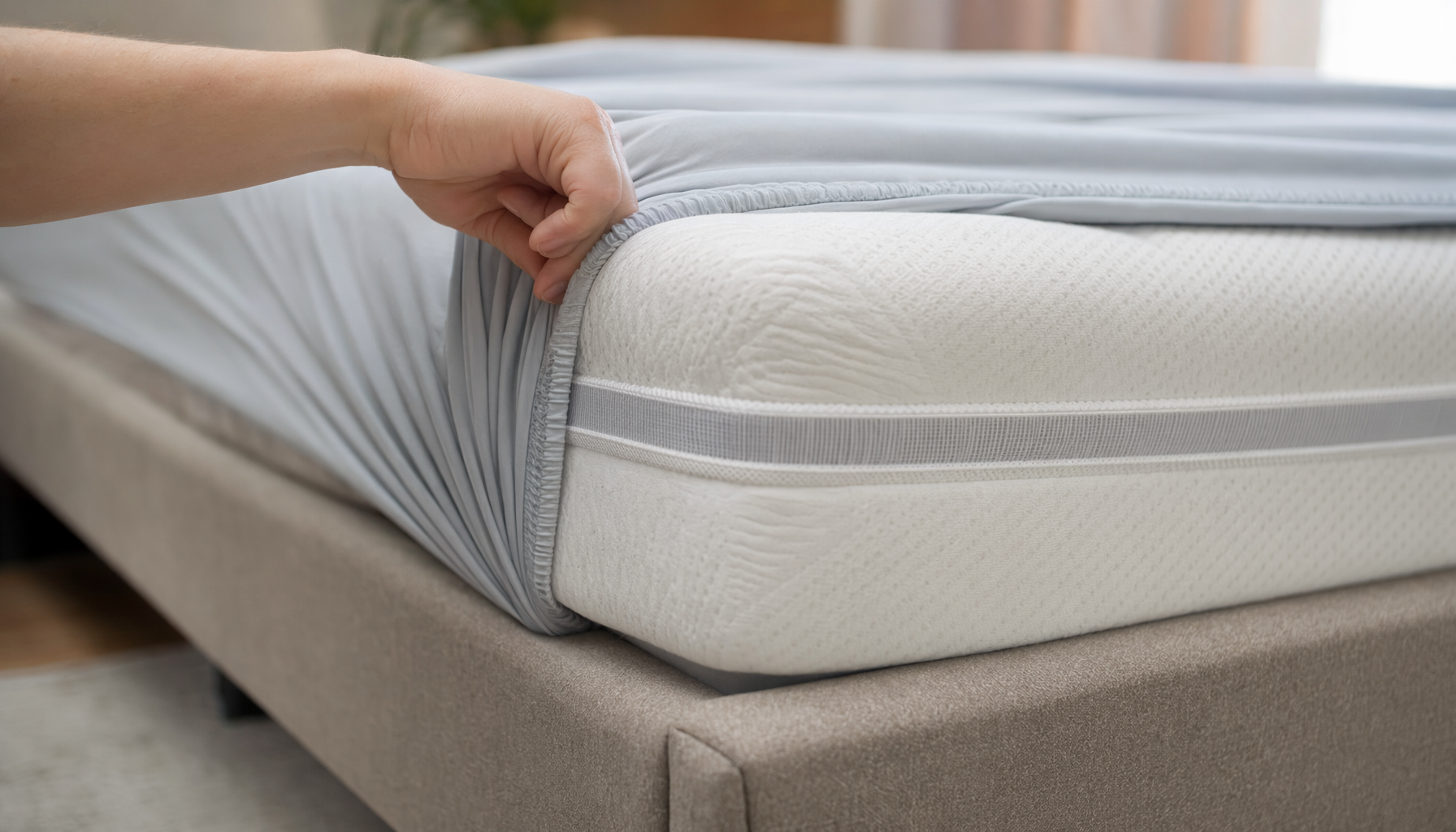
18-21 inch deep pocket + full-perimeter heavy-duty elastic: engineered to grip any mattress and never pop off.
5. Dimensional Stability: Why "Preshrunk" Is the Most Underrated Sheet Specification
Fabric shrinkage is not a cosmetic inconvenience—it's a structural engineering failure. When cotton sheets shrink 3-7% in their first wash (as is typical, despite "pre-washed" marketing claims), the pocket depth shrinks with them. A sheet spec'd at 16 inches that shrinks to 14.5 inches after two washes no longer fits the mattress it was purchased for. The elastic distorts unevenly as the base fabric contracts around it, creating permanent wrinkles and localized stress concentrations that accelerate elastic fatigue.
Microfiber polyester is inherently dimensionally stable because its failure mode under heat is fundamentally different from cotton's. Cotton fibers swell and contract as hydrogen bonds form and break with water molecules—a reversible but progressive process that compounds across wash cycles. Polyester filaments have no such mechanism. When produced with consistent fiber draw ratios and heat-set during manufacturing, they maintain their dimensions across repeated thermal and mechanical cycling.
What this means in practical terms: the sheet you receive today performs identically in wash 40 as in wash 1. No shrinkage recalculation, no re-measuring your mattress for a replacement, no ironing to flatten post-wash wrinkles because there are none. The wrinkle-resistance property is a direct consequence of dimensional stability—a fiber that doesn't contract unpredictably doesn't create the irregular surface topology that produces wrinkles.
6. Color Fastness: The 40-Wash Proof Test That Separates Engineering from Aesthetics
Color is not a purely aesthetic decision in premium bedding—it's a quality indicator. The dye chemistry used to color a sheet, and the precision of the dyeing process, directly predict that sheet's color durability across its functional lifespan.
Cotton sheets are typically colored with reactive dyes, which form covalent bonds with the cellulosic fiber. The bond is strong initially, but repeated alkaline wash chemistry, UV exposure, and thermal cycling systematically cleave those bonds. The result is the familiar "faded" appearance of a cotton sheet after a year of regular laundering—not a color that's different from what you bought, but a color that's demonstrably less saturated and less even. Pilling compounds this visual degradation: pill balls scatter light differently from the base fabric, creating a hazy surface appearance even in sheets that haven't faded significantly.
Premium microfiber uses disperse dye technology—dye molecules that are physically embedded within the polymer structure of the polyester filament during production, rather than bonded to the surface. The result is color that is structurally part of the fiber itself. It cannot rinse away because it was never on the surface to begin with. Tested at 40 high-temperature machine wash cycles under standardized conditions, properly disperse-dyed microfiber shows no measurable color shift. The color fidelity of wash 1 and wash 40 are analytically indistinguishable.
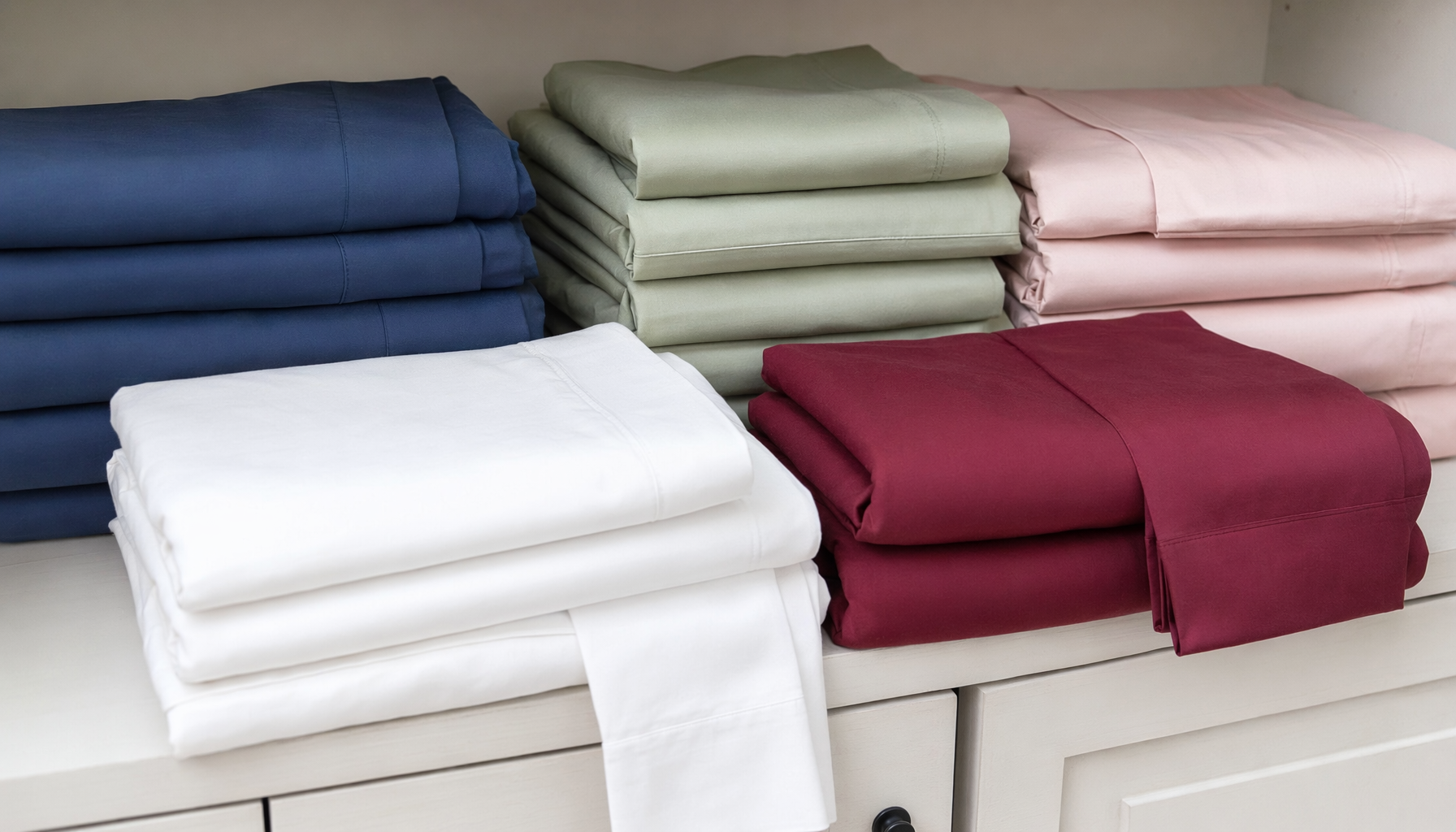
40+ colorways, 40+ high-temperature washes—disperse dye engineering means the color you choose stays exactly that color.
7. The Real Cost-Per-Night Calculation: Why Premium Microfiber Wins Over Time
Most sheet purchasing decisions are made on upfront unit price, which is precisely the wrong framework. A $180 set of Egyptian cotton sheets that pills in 18 months, shrinks unevenly, and requires professional laundering to avoid severe wrinkling costs more per night than a $65 set of engineered microfiber that maintains its performance across 3+ years of weekly washing.
The math is straightforward: $180 / 540 nights (18-month lifespan) = $0.33 per night. Compare that to $65 / 1,095 nights (36-month lifespan with identical performance) = $0.059 per night. The "affordable" microfiber sheet delivers a 5.6× cost-per-night advantage over the "premium" cotton set—before accounting for the ironing time that cotton demands and microfiber eliminates entirely.
Material science converges with economic rationality here. The same engineering properties that make premium double-brushed microfiber the superior thermal and tactile performer also make it the superior long-term financial decision. There is no tradeoff between performance and value—LuxClub's engineering-first approach delivers five-star hotel quality at a fraction of the cost, with a 40+ wash color guarantee, full-perimeter elastic architecture, and bilateral double-brushing that outlasts every comparable cotton or bamboo alternative on the market.
Frequently Asked Questions
Q1: Does thread count actually matter when buying sheets? Thread count is one of the most heavily marketed—and most misleading—specifications in the bedding industry. The metric measures how many threads exist per square inch of woven fabric, but it says nothing about fiber quality, ply manipulation (thin multi-ply threads inflating counts artificially), or actual tactile performance. A 300-thread-count premium microfiber sheet consistently outperforms a 1000-thread-count cotton sheet in softness, thermal regulation, and durability. Instead of chasing thread counts, evaluate fiber architecture, brushing quality, elastic engineering, and dimensional stability. These specifications have a direct causal relationship with how your sheets actually perform, unlike thread count, which has been systematically gamed by manufacturers for decades.
Q2: How do I know if a fitted sheet will stay on my mattress? The two specifications that predict fitted sheet retention are pocket depth and elastic architecture. Modern mattresses—especially memory foam and hybrid constructions—routinely exceed 14-16 inches in depth when a topper is added. Look for a minimum 18-inch pocket depth, preferably 18-21 inches. More importantly, verify that the elastic runs the full perimeter of the sheet rather than only at the four corners. Corner-only elastic concentrates mechanical stress at narrow anchor points that fatigue and stretch permanently within 12-18 months. Full-perimeter heavy-duty elastic distributes that tension evenly across all four sides, maintaining consistent grip significantly longer. A sheet that specifies both deep pockets and full-perimeter elastic is engineered to stay put on any modern mattress configuration.
Q3: Are microfiber sheets good for people with sensitive skin or allergies? Premium double-brushed microfiber is an excellent choice for sensitive-skin sleepers and allergy sufferers. The sub-denier filaments (below 1.0 denier per fiber) create an exceptionally smooth, uniform surface without the fiber-tip irregularities that cause skin irritation in coarser textiles. Microfiber's hydrophobic surface properties resist the high-humidity microclimate (above 70% relative humidity) that dust mites require to reproduce—a meaningful advantage for allergy sufferers compared to moisture-retaining cotton. The preshrunk, dimensionally stable construction also means there are no fabric distortions or loose fiber ends that can trap particulate matter. Unlike some bamboo rayon products that use residual chemical processing agents in production, properly manufactured polyester microfiber contains no post-processing chemical residues that could irritate reactive skin.
Q4: What's the difference between microfiber and regular polyester sheets? Not all polyester sheets are equivalent—and this distinction matters significantly. Standard polyester fabric is typically manufactured with larger-diameter filaments (above 1.0 denier), creating a rougher, less breathable surface. Premium microfiber requires sub-denier filaments, meaning each individual fiber is finer than a strand of silk, which dramatically increases the fabric's surface softness and moisture-management capability. Mechanical double-brushing—applied to both sides of the fabric—further raises and softens the fiber pile, creating the buttery-soft texture associated with high-end microfiber. The engineering delta between budget polyester and properly engineered double-brushed microfiber is substantial and immediately tactile.
Q5: How should I care for microfiber sheets to maximize their lifespan? Microfiber sheets require less care than any natural fiber alternative—which is itself a quality indicator. Machine wash in warm water (not hot, which can cause minor fiber stress over many cycles) with a standard liquid detergent; avoid fabric softeners, which coat the hydrophobic microfiber surface and reduce moisture-wicking performance over time. Tumble dry on low to medium heat. The wrinkle-resistant, preshrunk construction means sheets can be removed from the dryer and placed directly on the bed without ironing or steaming. Avoid bleach, which degrades polyester filaments over repeated use. With these basic guidelines, properly engineered microfiber sheets maintain their original tactile performance, color vibrancy, and dimensional accuracy through 40+ wash cycles—a claim that no cotton or bamboo viscose alternative can match at the same price point.